In 1957 the Stockholm City Council voted to spend one per cent of every tunnelbana construction budget on art. Sweden didn’t invent percent-for-art (the Americans had been arguing about it since the 1930s), but Stockholm was the first European capital to wire it into a transit system. Almost seventy years later, 100 of the 110 tunnelbana stations carry a piece of decorated work, and the network now markets itself as the longest art gallery in the world: 110 km of platforms with paintings, mosaics, sculptures, blasted bedrock, and the occasional rainbow you can’t photograph properly without lying down.
Most guides published online send you to the same three stations: T-Centralen, Solna Centrum, Stadion. They aren’t wrong. Those are the famous ones, and they earn the photographs. But three stations is a 35-minute round trip, and a 24-hour pass at 175 SEK (~€16) buys you a lot more than that. This piece is the longer ride: ten or twelve stations done properly with the artist behind each one, plus the four outer-ring stations the standard list skips and shouldn’t. I’ve done the route twice, once on a Saturday afternoon (a mistake) and once on a Tuesday at 10:30 (the right answer).
In This Article
- The 1957 decision and why it still matters
- Tickets, timing, and how to ride
- The Blue Line is where the art lives
- T-Centralen, blue platform
- Rådhuset
- Kungsträdgården
- Solna Centrum
- Hallonbergen and Näckrosen
- The outer Blue Line: Tensta, Rinkeby, Akalla, Husby
- Tensta
- Rinkeby
- Akalla and Husby
- The Red Line: cave geometry and rainbows
- Stadion
- Tekniska Högskolan
- Universitetet
- Mörby Centrum
- Östermalmstorg
- The Green Line: less art, but the everyday network
- Thorildsplan
- Hötorget
- Bagarmossen, the green-line outlier
- A practical route: ten stations, two and a half hours
- If you only have one hour
- If you have a full day
- The free guided tour, and why I’d skip it
- Where to get out and eat
- Other Stockholm and Sweden context
- If you want to go deeper
The 1957 decision and why it still matters
The first stretch of tunnelbana opened in October 1950, running from Slussen to Hökarängen on what became the green line. The platforms were tiled, lit, and conspicuously plain. Two artists, Vera Nilsson and Siri Derkert, lobbied the City Council through the mid-1950s for the idea that art should be funded as part of the construction budget rather than added afterwards. Their pitch was that public transit was where the city’s least-served residents actually saw art: not in galleries on Östermalm but on the way to a shift at a factory in Bromma.
The motion passed in 1957. From that year forward, every new station, every extension, and every renovation carried a line item for commissioned work. Decisions about who got the commissions ran through Stockholms Konstråd (the city art council) and SL, the transit operator, with the artists chosen partly to reflect the neighbourhood the station served. The rule wasn’t watertight: a few of the central-line stations from the late 1950s carry only token decoration, and ten stations on the outer reaches still have nothing. But 100 of 110 is a hit rate no other metro system on the continent has matched.
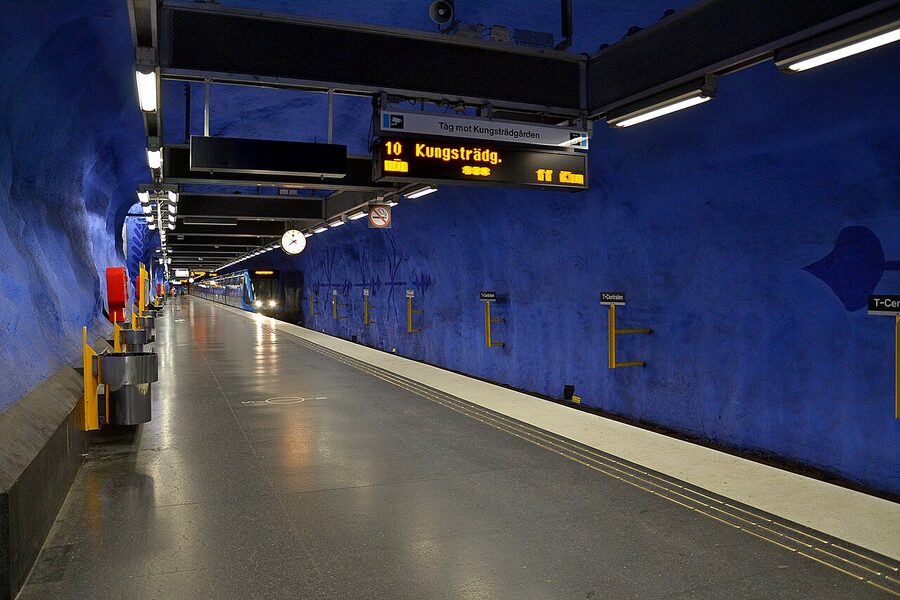
Two structural decisions in the 1970s shaped what most of the famous stations look like today. First: the blue line, opened from 1975 onwards, was bored deeper than the earlier lines and came up through bedrock. The architects and artists left the bedrock visible rather than cladding it. That’s why Rådhuset, Kungsträdgården, Solna Centrum and the outer Blue stations look like caves: they are caves, painted. Second: the 1970s commissioning shifted from decorative tiling toward narrative work with explicit politics. Anders Åberg’s 1975 Solna Centrum mural argued openly about rural depopulation; Siri Derkert’s 1965 Östermalmstorg etchings put feminist and peace-movement slogans into a station full of suit-and-tie commuters. None of this was hidden. Stockholmers ride past it twice a day and mostly stop noticing, which is the city’s running joke about itself.
Tickets, timing, and how to ride
SL, the regional transit operator, sells three things you might use for an art ride. A single ticket is 42 SEK (~€3.80), valid for 75 minutes including unlimited transfers. A 24-hour pass is 175 SEK (~€16). A 72-hour pass is 350 SEK (~€32). For a full art tour you want the 24-hour pass: a single ticket runs out roughly two stations before you’ve finished, and the gain in flexibility (you can leave a station, come back, photograph at a different time of day) is worth the extra hundred kronor.
Buy through the SL app on your phone, or tap a contactless card directly at the gate. The app is the cleaner option because it keeps the receipt and lets you swap pass type without a queue. Vending machines exist but the menus default to Swedish; the app defaults to whatever language your phone is set to. Don’t bother with paper SL Access cards as a visitor: they cost an extra 20 SEK and add nothing.
The single most useful thing in this article is the timing rule. Ride between 10:00 and 15:00 on a Tuesday, Wednesday or Thursday. Avoid 07:00 to 09:00 and 16:00 to 18:00 entirely: not only are platforms full, the lighting cycle on the blue line shifts toward harsher overheads at peak times to push commuters along faster. Avoid Saturdays after midday for the central stations: T-Centralen and Östermalmstorg fill with shoppers and tour groups. Sundays are quieter than Saturdays but the blue-line shopping-mall stations (Solna Centrum, Akalla) are tied to weekend retail traffic and don’t empty out.
Photography rules are simple: no flash, no tripod, no monopod. SL doesn’t enforce hard lines on amateur photographers (you’ll see plenty of phones) but a tripod will get you politely moved on. Stand against a column or a wall when the train arrives so commuters can flow past. The blue-line caverns are dark and your phone will struggle: lean it on something solid for a second of stillness rather than try to handhold below 1/30s.
The Blue Line is where the art lives
If you have one hour and not three, ride the blue line and skip the rest. Roughly 80 per cent of the tunnelbana’s photographable art is here: the seven stations from T-Centralen north to Akalla, plus Kungsträdgården and Rådhuset to the southeast and west of the centre. The blue line is the youngest of the three (opened 1975-1985), the deepest, and the one where the bedrock-cavern format made the artists stop pretending they were decorating walls and start treating the rock itself as the canvas.
T-Centralen, blue platform
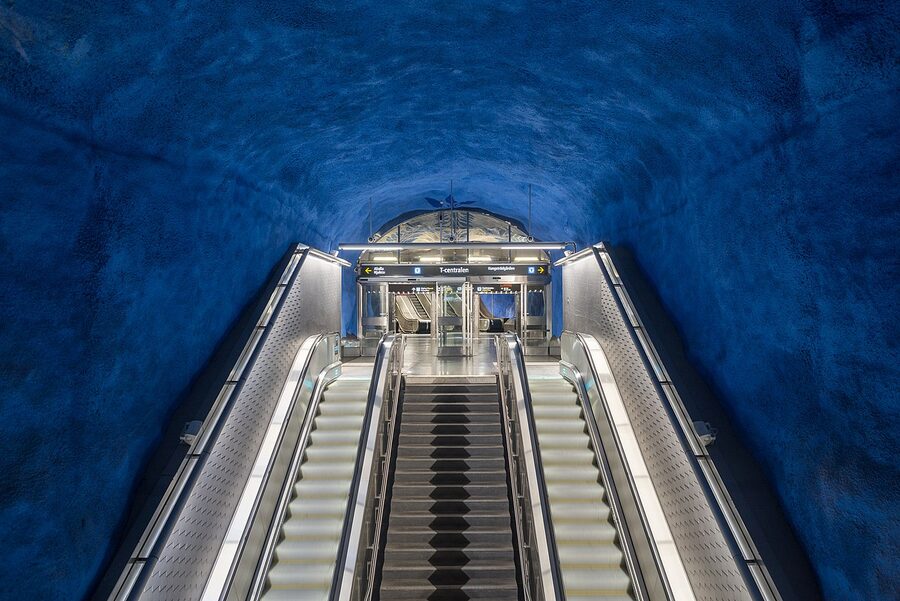
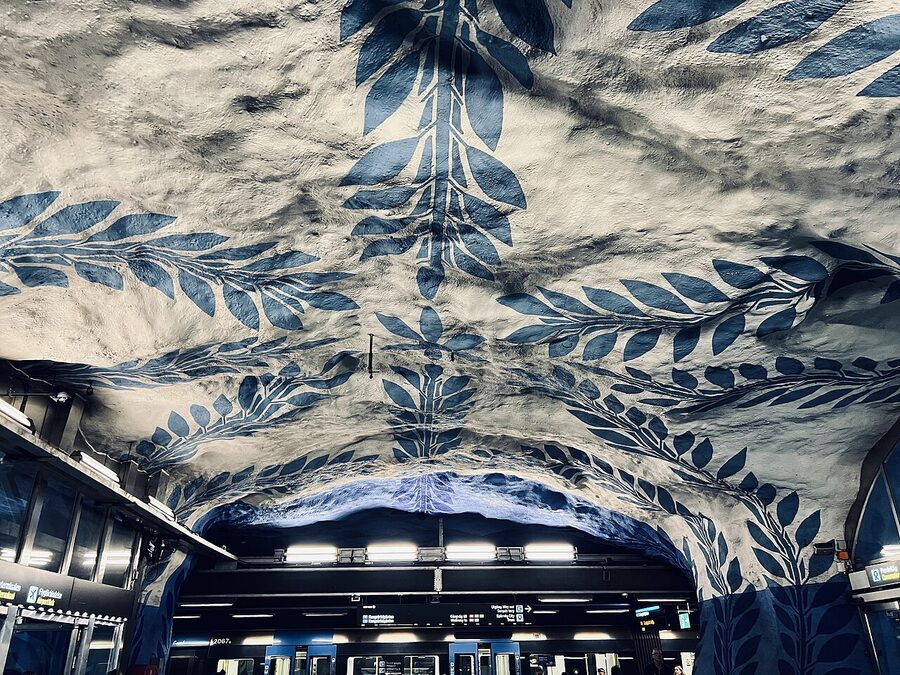
The blue platform of T-Centralen is the entry point and the natural ending: every visitor arrives or leaves here, every line crosses through. Per Olof Ultvedt was given the commission in 1975 and produced what most travellers think the whole tunnelbana looks like: a vault-shaped cavern coated in pale grey-blue with hand-painted vines, leaves, and silhouettes of the construction workers who blasted the platform in the first place. Ultvedt’s brief was acoustic as much as visual; the rough cavern surface was painted to soften the bounce of train noise during rush hour, and the colour was chosen to slow the eye and reduce the sense of crowding.
The figures on the ceiling are the construction crew Ultvedt knew personally; he sketched them on site during the build and painted them in to credit the labour. If you’re starting your tour here, walk to the southern end of the platform first, past the escalator, and look back. That’s the angle the photographs are made from.
Rådhuset
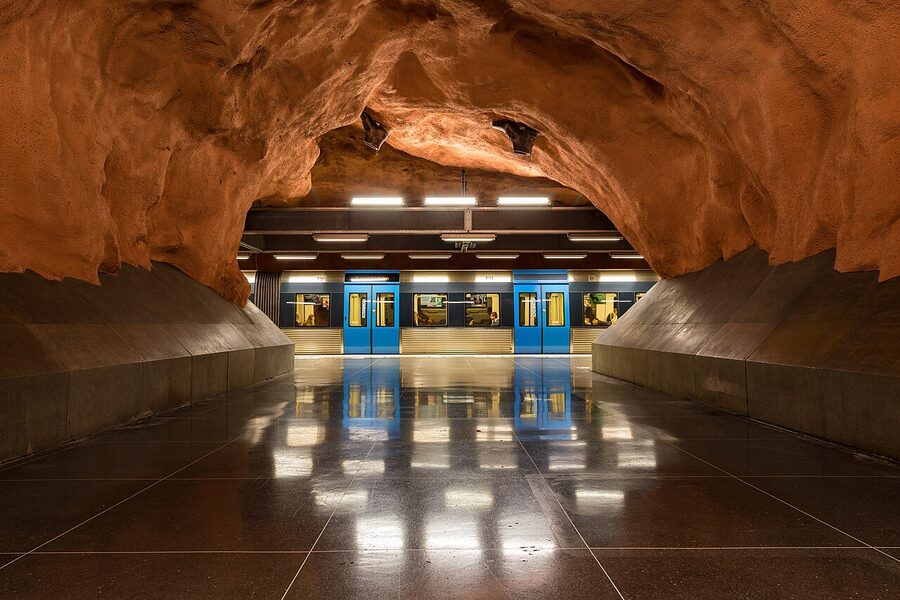
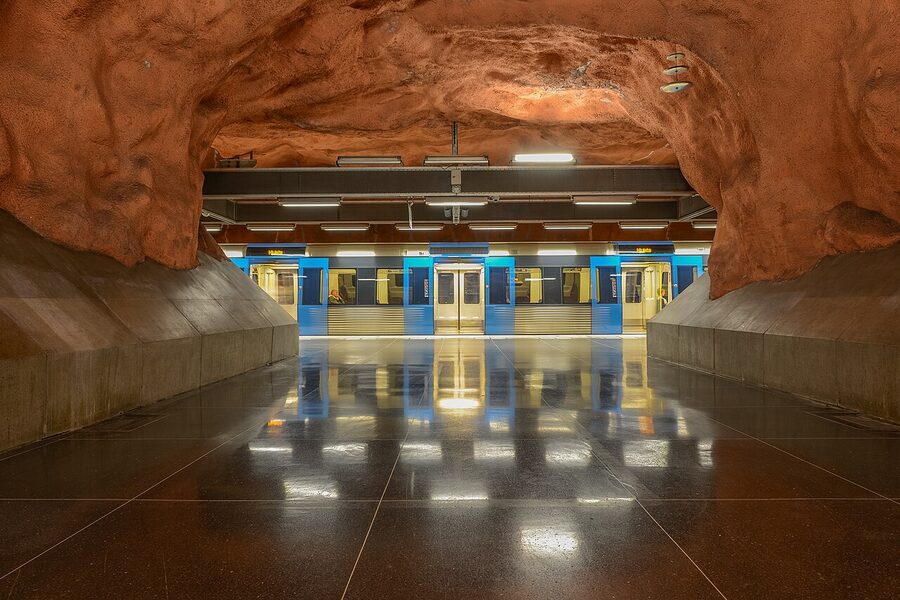
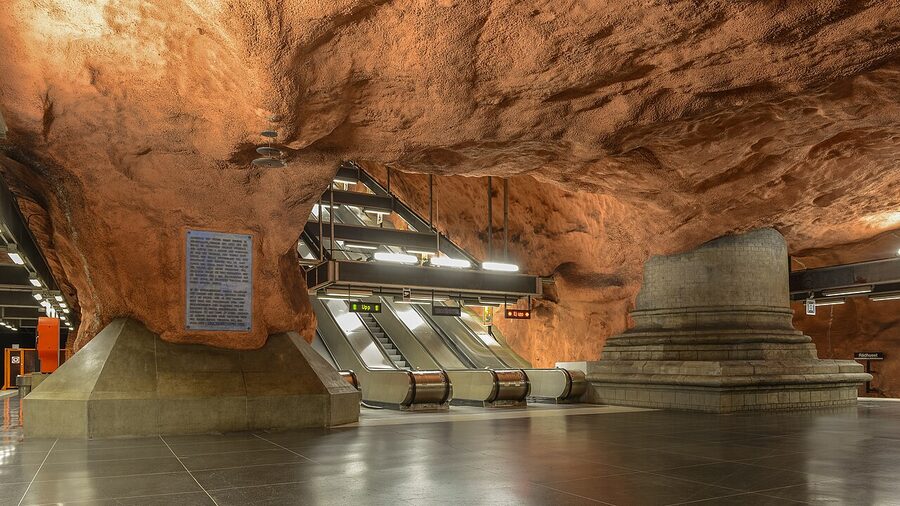
One stop west of T-Centralen on the blue line. Sigvard Olsson, 1975. The platform is the ceiling of a cathedral and the floor of a quarry: bedrock left visible, painted in burnt-orange and ochre, with a scattering of sculptural objects pressed into the walls (small bronze shoes, twisted iron, a 19th-century-style Stockholm street lamp). The conceit is that you’ve been dropped into the basement of the city’s old courthouse, which sits directly above. Most travellers walk through Rådhuset without stopping; it’s the lower-key blue-line cavern but arguably the one where the cave-as-art idea reads most cleanly. Allow ten minutes.
Kungsträdgården
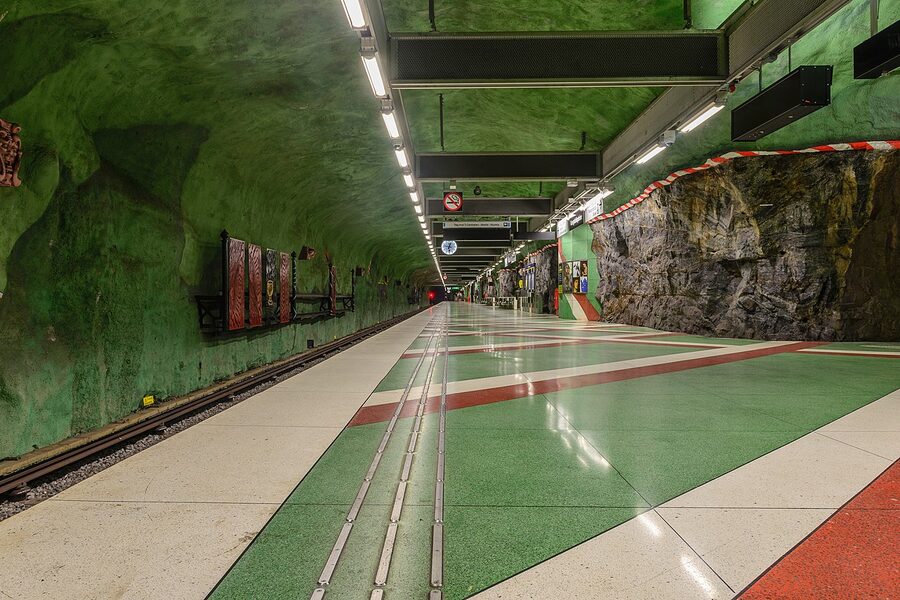
Two stops east of T-Centralen, the southern terminus of the blue line. Ulrik Samuelson, 1977. This is the hardest of the three “famous” stations to photograph and the one I’d argue is the best done. The platform is a long cavern painted in green, red, white and black, with reclaimed fragments of older Stockholm buildings (capitals, balustrades, stone fragments from the demolished Makalös palace and the old opera house) embedded into the walls and the floor. There’s a small fountain, a row of false statues, and a deliberately overgrown corner that’s been claimed by mosses and the only known underground species in the network: a cave spider and a fungus that have adapted to the lighting.
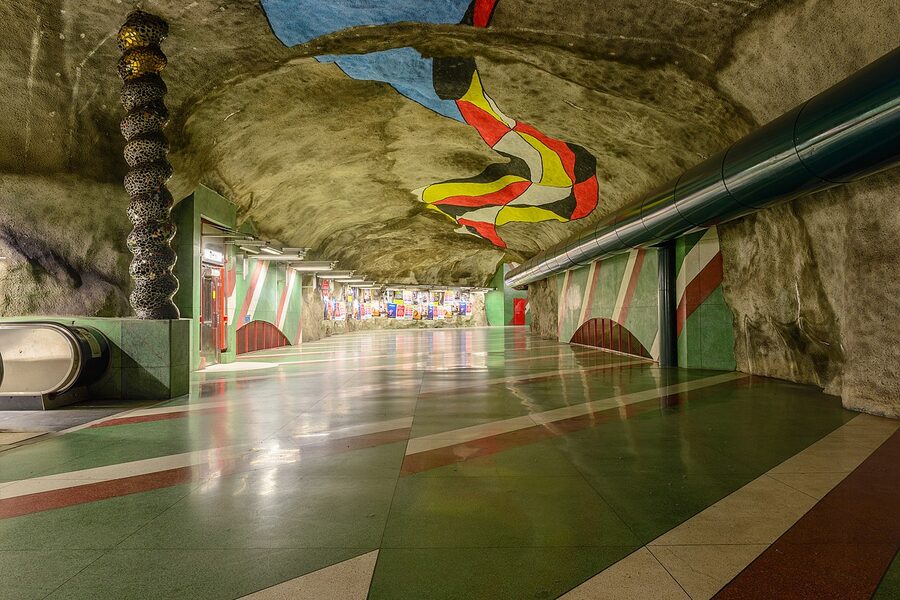
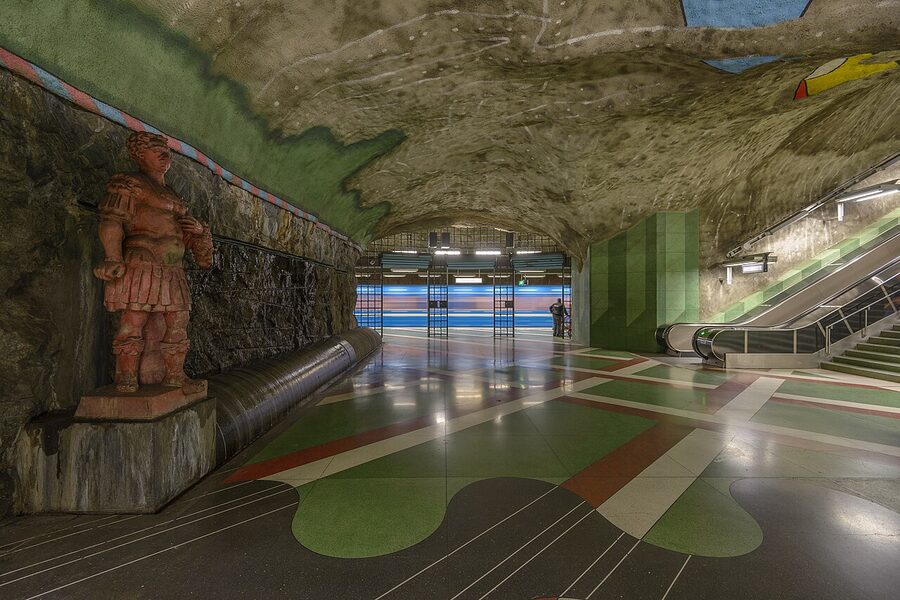
This is also the only blue-line station with two distinct artistic moves: the central platform is the cavern as garden, and the entrance hall above (street level, at Kungsträdgården park) is its own piece, with smaller fragments and a more domestic scale. Walk up the long escalator and look around before you leave; most visitors don’t.
Solna Centrum
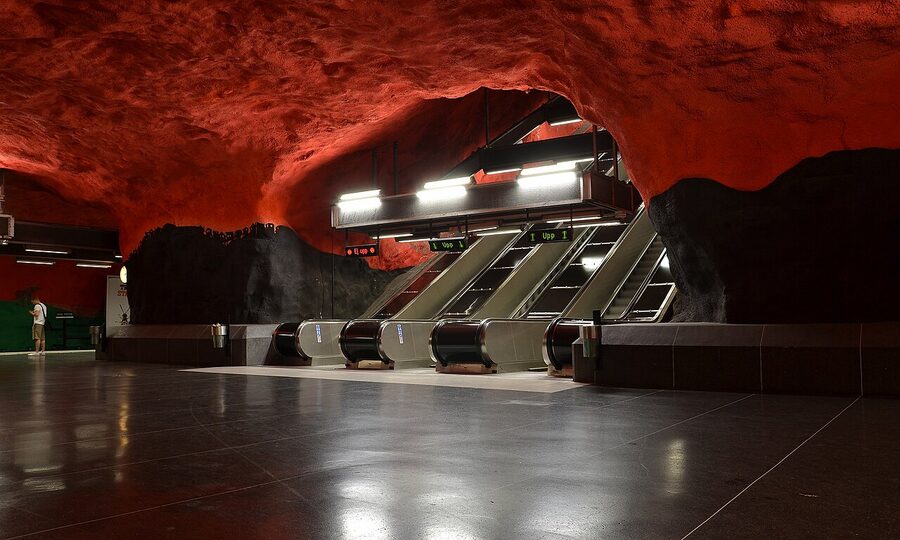
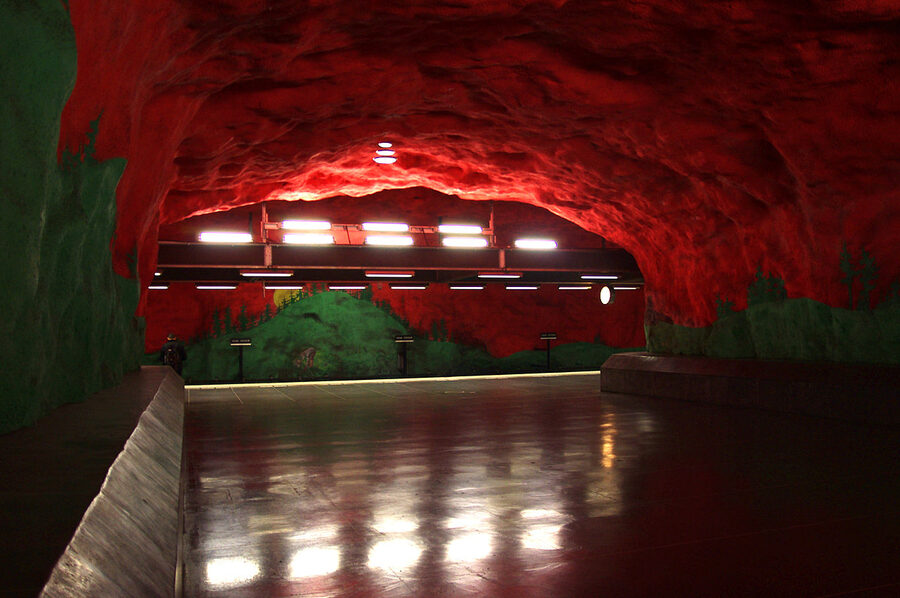
Five stops north of T-Centralen on the blue line. Anders Åberg and Karl-Olov Björk, 1975. The most photographed station after T-Centralen, and the one that actually rewards a slow read. Most guides describe Solna Centrum as “a sunset”. It isn’t. Åberg painted the ceiling in red-orange to look like a forest fire and the lower walls in dark spruce-green to read as the rural Norrland landscape his generation had grown up in and watched depopulate. Along the platform there are figures: a logger, a hunter with a rifle slung, an elk, a hooded figure (the Forest King), a small wooden church, the timber-framed walls of a farmstead.
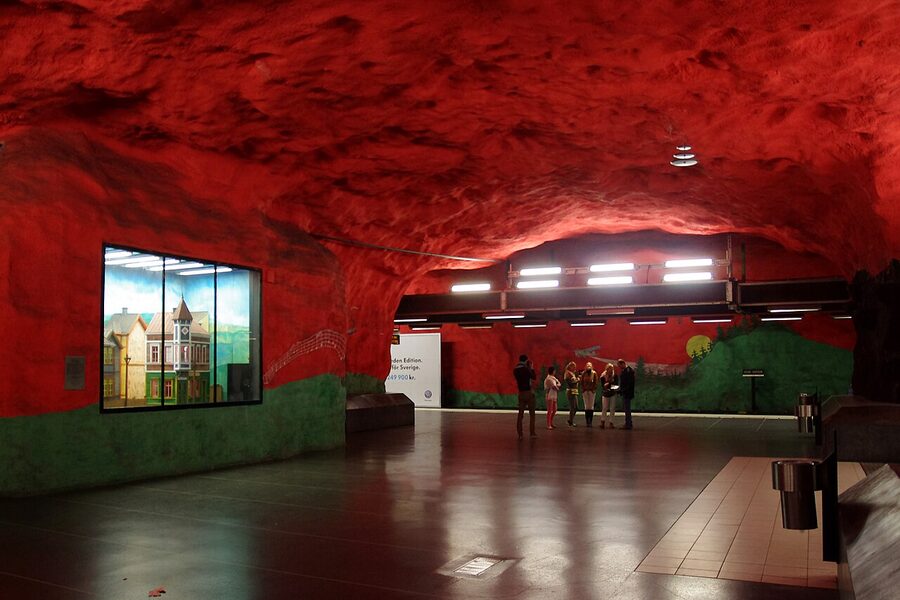
The work is a political statement, and not a subtle one. Åberg was protesting the rural-to-urban migration that had emptied northern Sweden through the postwar decades and shifted the country’s centre of gravity south to Stockholm. He put the argument on the ceiling of the station that opened the new northern suburb that absorbed those rural migrants. If you stand at the centre of the platform and look north, the spruce wall on the left reads as the forest left behind. On the right, the same forest, on fire. That’s the piece. Most travellers see it for ninety seconds and move on; that’s exactly what Åberg expected.
Hallonbergen and Näckrosen
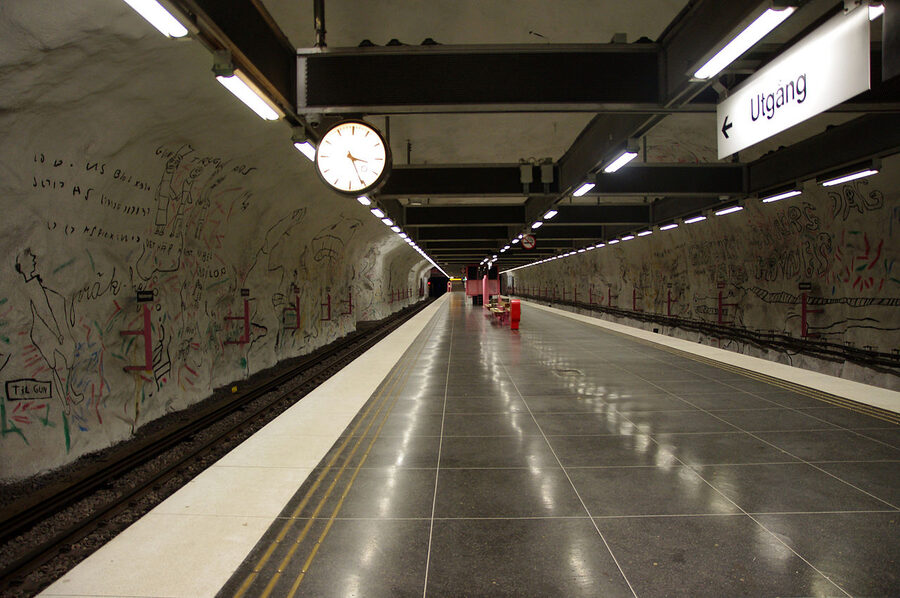
One stop north of Solna Centrum. Elis Eriksson and Gösta Wallmark, 1975. Hallonbergen takes the kindergarten conceit literally: the platform walls are scaled-up children’s drawings, deliberately wonky houses and stick figures and crooked cats, painted as if a class of seven-year-olds had been given a wall and an afternoon. The station serves a residential neighbourhood with a lot of families, and the artists’ point was that kids would actually look at this on the way to school. They do. It’s worth fifteen minutes.
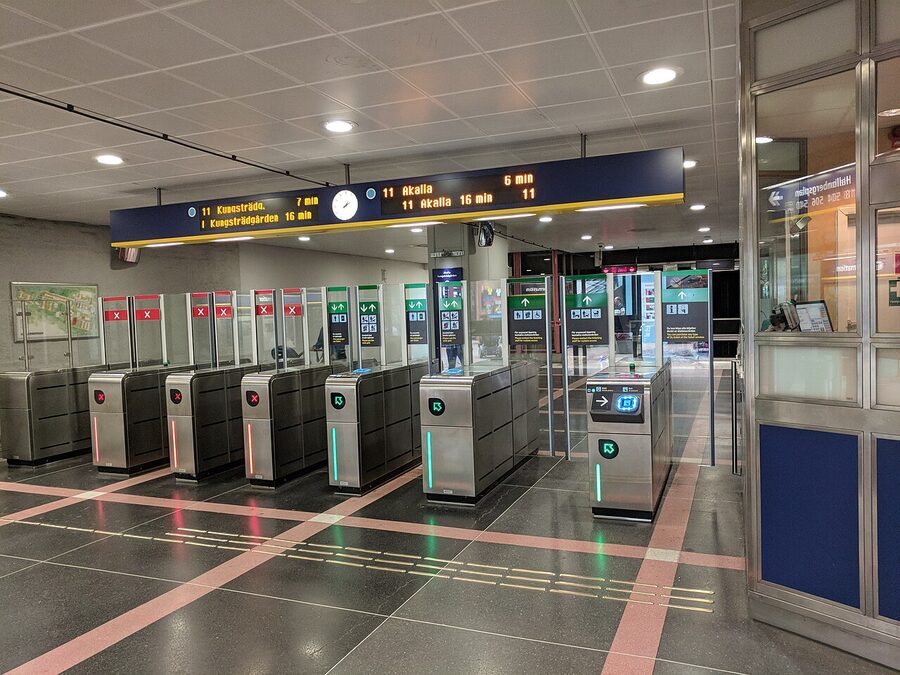
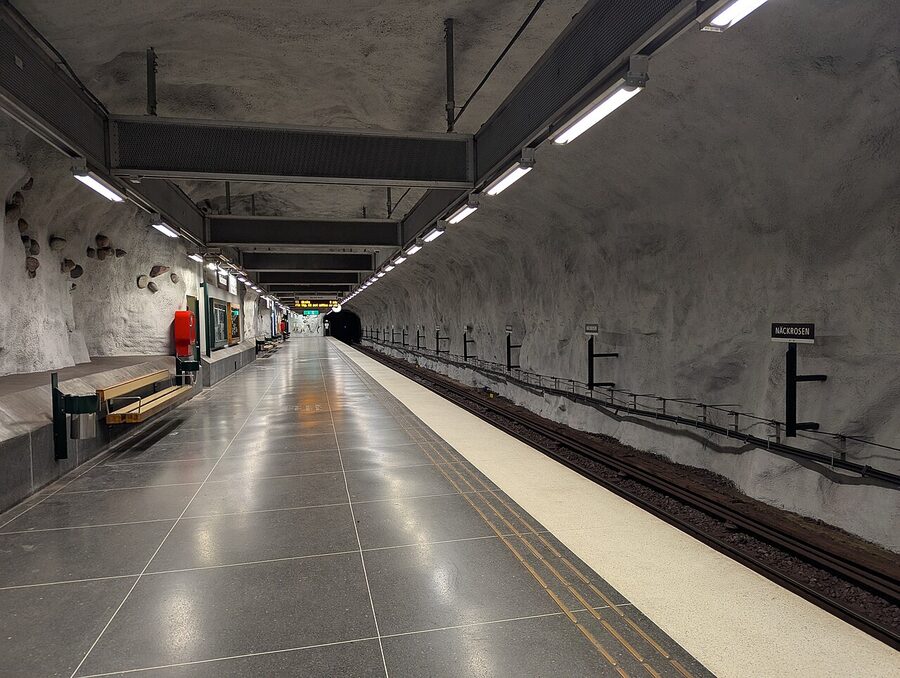
Näckrosen, between Solna Centrum and the city, is the SFI / Filmstaden station: the original Swedish film industry was based here, and Lizzie Olsson Arle decorated the platform with stones, bones, and bronze film props from old Bergman shoots. Most visitors skip it. They shouldn’t. Allow eight minutes.
The outer Blue Line: Tensta, Rinkeby, Akalla, Husby
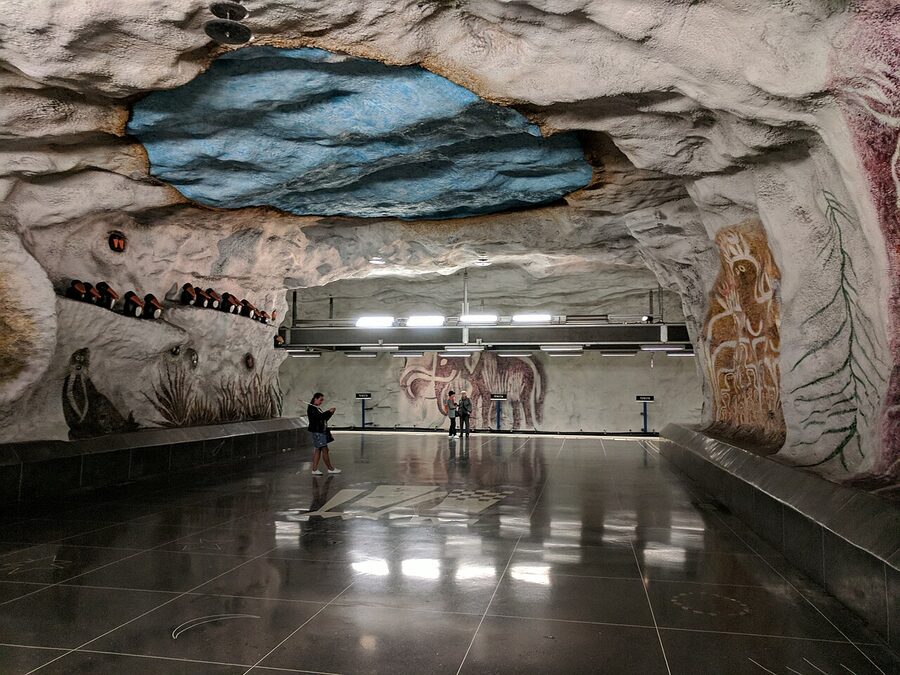
This is the stretch of the route the standard Stockholm metro art tour skips, and skipping it is wrong. The four stations on the outer northern Blue (Tensta, Rinkeby, Hjulsta on the western branch; Akalla, Husby on the eastern) carry some of the strongest political work in the network and serve the suburbs that absorbed Stockholm’s 1970s and 1980s immigration. Helga Henschen’s commission at Tensta was explicit: paint a station for a neighbourhood the rest of Stockholm doesn’t visit.
Tensta
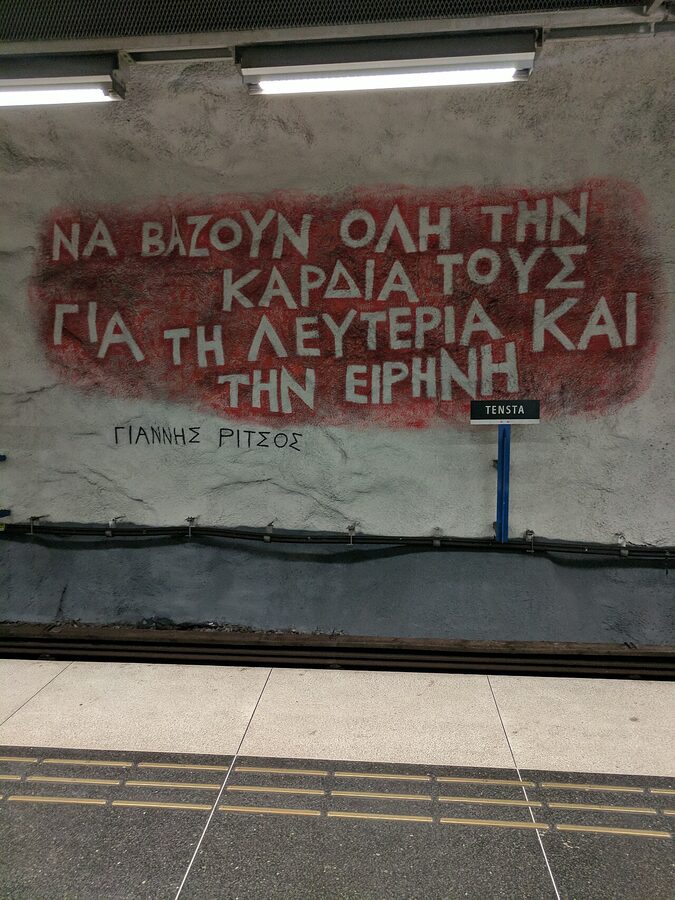
Helga Henschen, 1975. Henschen had spent the previous decade as one of Sweden’s loudest civil-rights painters, and her brief at Tensta was to put the new immigrant population on the walls of their own station. The platform reads as a long mural of children, animals, foreign-language script, and the slogan “ros till alla” (a rose for everyone) repeated in a dozen languages. There’s a section explicitly addressing Sweden’s reception of refugees from Chile after the 1973 coup: blue herons, mountains, and a Spanish-language inscription. The work is dense, not photogenic in the way Solna Centrum is, and you need to walk it. Allow twenty minutes.
Rinkeby
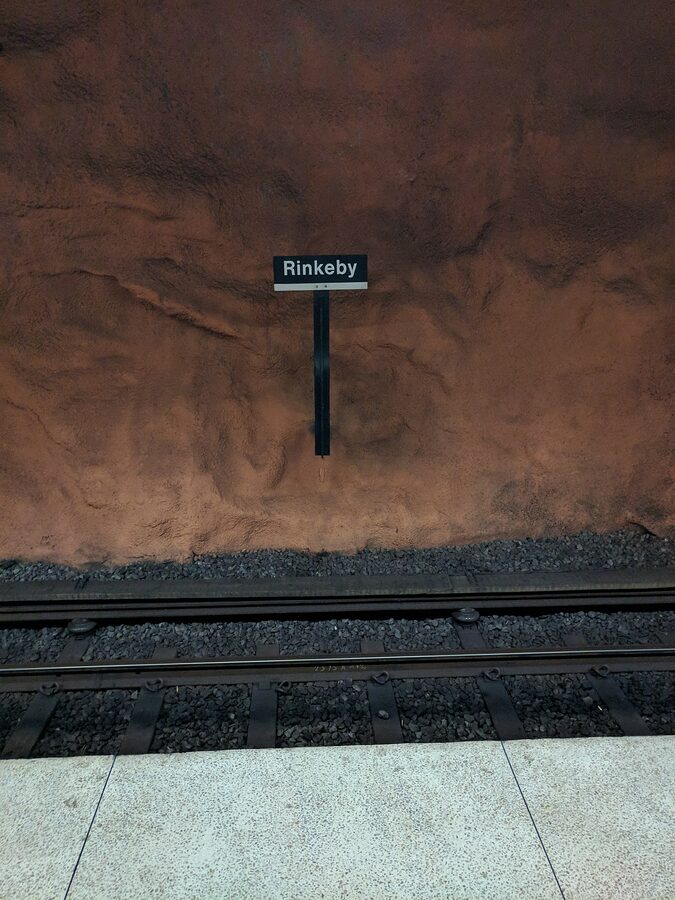
One stop east of Tensta. Sven Sahlberg and Nisse Zetterberg, 1975. The brief at Rinkeby was a Bronze Age treasury: gold leaf along the ceiling, Viking-era motifs (runes, axes, animal-style ornament), and red-painted rock for the walls. The cleverness of the commission is that it puts the actual archaeology of Sweden into the suburb that the rest of Sweden tended to think of as outside its history. Stand at the southern end of the platform; the gold reads better there.
Akalla and Husby
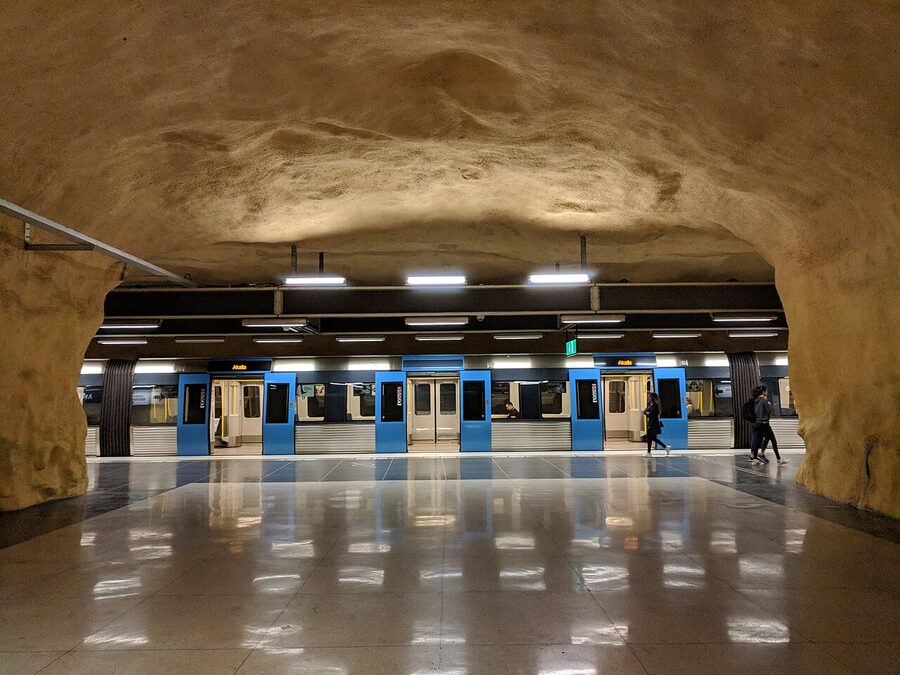
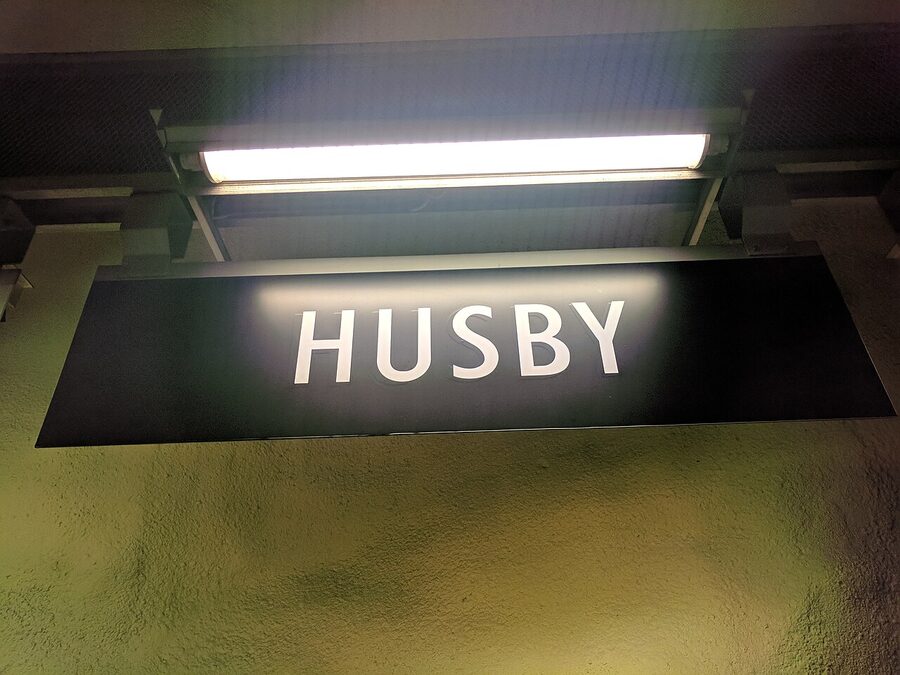
Akalla, the eastern Blue terminus. Birgit Ståhl-Nyberg, 1977. A long figurative mural along the platform showing daily life: people at work, at home, in school, on the bus, eating, queuing, sleeping. Ståhl-Nyberg’s work isn’t subtle (none of the 1970s commissions are) but it’s the most observational piece on the line, and the one that ages the best. Husby, one stop south, has Lasse Andréasson’s coloured stones embedded in the walls and a 1977 Birgit Broms ceramic at the entrance. Both stations are quiet; you’ll likely have the platforms to yourself.
The straight verdict on the outer Blue: if you have the 24-hour pass, ride to Akalla. The trip from T-Centralen takes 22 minutes one way and the four stations together take maybe an hour to walk. You’ll see no other tourists. The art is among the strongest in the network and the political reading is sharper than at the central stations. Most published guides skip these stops because the platforms are less photogenic; that’s the wrong test. Stockholm’s tunnelbana is at its most interesting precisely where the camera struggles.
The Red Line: cave geometry and rainbows
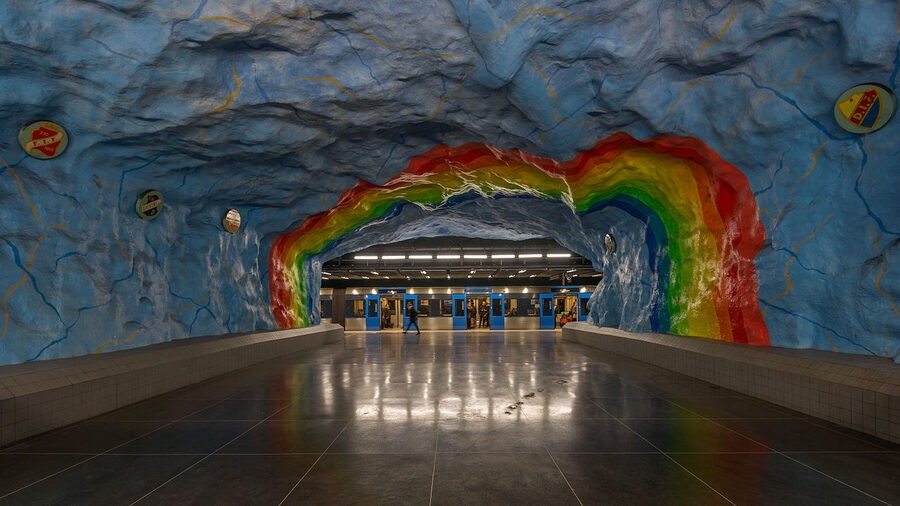
The red line is older than the blue (the central stretch opened 1964) and shorter on famous stations. Three are worth riding for: Stadion (the rainbow), Tekniska Högskolan (the science station), and Universitetet (Linnaeus, plus a Romani-history room at the southern end of the platform).
Stadion
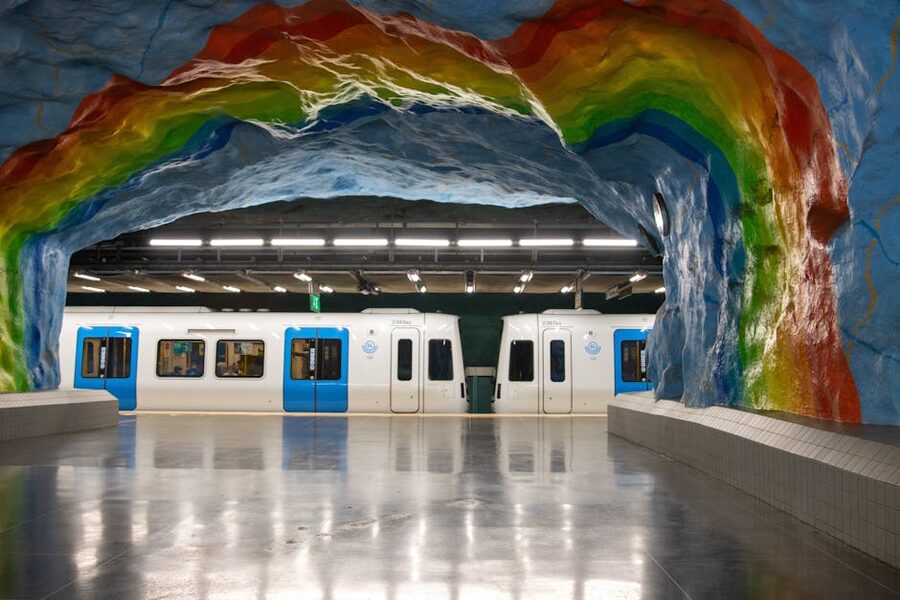
Two stops north of T-Centralen. Åke Pallarp and Enno Hallek, 1973. Stadion was the first of Stockholm’s bedrock-cave stations and it was built into a deeper hole than the architects had quite anticipated. The two artists were brought in to fight the claustrophobia: their answer was a sky-blue cavern wall with a single arched rainbow painted across it. The work is older than Pride (the rainbow flag arrived in 1978) and the visual reference was meteorological, not political, but the coincidence has aged into the second meaning. Stockholm’s metro management has not corrected the misreading.
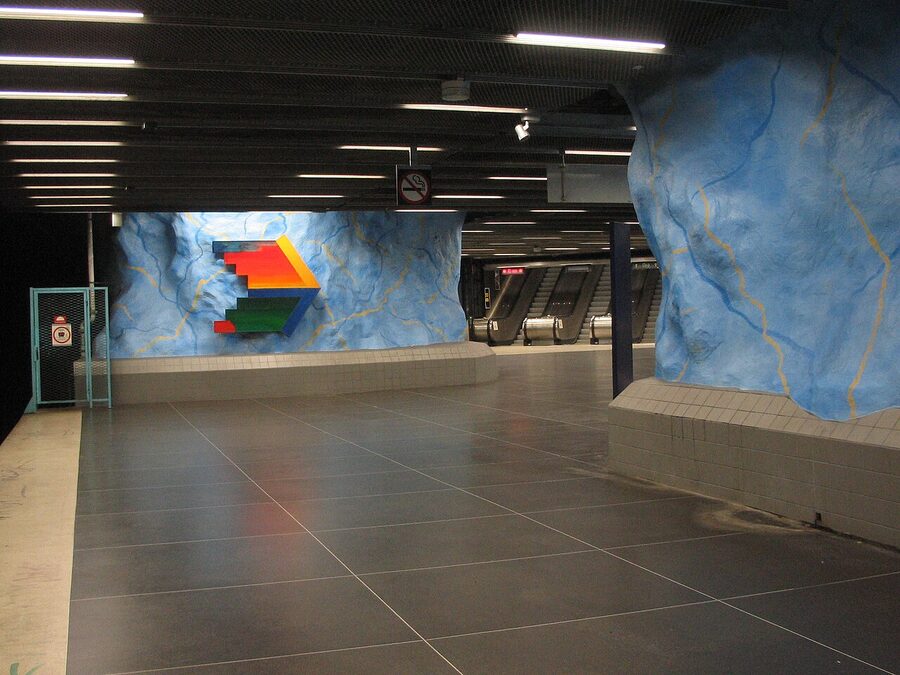
Stadion is the most photographed red-line station and the busiest of the three. Mid-morning weekday is the workable window. Walk to either end of the platform and frame the rainbow against the cavern; the close-up shots tend to flatten the work.
Tekniska Högskolan
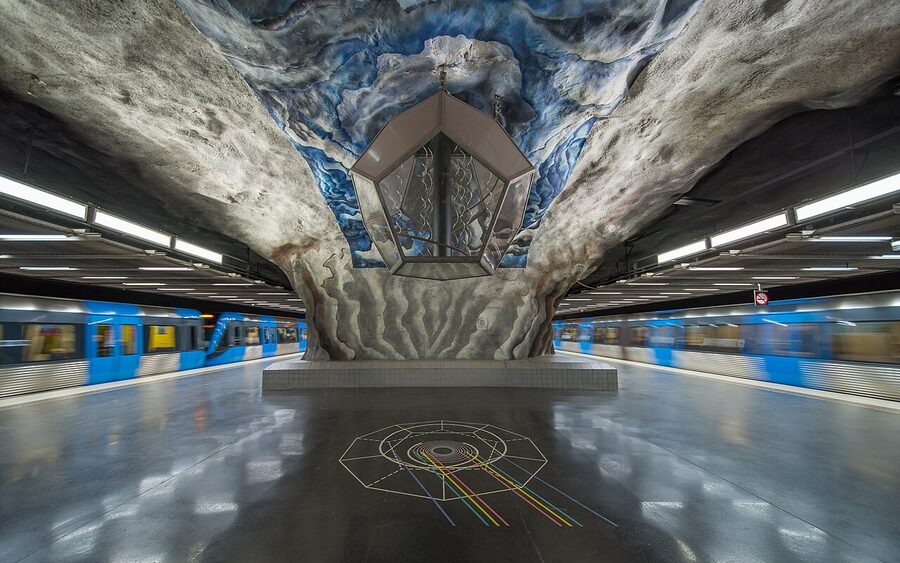
One stop further north. Lennart Mörk, 1973. The station serves the Royal Institute of Technology (KTH) and the brief was thematic: paint the natural sciences. Mörk delivered four panels along the platform (fire, water, earth, air) referencing the four classical elements through Newton, Galileo, and Kepler. There’s a working pendulum hanging from one of the rock columns and a stylised solar system on the ceiling. It’s the most “museum-y” of the bedrock stations: a place where you can spend twenty minutes reading and not feel finished.
Universitetet
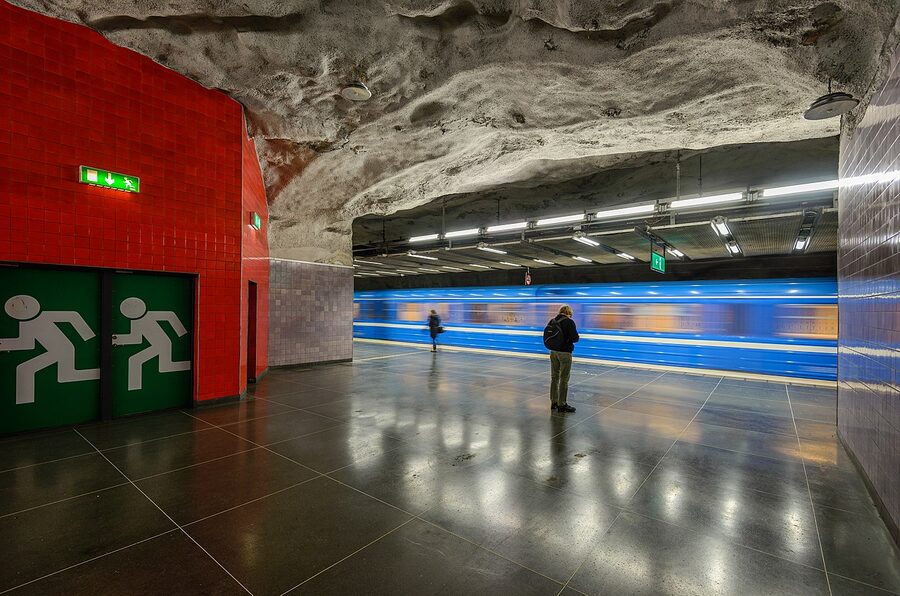
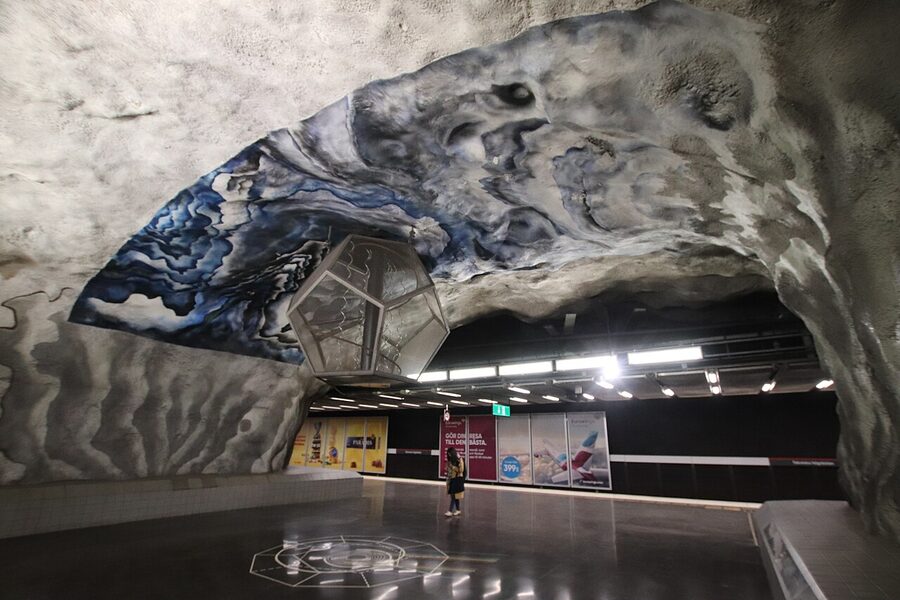
One more stop north. Françoise Schein, 1998. Universitetet is the youngest of the famous stations on the red line and the only one with the new percent-for-art rule applied to a renovation rather than a build. Schein covered the entire platform in white tiles with two overlaid texts: Linnaeus’s botanical taxonomy on one wall, the full UN Declaration of Human Rights on the other. The two read against each other; the joke is that taxonomy and rights are both ways the eighteenth and twentieth centuries tried to organise the world.
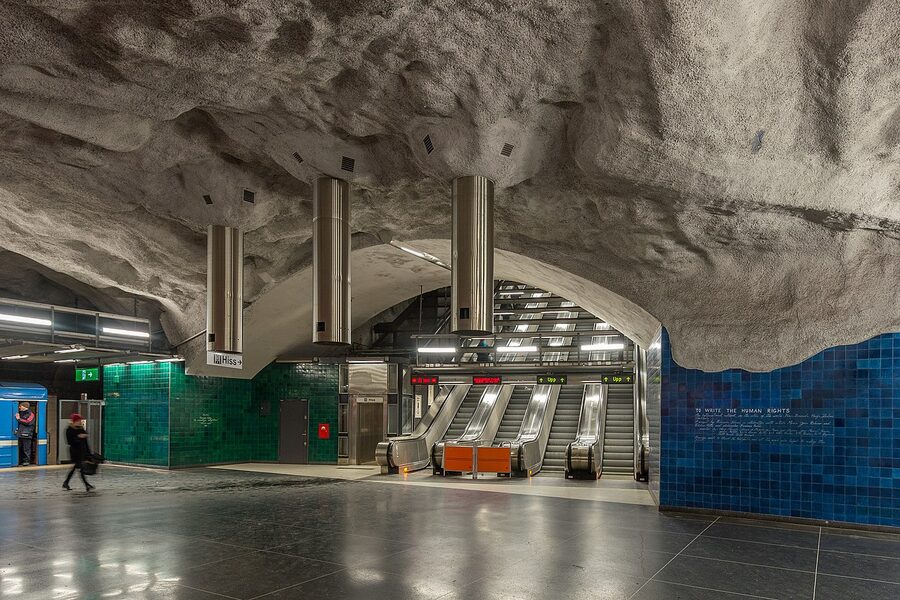
Walk to the southern end of the platform. There’s a small panel commemorating the Swedish Romani community; Schein added it in 2012 as part of an extension to the original work. Most riders never notice it.
Mörby Centrum
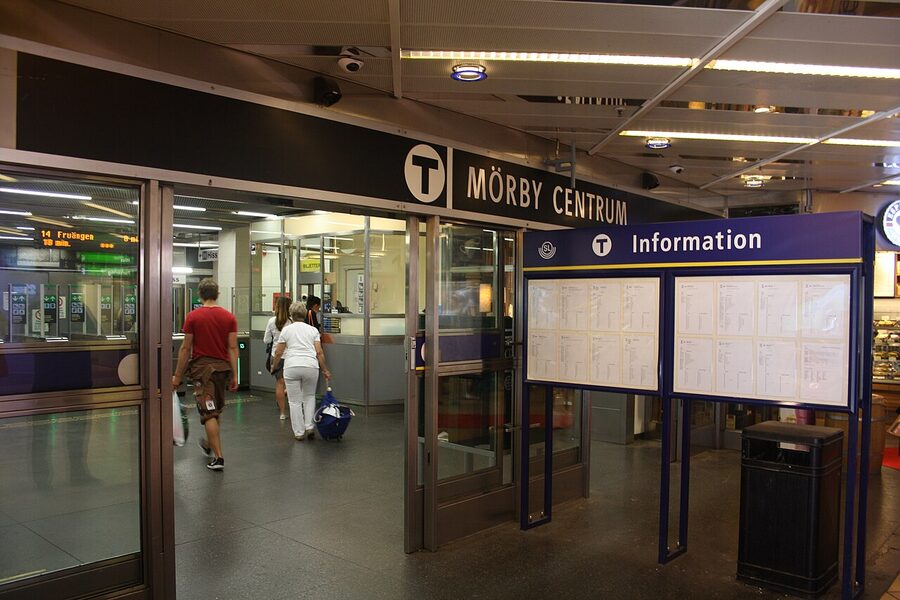
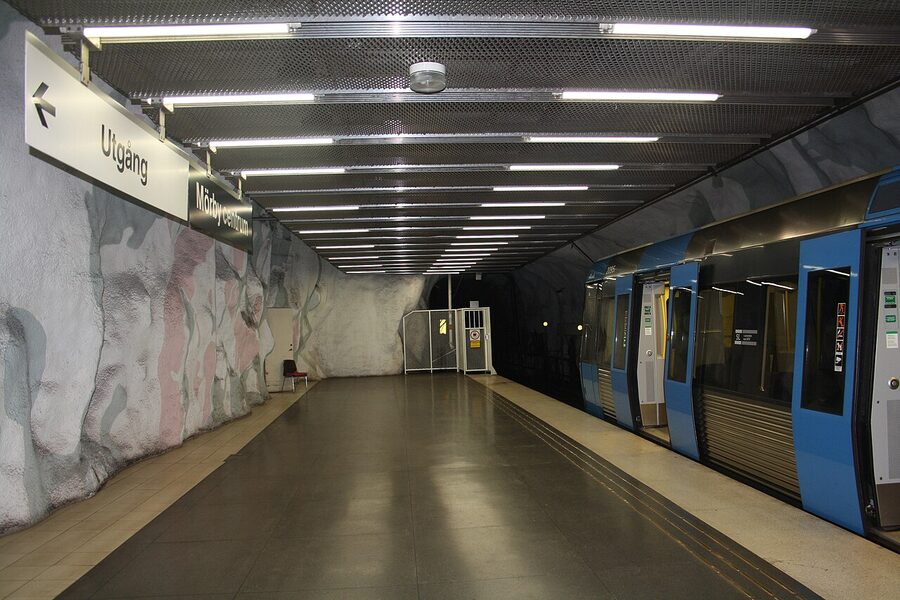
The northern terminus of the red line. Karl-Olov Björk and Gösta Wessel, 1978. Mörby gets ridden through, never to. The platform is painted dark red and pale grey, with a narrow figurative band along the wall where small faces and silhouettes pass behind the colour. It’s the most low-key of the red-line stations and most riders don’t get off. Worth ten minutes if you’re already on the train.
Östermalmstorg
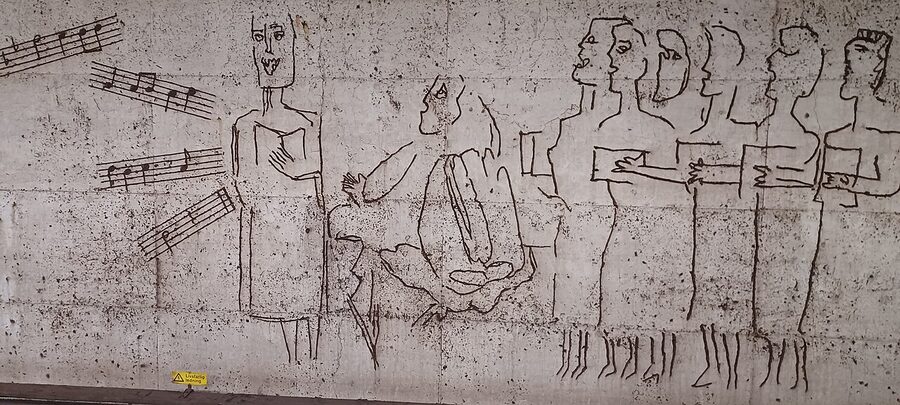
One stop east of T-Centralen on the red line. Siri Derkert, 1965. Derkert was 77 when she got the commission and one of Sweden’s most established modernists, and she used the platform to put a women’s-rights and nuclear-disarmament argument directly onto the walls of the city’s wealthiest neighbourhood. The piece is etched onto poured-concrete panels: portraits of suffragettes, anti-nuclear slogans, the names of women writers and scientists, and stylised peace doves. It opened a year after the 1964 station did, paid for retrospectively under the percent-for-art rule.
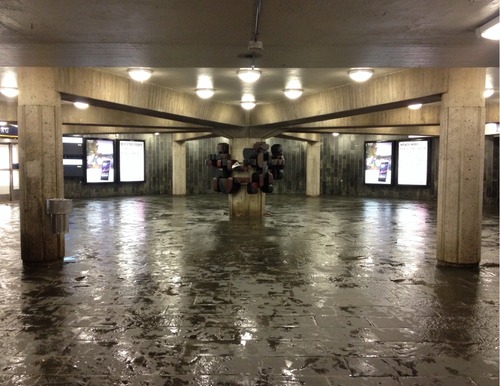
Östermalmstorg is the station that most rewards a slow read. The etchings are dense, in places hand-written, and the politics are more pointed than anything on the blue line. Look for the line “kvinnor i alla länder, förenen er” (women of all countries, unite). Allow twenty-five minutes.
The Green Line: less art, but the everyday network
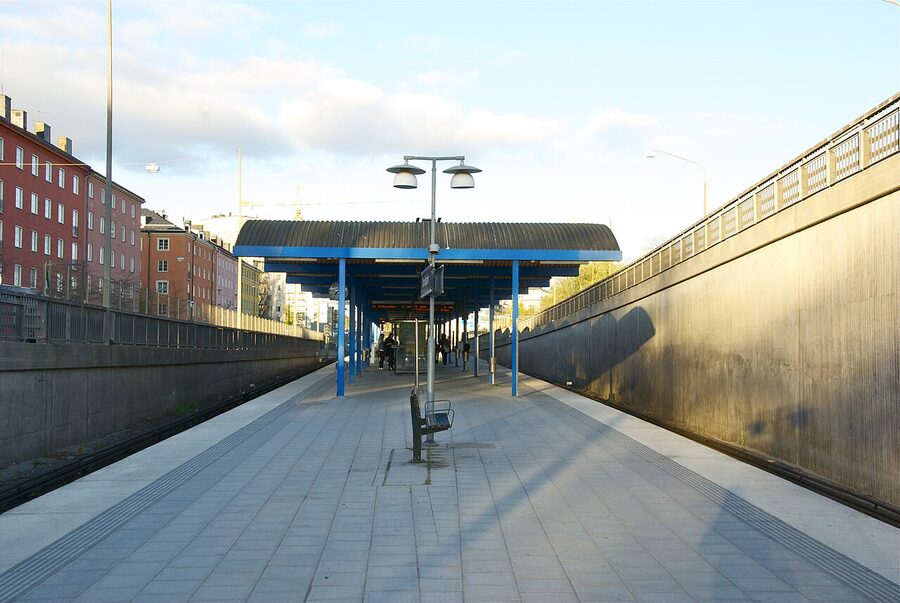
The green line is the network’s oldest (1950 onwards), the busiest, and the one with the least art per kilometre. A handful of central stations are decorated; most aren’t. Two are worth a stop: Thorildsplan and Hötorget.
Thorildsplan
Three stops west of T-Centralen on the green line. Lars Arrhenius, 2008. The youngest of all the stations on this list. Thorildsplan was a plain-tile station from 1952 with no commissioned art at all until SL ran a competition in the mid-2000s. Arrhenius won by proposing 8-bit pixel art: Space Invaders aliens, PacMan ghosts, Super Mario, Tetris blocks, all rendered in coloured tiles across the platform walls. The piece reads as a generation’s worth of childhood memory; it was the first station on the network commissioned for an audience that grew up on screens.
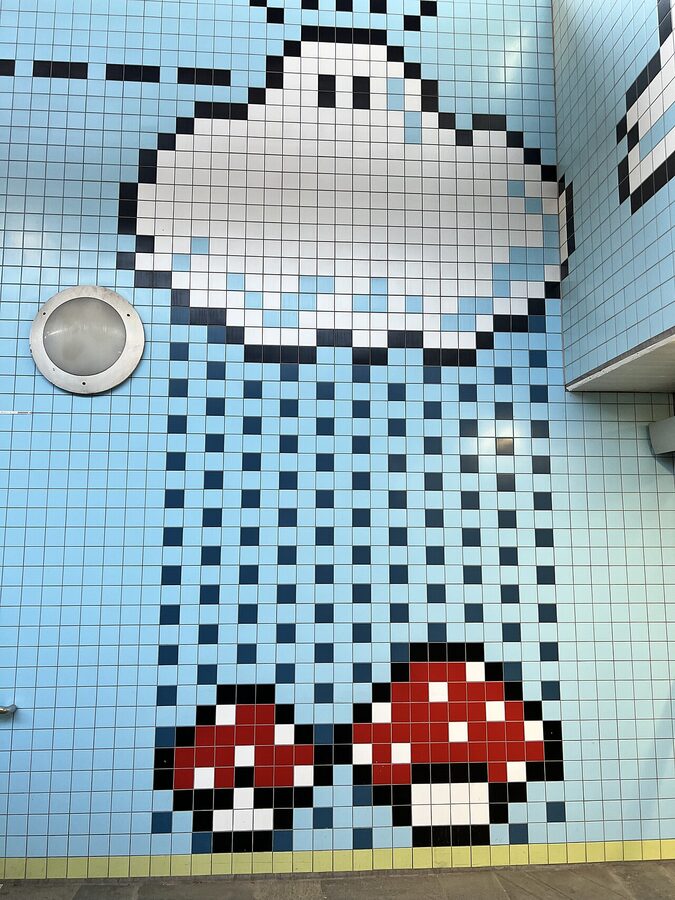
Thorildsplan is also the easiest station on the network to photograph. The platform is open and well lit, the tile work catches the light cleanly, and there’s no claustrophobia to fight. Allow ten minutes.
Hötorget
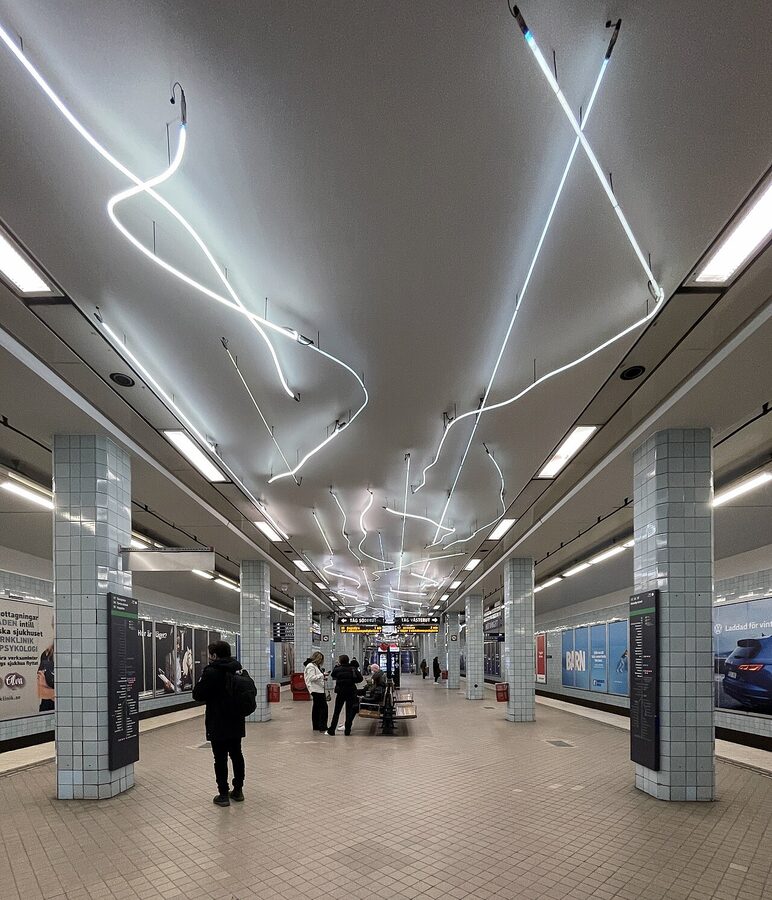
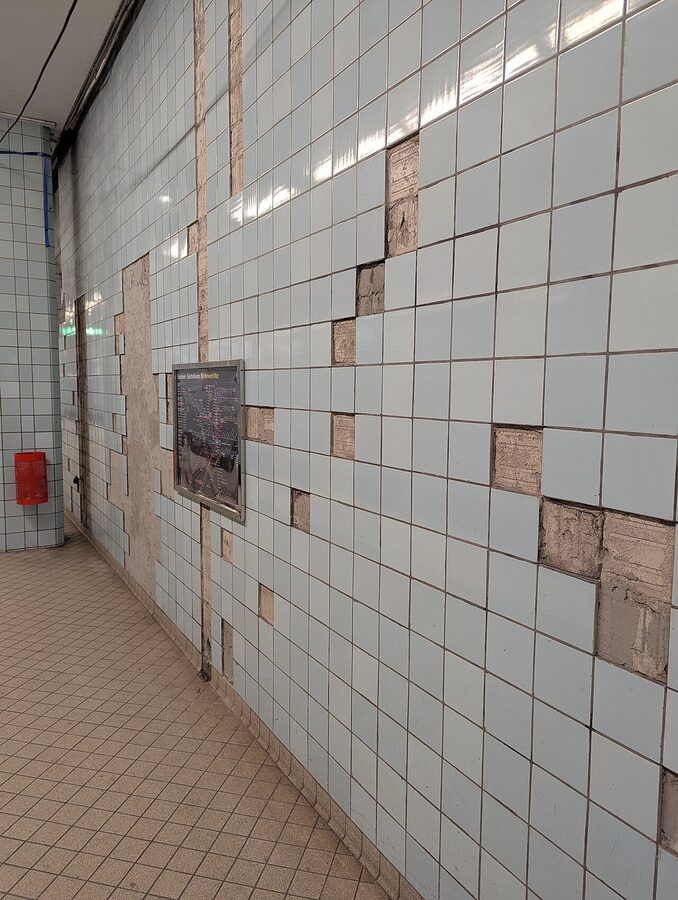
One stop north of T-Centralen on the green line. Originally tiled in 1952 with no art at all. Gun Gordillo, 1998. The original 1950s station was deliberately unadorned, in keeping with the early network’s plain-tile aesthetic; Gordillo added a neon ceiling installation in 1998 to soften the platform without renovating it. The combination is now its own thing: original retro signage, original benches, plus a string of pale-blue and white neon overhead. Hötorget is the station to ride for a sense of what the whole network looked like before the percent-for-art rule changed the brief.
Bagarmossen, the green-line outlier
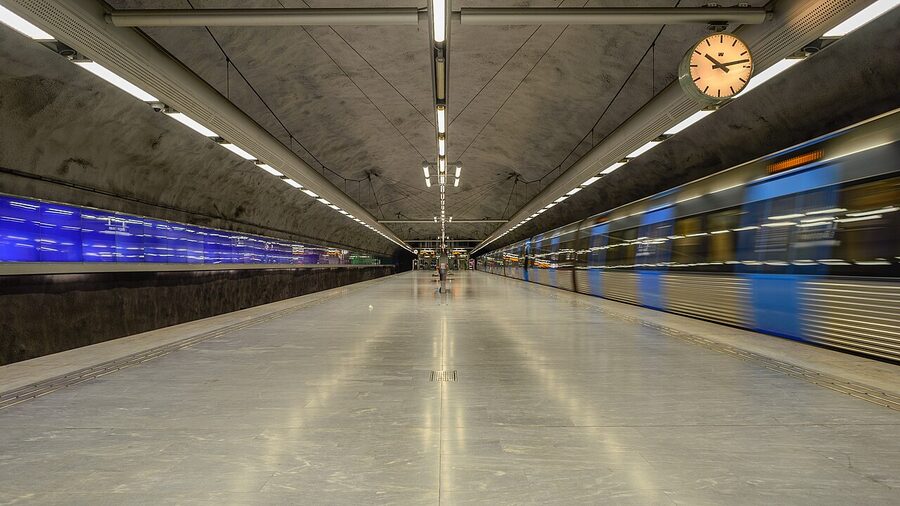
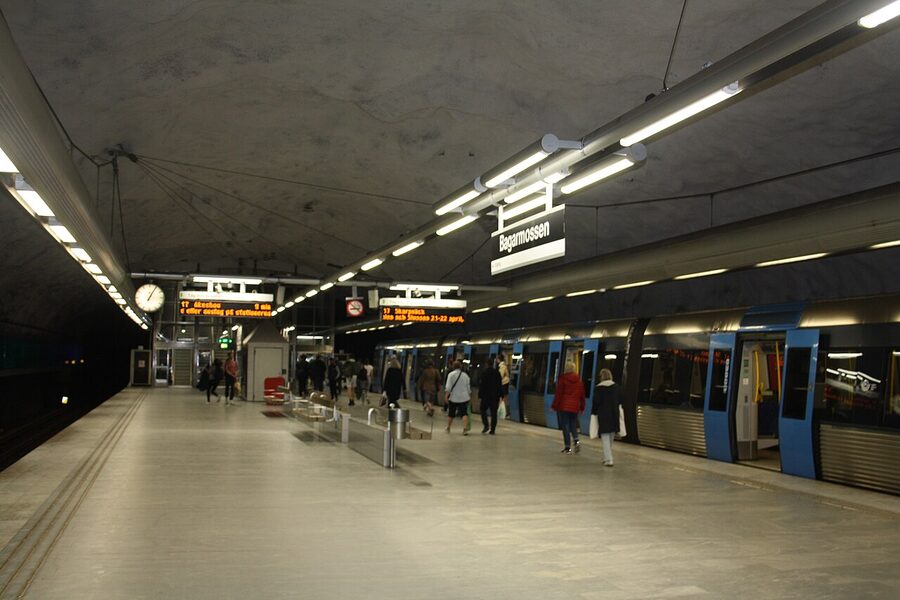
Six stops south of T-Centralen on the green line, near the southern terminus. Lars Kleen, 1994. Bagarmossen sits at the edge of the network and gets ignored by every published metro art guide I’ve read. Kleen’s commission turned the station into an industrial cathedral: cast-iron supports, exposed I-beams, hand-painted constellations and zodiac signs, and small wooden boats hanging from the ceiling. It’s an odd, dense, slightly off-balance piece that reads better the longer you look at it. Allow fifteen minutes. You’ll have the platform to yourself.
A practical route: ten stations, two and a half hours
If you want a single route to follow, here’s the one I’d repeat. Start at T-Centralen on the red-and-green platform (1957, geometric tiles, the original station). Take the green line one stop north to Hötorget. Then back to T-Centralen, switch to the red line and ride three stops north: Östermalmstorg, Stadion, Tekniska Högskolan. One more stop to Universitetet. Back to T-Centralen.
Switch to the blue line. Ride west one stop to Rådhuset. Back through T-Centralen and east two stops to Kungsträdgården. The line ends here; ride back through and out north to Solna Centrum (five stops). Get off, walk the platform, then back on and one stop further to Hallonbergen. Back to T-Centralen on the blue line. End on the blue platform of T-Centralen with the Ultvedt vines.
Total: ten stations, roughly two and a half hours including walking each platform. The whole thing fits inside a single 24-hour pass with no transfer panic. If you want to add the outer Blue (Tensta, Rinkeby, Akalla, Husby), budget another two hours and a separate trip; the line splits north of Västra Skogen and you can’t easily do both branches in one go.
If you only have one hour
Skip the red line entirely. Start at T-Centralen blue platform, ride to Rådhuset, back, change at T-Centralen and east to Kungsträdgården, back, then north to Solna Centrum and straight back. Six stations, sixty-five minutes if you walk briskly, hits the four most photographed stations in the network. The single-ticket 75-minute window will cover this if you don’t dawdle.
If you have a full day
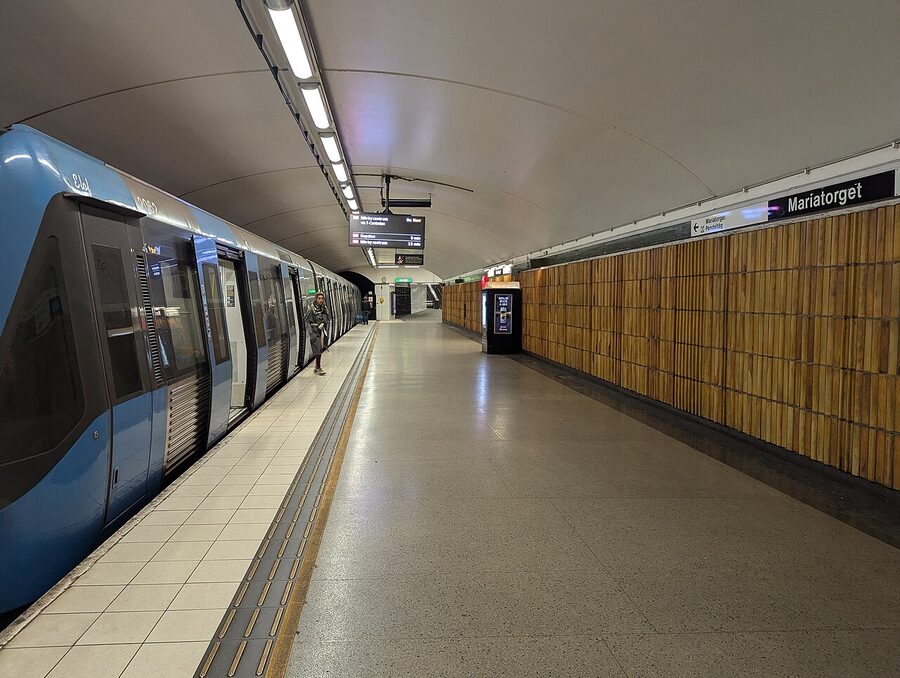
Add the four outer Blue stations (Tensta or Akalla branch, but not both unless you really want to ride into the same suburb twice), Bagarmossen on the green line, Thorildsplan further west, and Mariatorget on Södermalm. That’s a fifteen-station day with plenty of platform-walking and at least two coffee breaks above ground. If you’re combining with a Hornstull stop on the red line, the Södermalm neighbourhood guide is a natural pairing. The walking guide to Hornstull and Södermalm covers the food and the second-hand shops above the station.
The free guided tour, and why I’d skip it
SL runs a free art tour on Tuesdays and Thursdays during the summer months (June through August), led by a Stockholmer who mostly volunteers. It leaves from the SL information desk at T-Centralen at 15:00 (in English on most departures, occasionally only Swedish, check sl.se on the day) and runs for about ninety minutes. The tour is genuinely free with any valid SL ticket, which is a good thing on paper.
The reasons to skip it: it’s group-paced and group-sized (typically 15-25 people), it visits a fixed list of five or six stations rather than the longer route I’ve described above, and you’re stuck on someone else’s photographic timing rather than your own. The reasons to take it: if you have one short window, you’d rather not navigate the network solo, and you want a Swede explaining each station in person rather than a written guide.
For most readers, the self-guided ride wins. You’ll see more art, you’ll have a better chance of empty platforms, and the 24-hour pass plus this article costs roughly the same as a nice fika. The exception is if you want the social element: the SL tour has a small coffee-and-bun break halfway through and is genuinely friendly. There’s a longer paid tour run by Stockholm Art Walk (around 250 SEK / ~€23, daily, two hours) that visits more stations; I haven’t done it and can’t review it.
Where to get out and eat
The standard mistake on a metro art day is to do all ten stations in a single push and then realise it’s three in the afternoon and you’ve eaten a pretzel. Two stops on the route surface near actual food. T-Centralen is the easy one: walk five minutes north to Hötorgshallen, the indoor market, for sill, herring, salmon and the cheaper end of Stockholm lunch. Östermalmstorg is the other: Östermalms Saluhall, the 19th-century food hall, sits directly above the station with a row of decent counter-restaurants for an hour-long lunch.
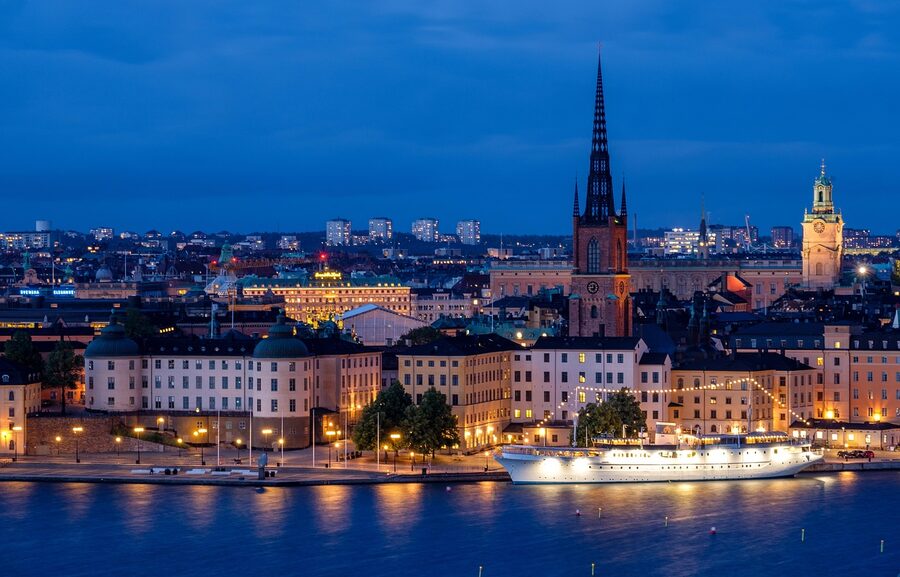
The Hornstull / Södermalm exit is the third option: the red line passes through and the neighbourhood above the station is the city’s best for second-hand shops, cafes and the Sunday flea-market on the waterfront. Mid-route, it’s a sensible coffee stop and a chance to pick up something for the second half. For a full Stockholm context, the three-day Stockholm guide covers neighbourhoods, food, and the practical layout if this is your first visit to the city.
Other Stockholm and Sweden context
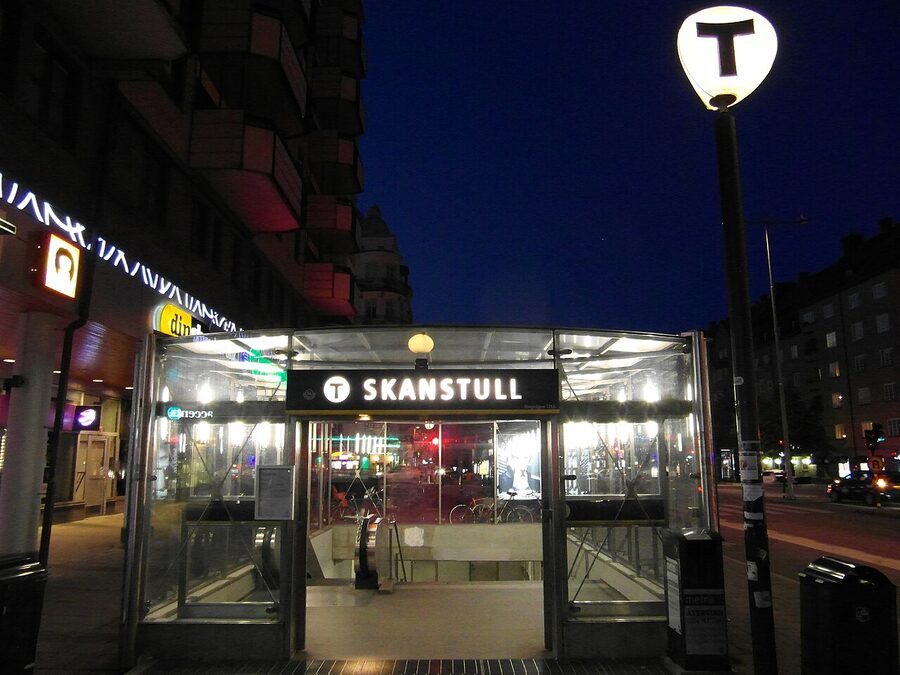
The metro art ride pairs well with the rest of a Stockholm trip in a few specific ways. If you’re combining Stockholm with the rest of the Nordics, the Stockholm to Helsinki overnight ferry is the natural eastern chain and gives you a half-day in Stockholm before boarding which the metro art route fills perfectly. If you’re going north for the aurora, the Tromsø versus Abisko comparison covers the route choice and the night-train logistics from Stockholm. And if you happen to be in town in December, the Christmas in Stockholm guide covers markets, ferry routes and the winter version of the city.
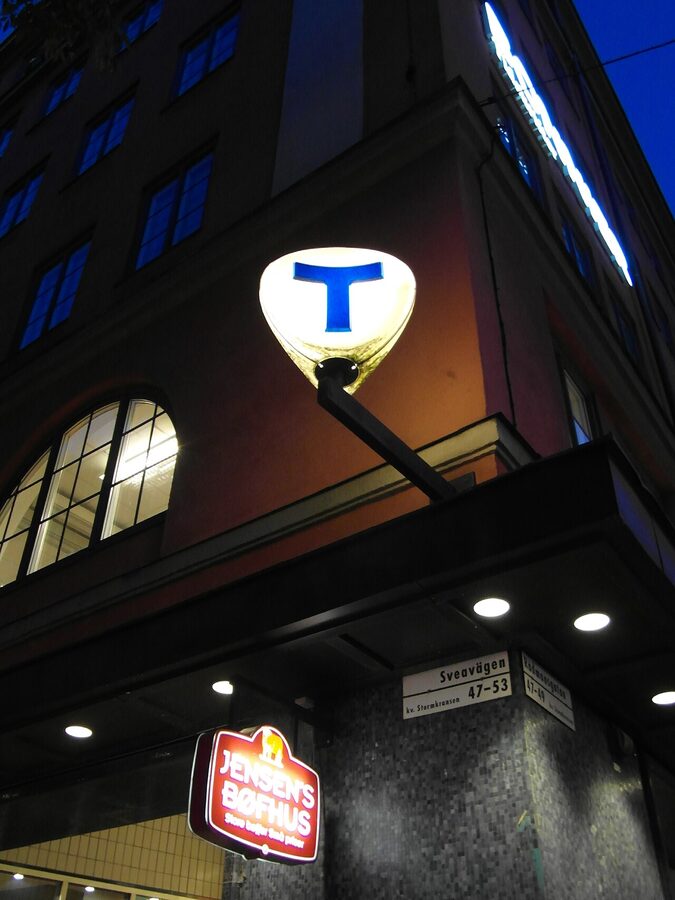
The cross-Nordic comparison: Oslo’s T-bane has a handful of decorated stations (Nationaltheatret has Per Krohg’s 1928 mural, Storo has glass) but nothing like the systematic percent-for-art commission. Helsinki’s metro is younger (1982) and almost untreated; the West Metro extension to Espoo added a few station-architecture flourishes but not full art commissions. Copenhagen’s automated Metro (2002 onwards) is architecture-led, with concrete and natural light treated as the design language rather than painting and mosaic. Stockholm is the outlier in scale and in age, and that’s why the comparison falls in its favour.
If you want to go deeper
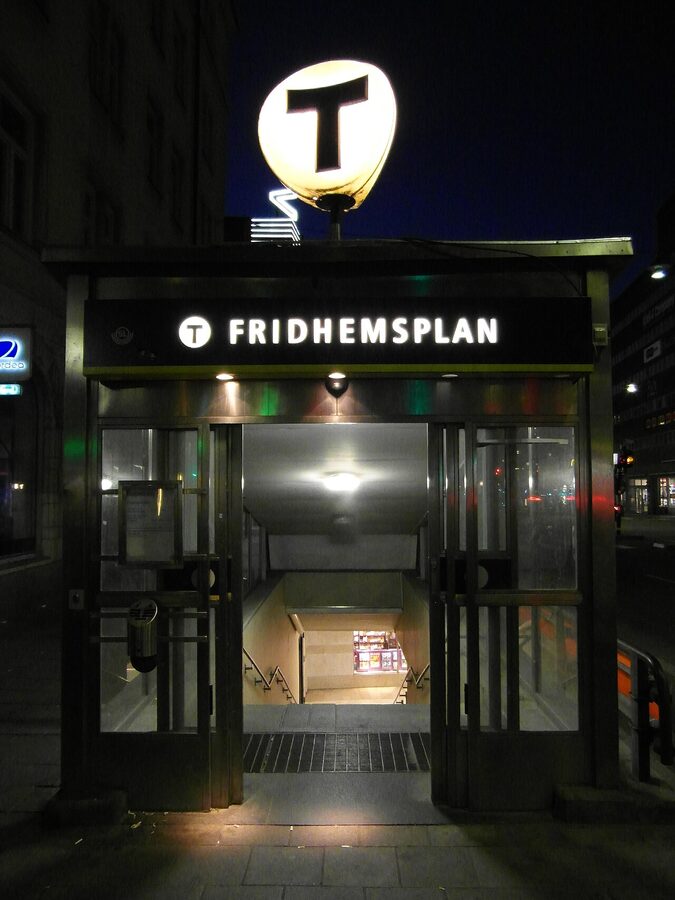
The Modern Museum (Moderna Museet) on Skeppsholmen runs an annual programme on metro art and occasionally hosts an exhibition tied to one of the original commissions; check moderna
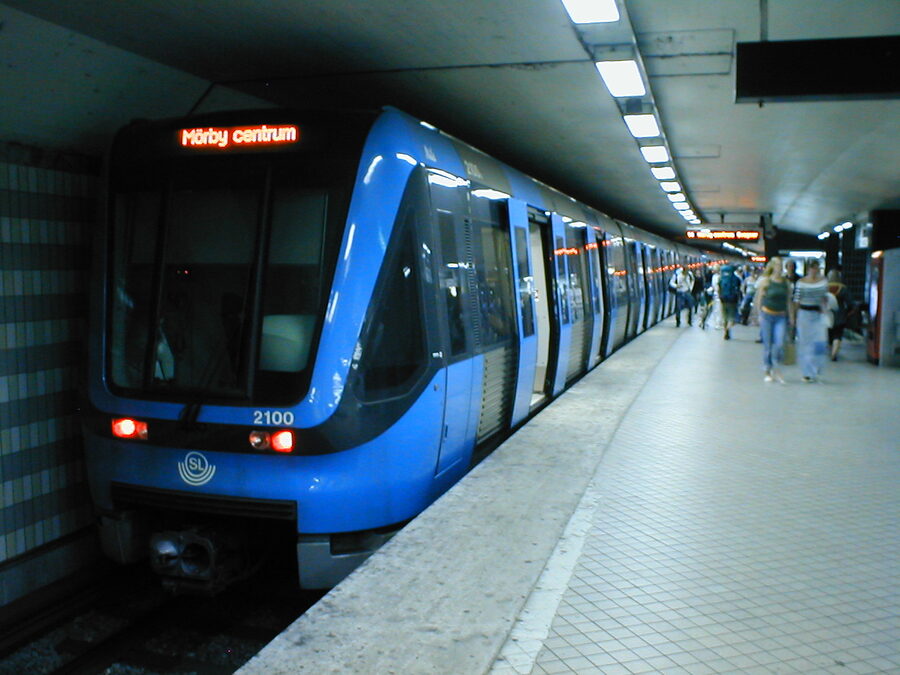
The 1957 vote was a piece of municipal policy that aged into a tourist attraction. None of the artists who took the early commissions imagined their work would be photographed by Tokyo design students or framed as the world’s longest gallery; they were painting a station for a worker’s commute home. Some of the work is great, some is fading, some is flat. But the cumulative thing, 100 commissioned pieces along 110 km of tunnel, sixty-eight years deep, is unique on the continent and probably worldwide. Ride it on a Tuesday morning, take an hour at Solna Centrum, and tell me afterwards whether the standard top-three list was enough.
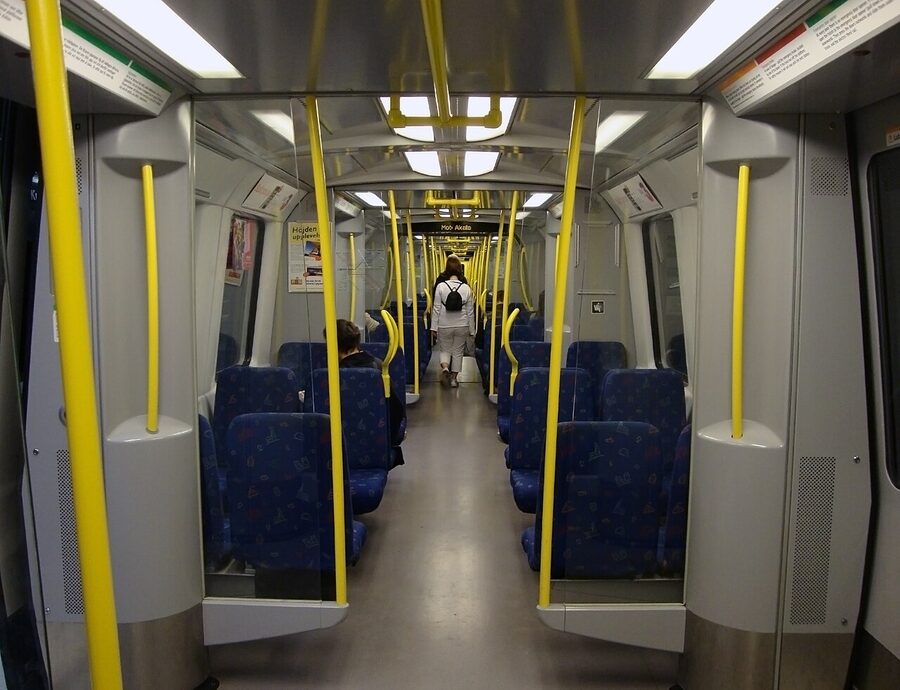
Final note on the timing rule. If you can only ride on a weekend, do Sunday morning before 11:00 rather than Saturday afternoon. The platforms genuinely empty out and the photography is workable. If you can only do a weekday but the only window is rush hour, ride against the flow: head outbound (north or west) at 08:00, inbound (south or east) at 17:30. The trains will be packed in one direction and almost empty in the other. The art doesn’t change. The ride does.