
The 09:48 Öresundståg from København H takes 37 minutes to cross the strait into Sweden. Sixteen kilometres of bridge, four kilometres of artificial island, and four minutes of tunnel between Hyllie and Triangeln. The ticket costs 119 SEK (around €10) on Skånetrafiken, less than the airport metro back in Copenhagen. You arrive in Sweden’s third-largest city with falafel that’s better than anything in Denmark and prices that drop 20 to 25 per cent on most things you’ll order. Most CPH travellers do it as a day trip, take a photo of the Turning Torso, and leave on the 17:00 back. That’s the wrong move.
Stay one night. Two if you can. Malmö rewards the second day in a way Copenhagen doesn’t reward a fourth, and the city is just different enough from its big Danish neighbour to be worth the crossing on its own terms. This is what 17 things-to-do listicles miss about Sweden’s third city: it isn’t a Copenhagen day-trip. It’s the Sweden side of a paired city break, with a different texture, a different food culture, and a hinterland of Skåne towns that were Danish until 1658 and still feel half Danish today.
In This Article
- The bridge, the tunnel, and getting here properly
- Why I would stop you from day-tripping
- A short history block, because Skåne wasn’t always Sweden
- Stortorget, Lilla Torg, and the squares of the Old Town
- Gamla Väster, the only properly old corner of the city
- Sankt Petri kyrka and the Hanseatic underlayer
- Malmöhus Slott and the Slottsträdgården
- Västra Hamnen, the Western Harbour, and the Turning Torso
- Ribersborgs Kallbadhus, the bath in the strait
- Möllevång and the Möllan food scene
- Folkets Park, on the way back
- The Skåne hinterland: four day-trips that justify staying in Malmö
- Lund, 11 minutes by Pågatåg
- Trelleborg, 30 minutes south
- Helsingborg, 33 minutes north
- Ystad, 50 minutes south-east
- Where to eat beyond falafel
- Where to stay, with verified Booking.com links
- Practical bits
- How Malmö fits in a wider Nordic trip
The bridge, the tunnel, and getting here properly
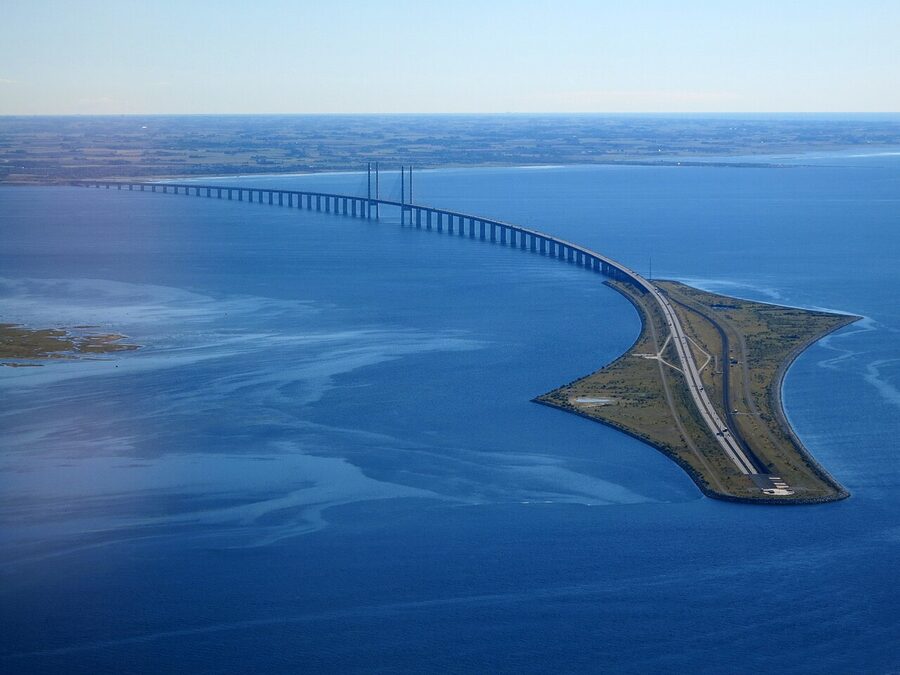
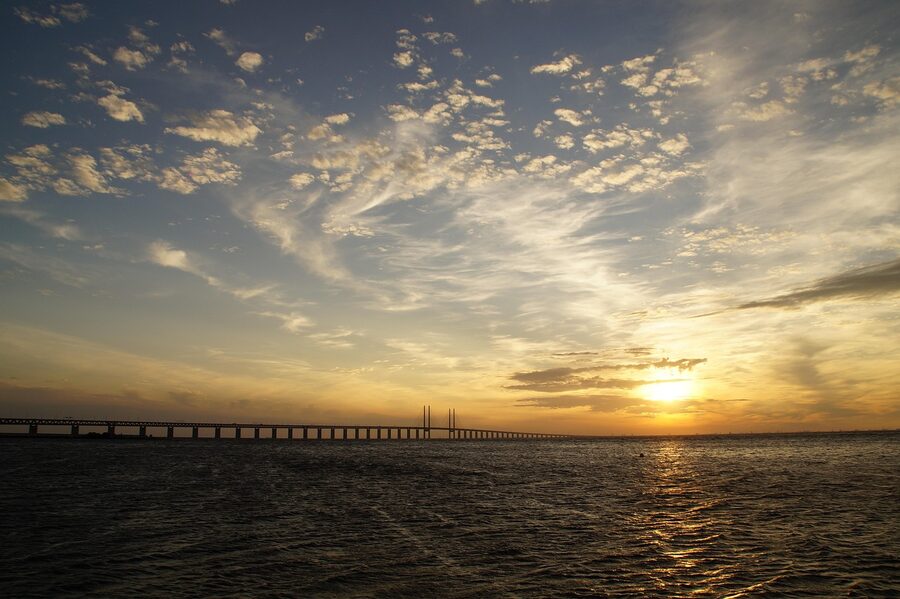
The Øresund crossing is the most useful piece of bi-national infrastructure in northern Europe and almost nobody who uses it understands what they’re crossing. So briefly: the bridge runs from Lernacken on the Swedish coast to a 4 km artificial island called Peberholm. From Peberholm, a 4,050-metre immersed tube tunnel takes you under the ship lane and surfaces on the Danish island of Amager, a kilometre from Copenhagen Airport. Trains run on the lower deck, four lanes of motorway on the upper. It opened on 1 July 2000 after ten years of construction and cost 30.1 billion DKK in 2000 prices, the most expensive single project Sweden has ever co-financed. It paid back its loans in 2024, four years ahead of the original 50-year forecast.
What you actually need to know to use it:
- Buy a Skånetrafiken ticket, not a DSB ticket. The Pågatåg local trains and the longer-distance Öresundståg both honour Skånetrafiken tickets. From Copenhagen Central, the Skånetrafiken single is 119 SEK or 88 DKK and is sold from the ticket machines on the platform marked with the orange Skånetrafiken logo. A DSB ticket to Hyllie is more expensive and won’t work for the local trains once you cross.
- Trains run every 10 to 20 minutes 06:00 to midnight. Last train back to CPH leaves Malmö C around 00:30. Frequency drops on Sundays.
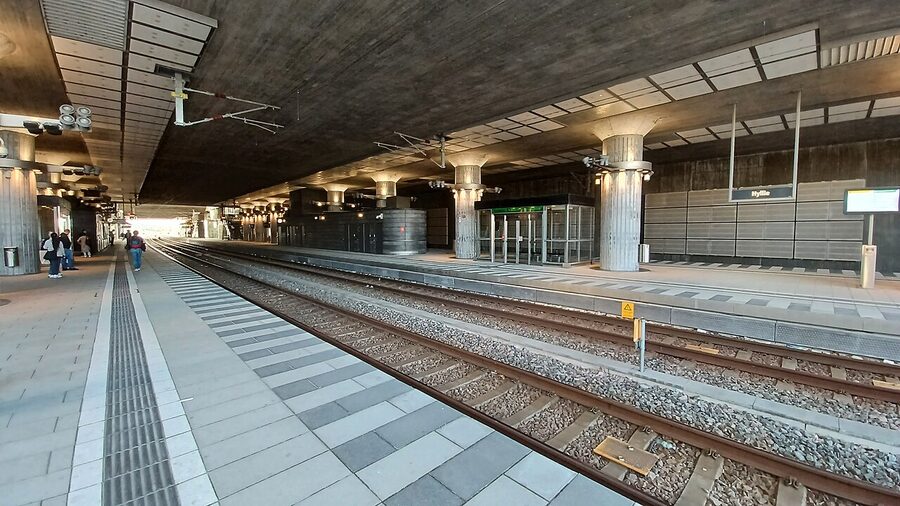
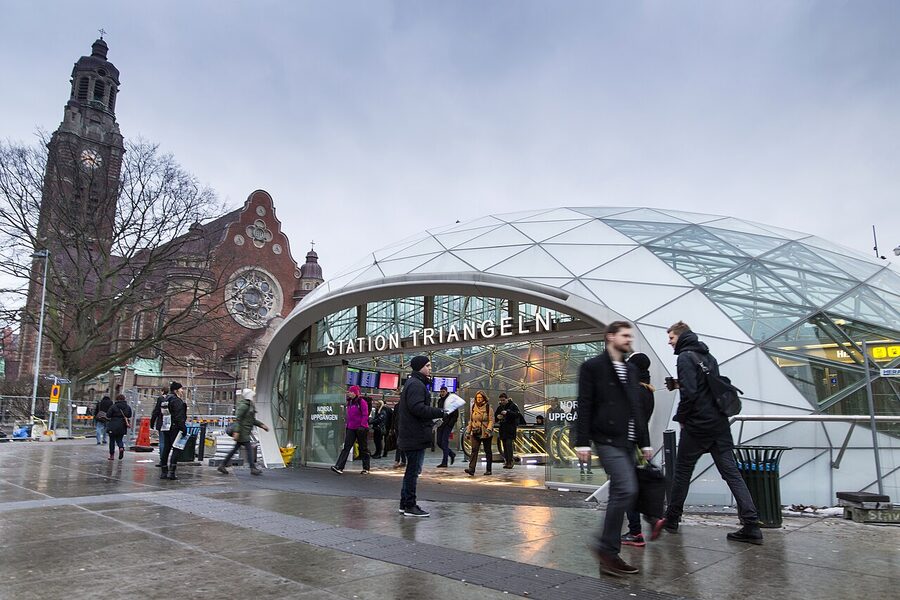
- Hyllie is the first Swedish stop, two minutes after the tunnel ends. If you’re staying near the Malmö Arena or shopping at Emporia, get off here. Otherwise stay on for Triangeln (better for Möllevång and the food scene) or Malmö C (Old Town, harbour, Western Harbour).
- Border passport checks happen at Hyllie, not on the train. Bring your passport, even from Schengen Denmark to Schengen Sweden. The checks were imposed in 2016 after the migrant crisis and have not been removed.
The other crossing options exist but rarely make sense. The Gråhundbus 999 runs from Copenhagen H to Malmö C in about an hour for 80 to 110 DKK and gives you the bridge view from a coach window, which is genuinely worth doing once. The HH Ferries between Helsingør and Helsingborg cover a different stretch of strait altogether and only matter if you’re starting somewhere in north Sjælland. Driving across the bridge yourself costs 510 SEK each way at the toll booth and the queue can be 30 minutes on a summer Friday. The train is the answer.
Why I would stop you from day-tripping
Six in ten Malmö visitors are doing it as a day trip from Copenhagen. They get the 09:48, walk Stortorget and Lilla Torg, see the Turning Torso from a distance, eat a falafel, get the 17:24 back. They’re not wrong. You can do that. But you’ll miss why anyone who’s spent real time on both sides of the Øresund actually prefers Malmö in some ways.
The reasons day-trips don’t work:
The food scene runs late and is a 15-minute walk from the central station. Möllevångstorget and the surrounding Möllan district hold what’s plausibly the best Middle Eastern food in Scandinavia, and it doesn’t really start serving until 18:00. If you’re catching the 17:24 train, you’re eating tourist falafel near Triangeln, not the real thing on Bergsgatan.
The bath culture is a sunset and morning thing, not a midday thing. Ribersborgs Kallbadhus is the city’s defining 1898 wooden bathhouse, sticking out 200 metres into the strait, and the right time to use it is around 19:00 in summer or 16:00 in winter when the sauna fills with people who’ve finished work. Day-trippers can technically swim there at 13:00, but it’s empty and there’s no atmosphere.
And the Skåne hinterland, which is genuinely the most overlooked thing in this part of Sweden, needs a base. Lund is 11 minutes from Malmö C. Trelleborg is 30 minutes. Ystad is 50. Helsingborg is 33. None of those make sense from a Copenhagen base. All of them work brilliantly from a Malmö base.
Stay one night minimum. Two if you have them. The decision frame I’d give first-timers in the region: three or four nights in Copenhagen, one or two in Malmö, ideally bridging the trip with the Saturday in Sweden. Saturday is when Möllevångstorget has its produce market and when locals are around. Sunday in Sweden’s third city is quiet in a way that suits the day-trip stereotype but not what’s actually here.
A short history block, because Skåne wasn’t always Sweden
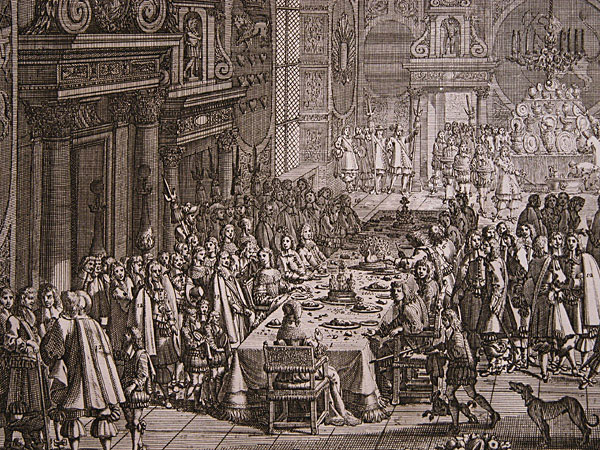
If you take one historical fact away from this article, take the date 26 February 1658. That’s the day the Treaty of Roskilde was signed, after the Swedish king Karl X Gustav marched his army across the frozen Storebælt and held a knife to Copenhagen’s throat. In a single document, Denmark lost Skåne, Halland, Blekinge, and Bornholm to Sweden. (Bornholm rebelled within 18 months and went back to Denmark; the other three are still Swedish.) Until that day, Malmö had been a Danish town for five hundred years. Some of the city’s older buildings predate the Swedish takeover, and the cobbled lanes of Gamla Väster still have a layout that’s recognisably more Danish than Stockholm.
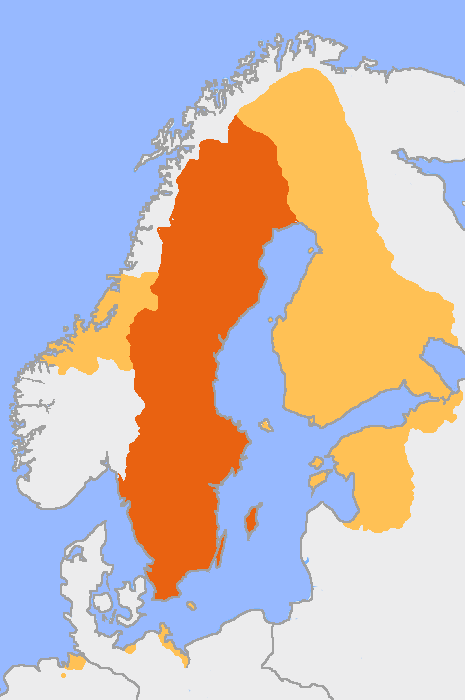
The other two history dates worth holding onto:
1 July 2000. The Øresund Bridge opens, and Malmö stops being a peripheral Swedish industrial city facing a difficult 1990s shipyard collapse, and starts being the Swedish foothold of a 3.8 million-person bi-national region. The city’s population was 245,000 in 2000. It’s around 366,000 now. About a third of that growth came from people working in Copenhagen and living in cheaper Malmö.
27 November 2005. The Turning Torso is officially inaugurated. Designed by Santiago Calatrava, 190 metres tall, 54 floors, twisting 90 degrees from base to crown. It’s still the tallest building in Sweden, and (briefly) the tallest residential building in Europe. We’ll come back to it. The point of the date is that the Turning Torso opened five years after the bridge, on the site of the Kockums shipyard that had closed in 1986. The whole Western Harbour district sits on what used to be slipways and dry docks. Skåne went from “Danish until 1658” to “industrial until the 1990s” to “the most architecturally ambitious bit of Sweden” within a tight twenty-year window.
Stortorget, Lilla Torg, and the squares of the Old Town
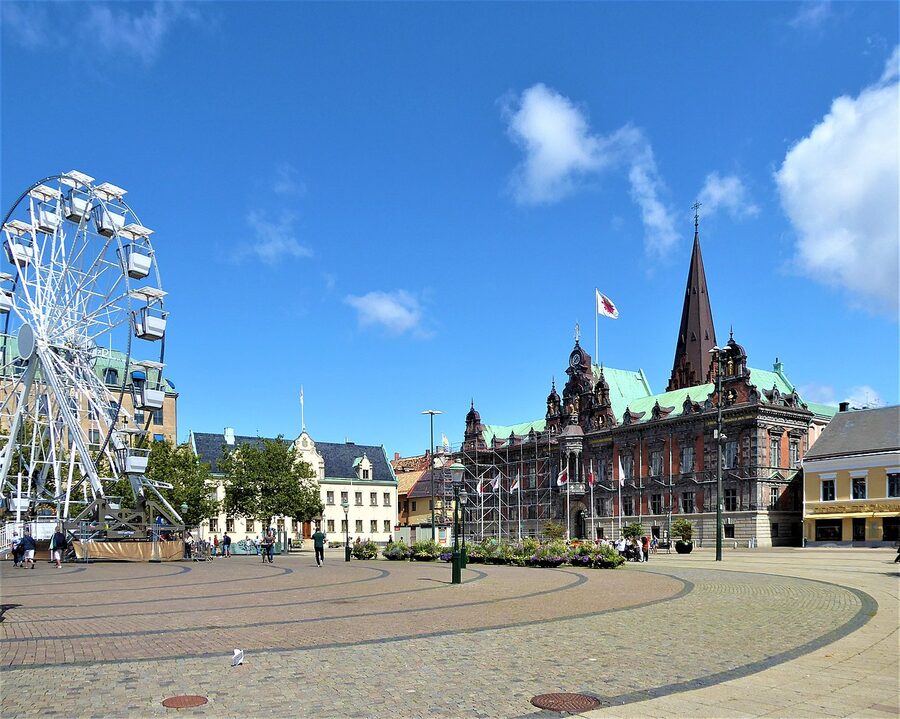
Stortorget is the big square. Laid out in 1538, when Malmö was the second-biggest Danish city after Copenhagen. The Renaissance town hall (Rådhuset) on the east side dates from 1546, the equestrian statue of Karl X Gustav from 1896. The yellow building on the south side is Apotek Lejonet, the Lion Apothecary, opened in 1571. The squares of the older Hanseatic ports along the Baltic all look related, and Stortorget is one of them. It feels Danish because in its first century it was Danish.
What to do here: not much. Walk through it, look up at the town hall, sit on the wide stone steps if it’s sunny. The cafés around the edge are pleasant and overpriced. The point of Stortorget is that it’s the connector between the two more useful squares.
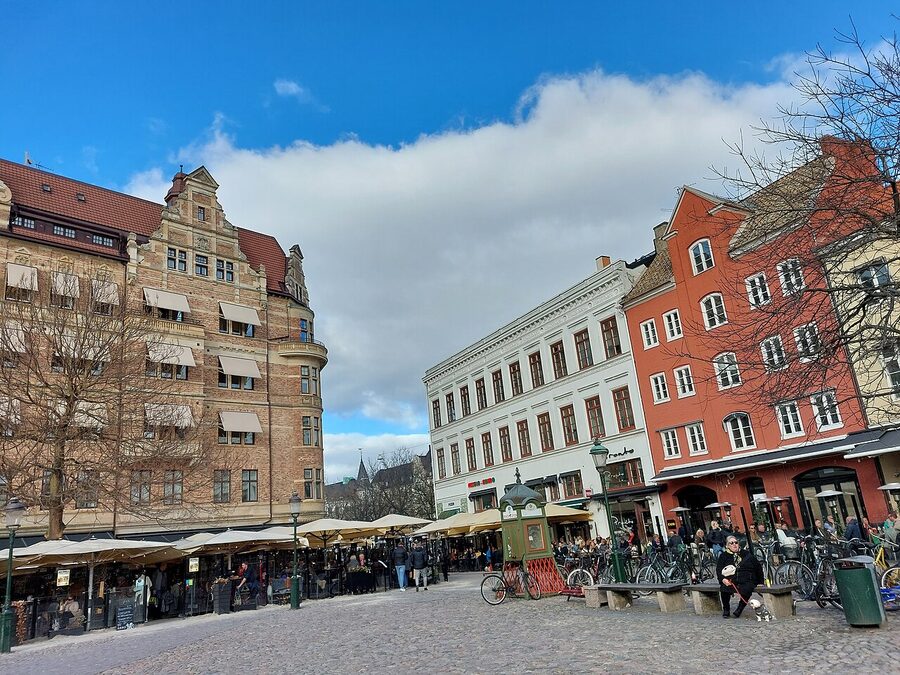
Lilla Torg is the smaller, prettier, more touristy one. It was carved out of Stortorget in 1592 because Stortorget was getting too full of stalls, and the half-timbered buildings around the edge are originals from that period and the next century or two. Today every ground floor on the square is a restaurant or a wine bar, and on a summer evening the entire square fills with outdoor tables under heaters. It is the most photographed corner of Malmö and not where I’d actually eat, but spend half an hour there with a beer at sunset and it earns its keep.
The third square nobody mentions is Gustav Adolfs Torg, two minutes south of Stortorget down Södergatan. It’s not pretty. It is functional: a tram stop, a bus interchange, a Friday flea market in summer. It’s where actual Malmö meets at a transport node, and reading it as part of the city beats pretending it isn’t there.
Gamla Väster, the only properly old corner of the city
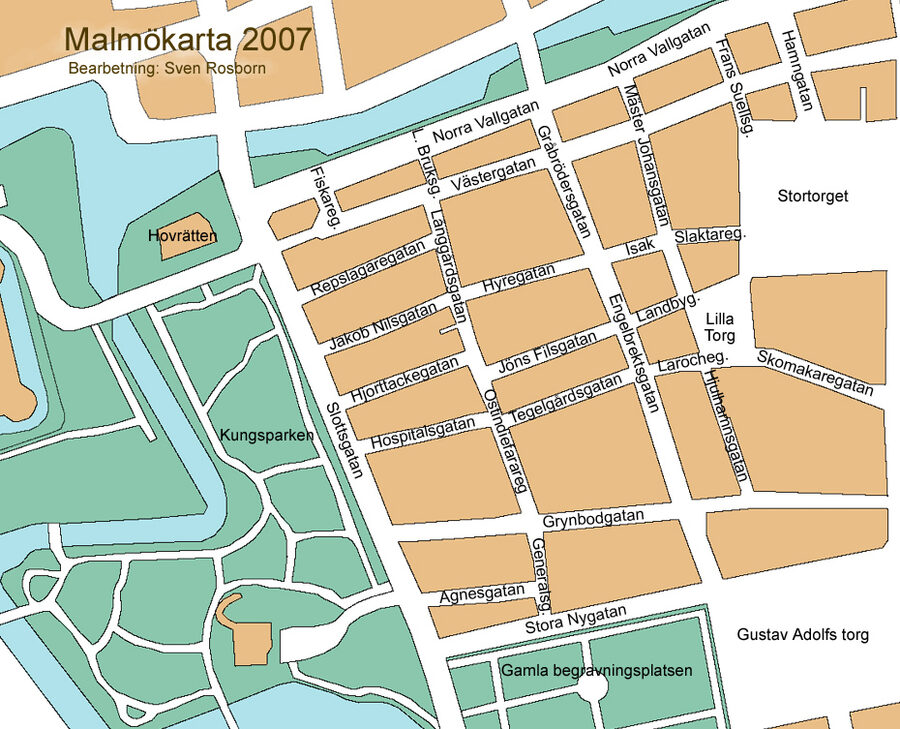
Gamla Väster is the cobbled rectangle west of Lilla Torg and south of the canal, bounded roughly by Hjorttackegatan, Mäster Johansgatan, Engelbrektsgatan, and the slope down to Slottsparken. It’s small. You can walk every street in 40 minutes. It’s also the only part of Malmö that survived 19th-century industrial demolition and 20th-century concrete planning intact, which makes it a precious thing.
What to look for: the painted wooden doors on Snapperupsgatan, the leaning gables on Jakob Nilsgatan, the tiny inner courtyards you can sometimes glimpse through arched gates. There’s a vintage bookshop called Antikvariat Hundörat on Engelbrektsgatan that has the kind of shelves you can lose an hour in. There’s a Basement Café on Hjorttackegatan that’s genuinely tiny and good. Between the two, Söderberg & Sara’s main location at Mäster Johansgatan 8 does a cardamom bun that’s worth crossing town for. It’s not a museum district. People live here.
One specific tip: walk Gamla Väster at 08:00 on a Sunday before anyone is up, then again at 22:00 the same day. The contrast is the city’s character.
Sankt Petri kyrka and the Hanseatic underlayer
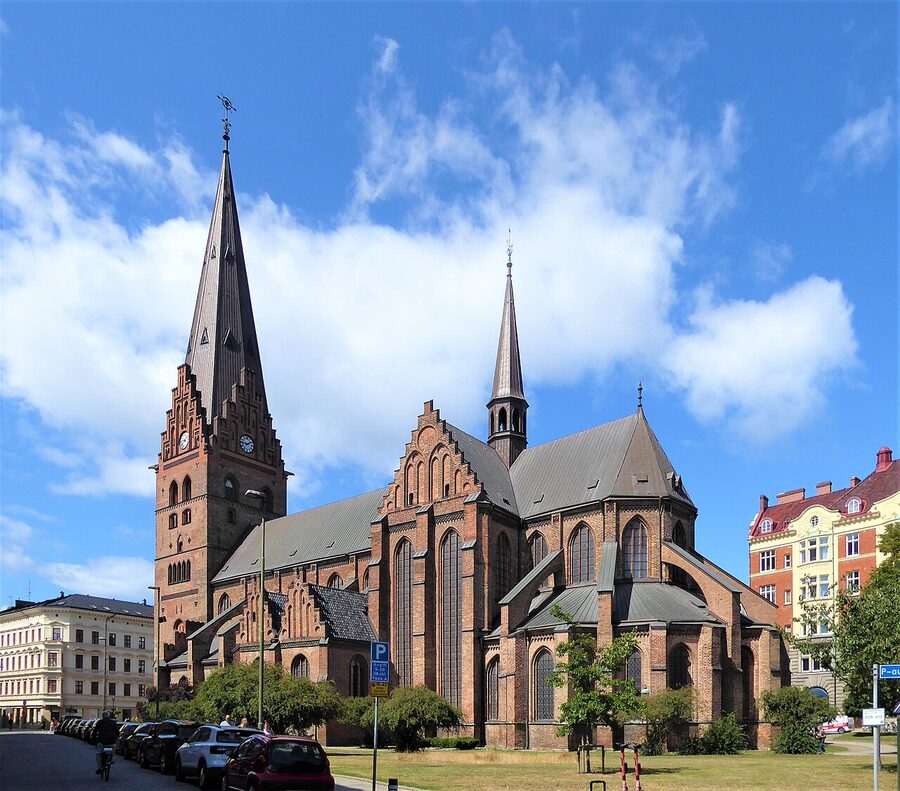
Sankt Petri is the city’s oldest building. The west tower started going up in 1346, the nave was finished about a century later. It’s Brick Gothic in the Hanseatic League style, which makes it a sister to the cathedrals of Lübeck and Stralsund and a cousin to St Mary’s in Rostock. If you’ve been around the southern Baltic, you’ll recognise the type. If you haven’t, this is a primer.
Inside, look for the Krämare chapel on the north side, painted with 15th-century murals that survived the Reformation when most of the church got whitewashed in 1554. The pulpit is 1599. The high altar reredos, fully gilded and four storeys tall, is from 1611. Free entry. Open daily 10:00 to 18:00 in summer, shorter hours in winter.
If you only enter one Malmö building, this is the one.
Malmöhus Slott and the Slottsträdgården
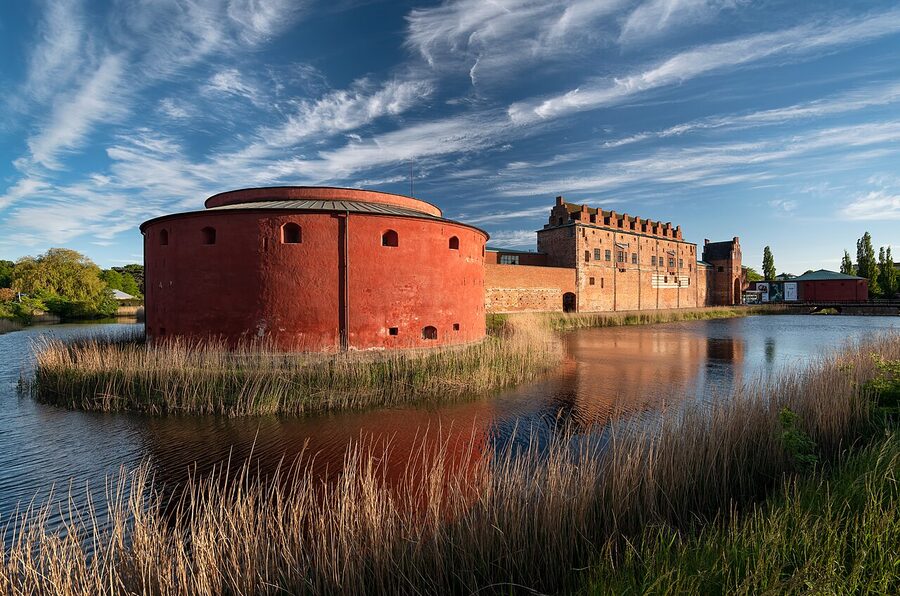
Malmöhus is the oldest preserved Renaissance castle in the Nordics, and also the squattest, dampest, least-photogenic castle on the entire Baltic. It looks like a fortress because it is one. Erik of Pomerania built the first version in 1434 to control the herring trade in the strait. Christian III rebuilt it in red brick in 1530. It served as a Danish royal residence and then as a Swedish prison from 1828 to 1909.
The buildings now house the Malmö Museum, a single-ticket aggregation of city history, art, natural history, and an aquarium. 100 SEK adults, 50 SEK students, free under 20. Open daily 10:00 to 17:00. The natural history wing is full of stuffed Skåne fauna and is the part you can confidently skip. The art collection, on the second floor of the main castle, has a strong selection of Skåne painters from 1880 to 1940 and is good for an hour. The medieval cellars under the castle are the most interesting bit and easiest to miss.
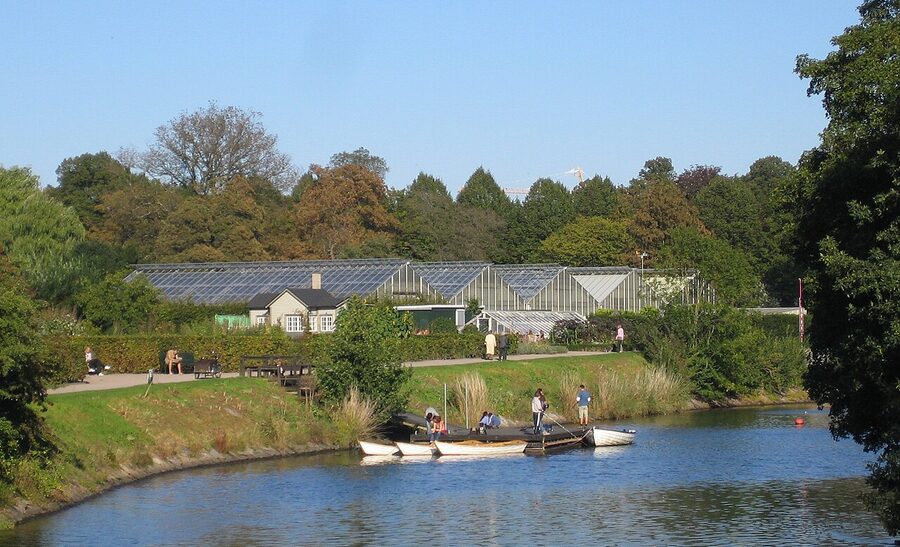
What you should actually do at Malmöhus: walk the moat path, ignore the museum unless it’s raining, and keep walking west to the Slottsträdgården. This is the city’s working garden, with vegetable beds, fruit trees, a herb maze, beehives, and a glass-roofed café in the centre that does the best fika lunch in central Malmö. Slottsträdgården is free and open dawn to dusk, and an hour here is more useful than ninety minutes inside the castle.
Continue west and you flow into Kungsparken, the city’s oldest formal park, laid out in 1872. South of Kungsparken is the smaller, prettier Slottsparken with its windmill (an actual 1851 functioning Dutch-style windmill, transplanted from a Skåne village in 1925). South of Slottsparken is Pildammsparken, the largest, with the man-made Pildamm lake and the open-air summer theatre. The four parks together make a green corridor running diagonally across the south-west of the city. You can walk the lot in 90 minutes, and on a sunny Sunday in May or September it’s the best part of Malmö.
Västra Hamnen, the Western Harbour, and the Turning Torso
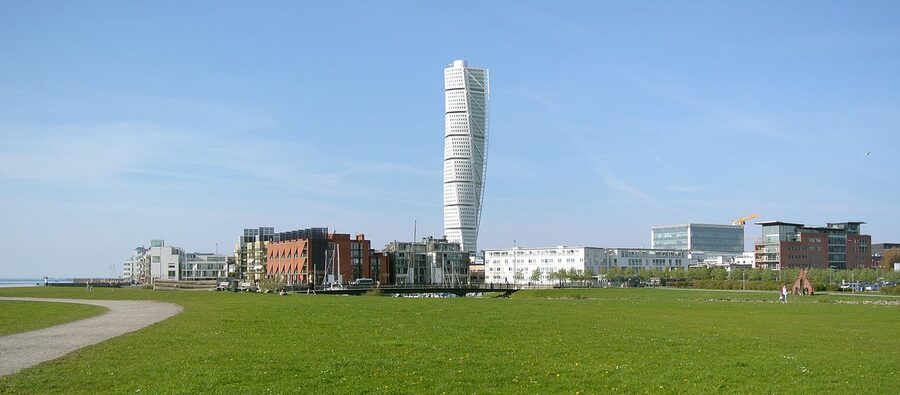
If Stortorget is medieval Malmö and Möllan is immigrant Malmö, Västra Hamnen is the city Malmö decided to be in 1996. That’s the year the Kockums shipyard finally closed for good, after a slow decade of redundancies that began in 1986 and saw the workforce shrink from 6,500 to under 200. The Stockholm-Helsinki ferries Silja Symphony and Mariella were the last big things built here. The yellow Kockums crane that defined the skyline for thirty years was sold to Hyundai in 2002 and shipped to Ulsan, where it’s still in use.
What replaced it: a sustainable-housing experiment called Bo01, opened as a European housing exhibition in 2001 and never demolished afterwards. The brief was to build a residential district that ran on 100 per cent local renewable energy, and the architects who got the commissions all came up with different answers. The streets are narrow on purpose, to break the wind off the strait. The buildings vary from 4 to 9 storeys, no two alike. The waterfront is a 1.7 km wooden boardwalk with built-in swimming ladders straight into the strait. There’s a tidal swimming bay in front of the Scaniaplatsen, where on a 24-degree July day every twentysomething in Malmö is in the water by 17:00.
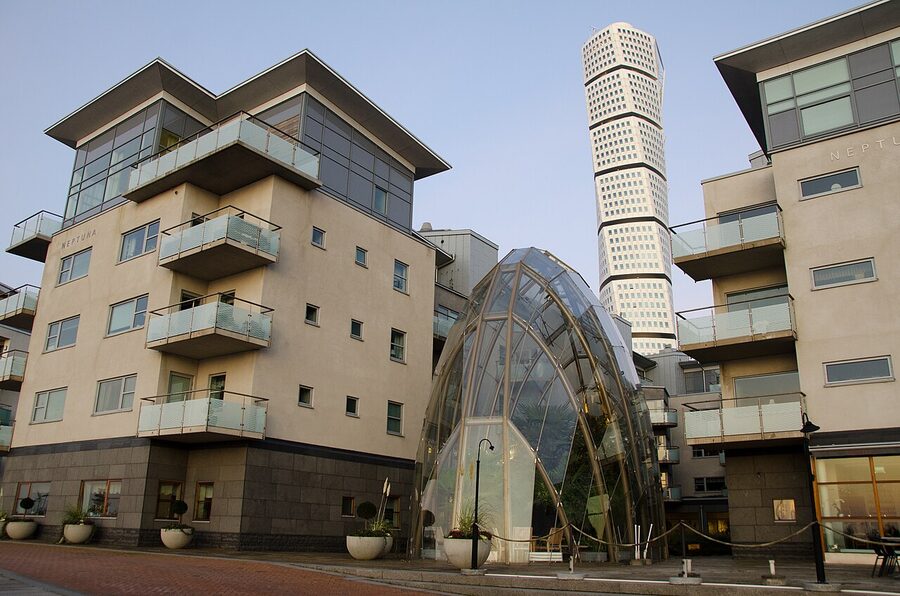
And presiding over all of it: the Turning Torso. Calatrava, 2005, 190 metres, 54 floors, 90 degrees of twist. The base is a square. The top is a square rotated 90 degrees. Each floor is rotated 1.6 degrees from the one below. It’s a residential building, mostly one and two-bedroom flats, plus a hotel on floors 51 to 53 that closed permanently in 2018 and has not reopened. There is no public observation deck. You cannot go up. The owner association is famously protective and the building is alarmed.
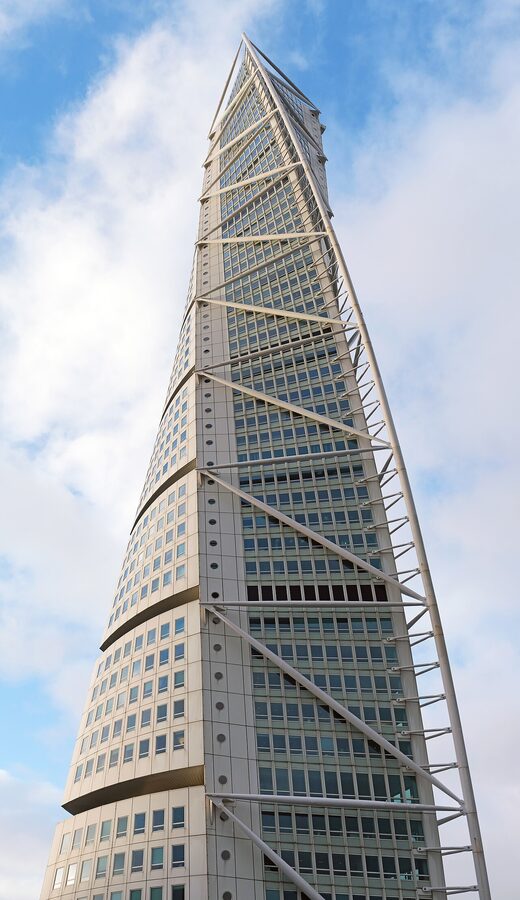
What you can do: photograph it. Walk around it. Drink coffee at the café at the base, which is open to the public and has a perfectly fine ground-level view straight up the spiral. The best photo angle is from Daniaparken, the small park 200 metres south, at sunset when the building catches the orange off the strait. The second-best angle is from the Ribersborg beach, a kilometre east, at blue hour when the windows light up.
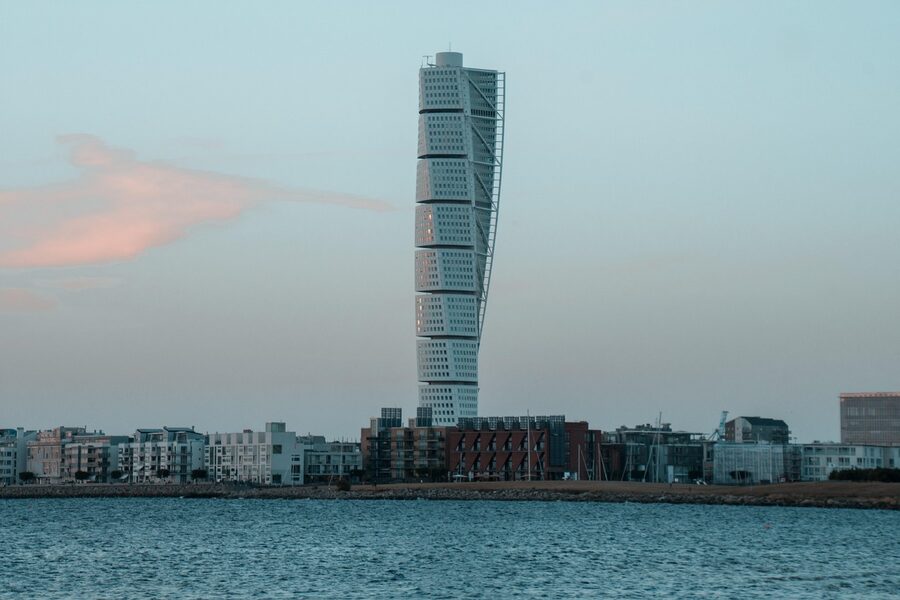
Verdict on Västra Hamnen: it’s the most photographed corner of Malmö, deservedly. Walk the whole boardwalk from the Turning Torso south past the Skanörsbron bridge to the Daniaparken-Sundspromenaden junction, then continue south along the strait to Ribersborg. The full walk is 4 km and takes 90 minutes with stops. There’s a bus (Linje 2) that runs from Malmö C to Västra Hamnen every 8 minutes if you want to skip the walk in.
Ribersborgs Kallbadhus, the bath in the strait
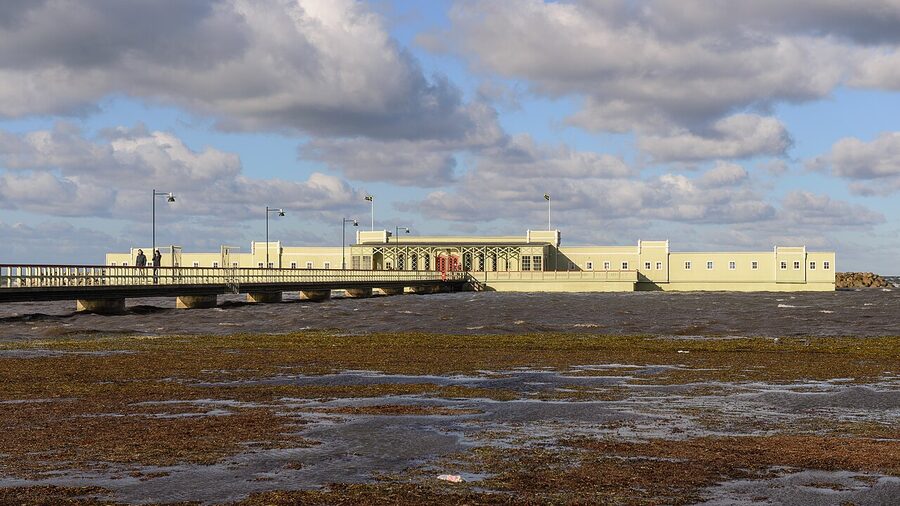
Ribersborgs Kallbadhus is the bath that built the bath culture Copenhagen has been borrowing from for fifteen years. Original bathhouse 1898, rebuilt 1960 after a 1957 fire, run as a non-profit since 2010. Wooden pier 200 metres long. Two outdoor cold-water swim pools at the end, one for women and one for men. Two sauna chambers with views over the strait toward Copenhagen. A small café. Naked bathing on the gendered-pool side. There is no mixed-gender section. (The Vejlepool harbour pool in Copenhagen is technically more accommodating; Ribersborg is the older, stricter, more correct version.)
Cost: 100 SEK for adults on a weekday, 130 SEK on weekends. 75 SEK student. Bring a towel; rentals are 50 SEK. Bring soap; the showers are spartan. Open year-round, but the magic is in winter when you alternate the 80°C wood-fired sauna with a 4°C strait swim and feel things you didn’t know you could feel.
What to know:
- The walk from Malmö C is 30 minutes along the canal and through Pildammsparken, or 12 minutes on the Linje 2 bus to the Limhamnsvägen stop.
- It gets busy from 16:00 onwards on weekdays, and from 11:00 on weekends. The local move is 19:00 on a weeknight.
- You can get coffee and cinnamon buns at the café on the pier without paying the bath ticket; just walk to the end of the pier and back.
- Bring a robe or oversized towel for the walk between sauna and pool. The wooden boardwalk is cold under bare feet.
- The strait water in February is around 3 to 4°C. In August it climbs to 19°C. Locals will tell you the winter version is better. They are correct.
If you only do one local thing in Malmö, and you have to choose between Ribersborg and the Turning Torso photograph, choose Ribersborg.
Möllevång and the Möllan food scene
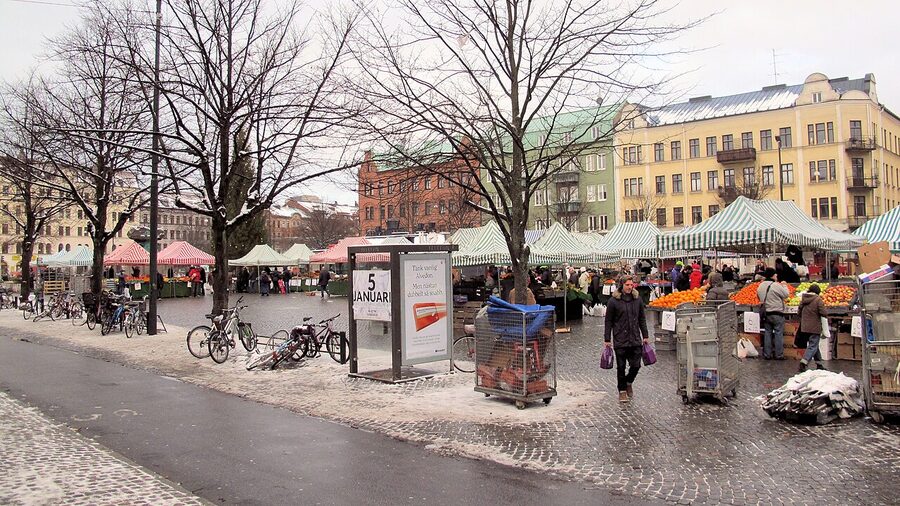
Möllevångstorget, “Möllan” to anyone from Malmö, is the square ten minutes south of Triangeln station that holds the city’s outdoor market every weekday from about 10:00 to 17:00, plus a Saturday version that runs longer and pulls in more stalls. It’s an open-air mix of vegetables from Skåne farms, herbs from Lebanese importers, fish from Limhamn, and Bosnian bakers selling burek by the kilo.
The square’s surrounding streets, Bergsgatan, Spångatan, Friisgatan, and Claesgatan, hold what is plausibly the best concentration of Middle Eastern food in Scandinavia. The community formed in the 1970s and 1980s with arrivals from Lebanon, Iraq, and the former Yugoslavia, and stabilised through the 1990s with Bosnian and Iranian additions. The food it produces is genuinely excellent, properly cheap by Nordic standards, and almost completely absent from English-language Malmö coverage.

Where to actually eat:
- Möllan Falafel at Bergsgatan 41 is what most locals will name first if you ask. Open since 1990. Falafel rulle (wrap) for 65 SEK. The chickpea-pea ratio is roughly 70-30, fried hot, served in a thin Lebanese pita with cabbage, cucumber, pickled turnips, and a vinegar-thinned tahini.
- Falafel No 1 at Friisgatan 5 is the other consensus pick. Slightly bigger pita, slightly more onion, claims to have the original 1980s recipe. Both are correct. Both are under 70 SEK.
- Badrans Super Falafel at Bergsgatan 21 is the version Danny Maiorca wrote up for a CPH audience and it’s good but it’s also the one tourists know. The line at 13:00 on a Saturday is the tell.
- Jalla Jalla at Bergsgatan 20 isn’t falafel, it’s Lebanese mezze, and it’s where I’d actually take someone for a proper sit-down meal in Möllan. Tabbouleh, fattoush, kibbeh nayyeh, the works. Two people eat well for 350 SEK (~€32).
- Saluhall i Möllan on Möllevångstorget itself is the indoor food hall in the converted 1904 market building. Multiple counters, no reservations, sit-where-you-can. The fish counter and the Bosnian burek counter are the standouts.

One warning: Möllan has a reputation for being a slightly rougher area than the rest of central Malmö. It is. The reputation is mostly a product of the same Swedish-tabloid framing that Copenhagen’s Nørrebro went through ten years ago, and the actual experience for a visitor in daylight is fine. After 23:00 it’s worth being aware of your surroundings, the same way you’d be in any post-industrial neighbourhood in any European city.
Folkets Park, on the way back
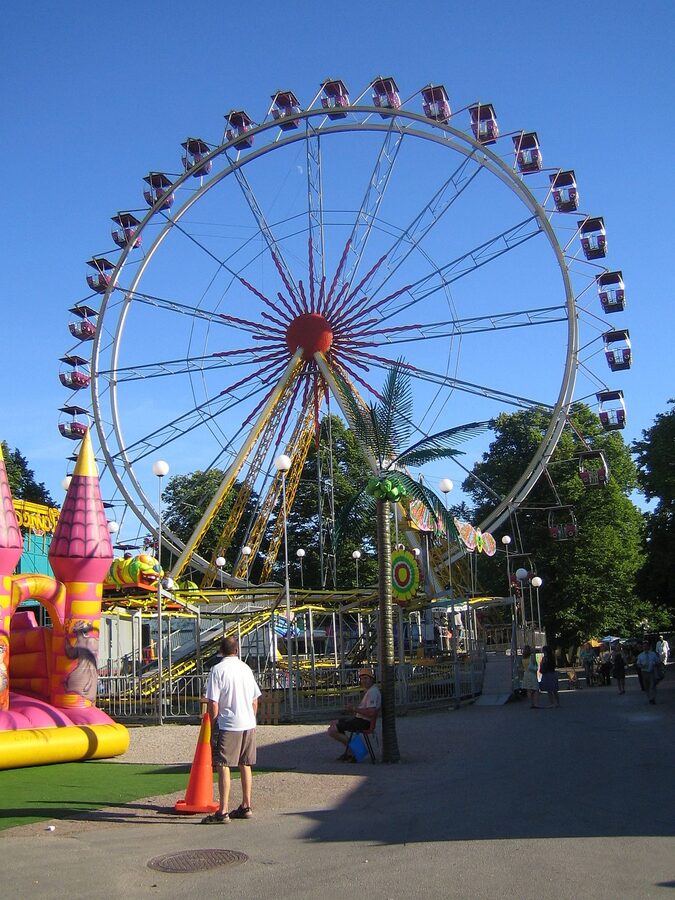
Folkets Park sits between Möllan and Möllevångstorget station, eight minutes’ walk from each. It opened in 1891 as Sweden’s first “people’s park”, a labour-movement gift to working-class Malmö, and it’s been free to enter ever since. The ferris wheel and the carousel still run. There’s a small reptile house. There’s a plant terrarium called Far i Hatten that doubles as the park café. There’s a beer garden in summer. There’s a flea market on Sunday mornings.
It’s not a destination. It’s a 30-minute pause between the falafel lunch on Bergsgatan and whatever you’re doing next. Bring a book. Sit by the carp pond. Watch the kids on the carousel. This is what Malmö feels like at street level when you stop trying to see things and start being in the city.
The Skåne hinterland: four day-trips that justify staying in Malmö
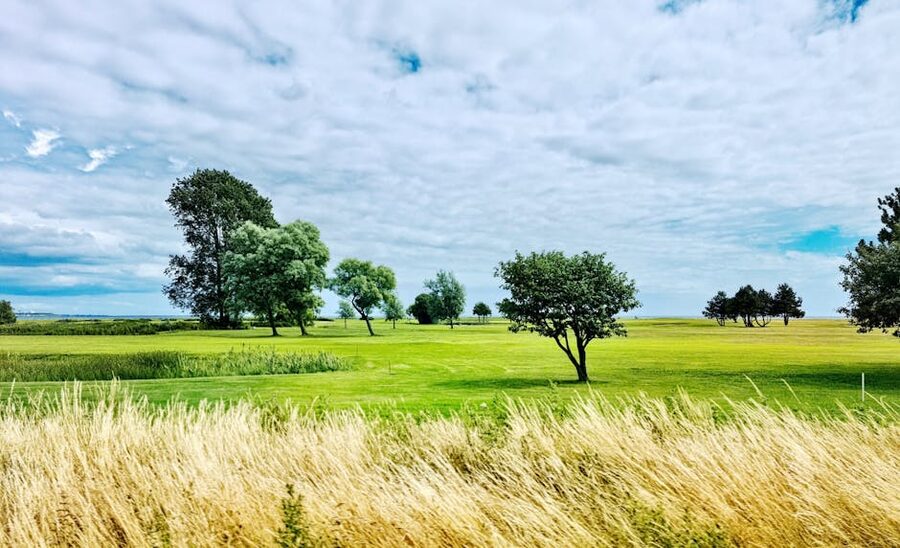
This is the part the Copenhagen-day-trip framing misses entirely. From a Malmö base, the rest of Skåne opens up. From a Copenhagen base, it doesn’t. Four trips worth doing in order of how easy they are.
Lund, 11 minutes by Pågatåg
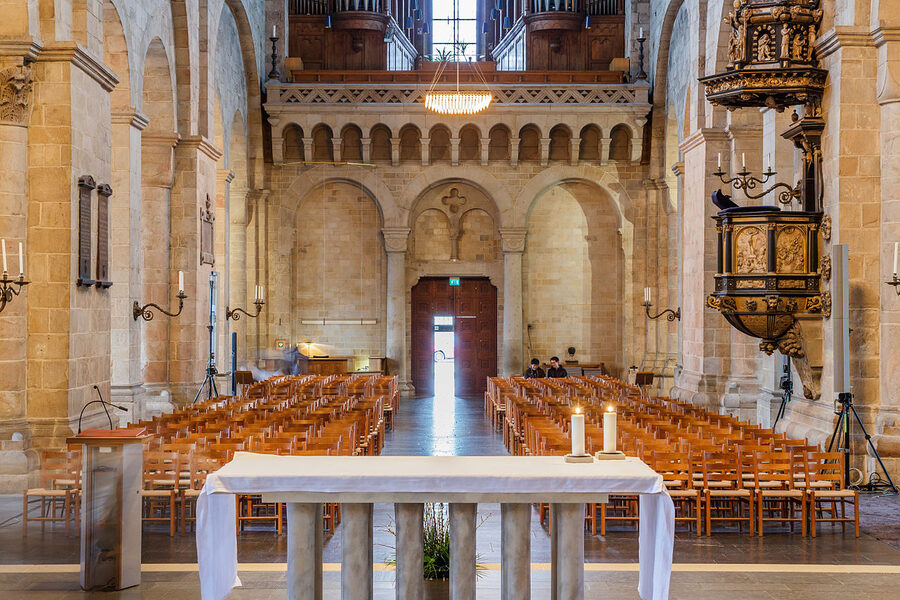
Lund is 18 km from Malmö C and the Pågatåg takes 11 minutes, every 10 minutes from 06:00 to midnight. 47 SEK single. From Lund station the cathedral is six minutes’ walk straight up Bangatan and Kyrkogatan. You will see students. Lund University has 40,000 of them and a city population of 92,000, so the ratio is conspicuous.
The cathedral was consecrated on 1 September 1145 and is the most complete Romanesque sandstone cathedral in Scandinavia. The nave columns are massive, the carving on the choir stalls is 14th-century original, and the astronomical clock at the western end of the south transept plays its full performance at noon and 15:00 every day except Sunday morning. The crypt under the choir is the surprise: 1123, the oldest part of the building, with worn stone steps and a thousand years of prayer hanging in the air. Free entry. The clock performance is the bit tour groups optimise for, the crypt is the bit they miss.
Beyond the cathedral, Lund’s open-air folk museum Kulturen is excellent, the botanical garden is free and has a Mediterranean greenhouse, and the historic city core around Stortorget is small enough to walk in 30 minutes. A four-hour Lund day trip from Malmö is about right. Lunch at Hotel Concordia‘s ground-floor café if you want to push it to a half-day.
Trelleborg, 30 minutes south
Trelleborg is Sweden’s southernmost town, 30 km from Malmö, 30 minutes on the 145 bus or 35 minutes by Pågatåg. It’s not a tourist destination. It is where the ferries from Travemünde, Rostock, and Sassnitz dock, which means Trelleborg is most CPH-Malmö visitors’ idea of a Swedish industrial port and most CPH-Malmö visitors are wrong about that. The reconstructed Viking-era ring fortress of Trelleborgen, opened to visitors in 1996 after archaeologists pulled the original 980 AD palisade out of the silt, is genuinely worth two hours.
The town itself has a small Old Town section, a 1907 Jugendstil town hall, and the southernmost lighthouse in Sweden at Smygehuk just to the west. If you want to say you’ve stood at the southernmost point of Sweden, Smygehuk is where you do it. It’s 6 km west of Trelleborg and there’s a 195 bus that runs every two hours.
Helsingborg, 33 minutes north
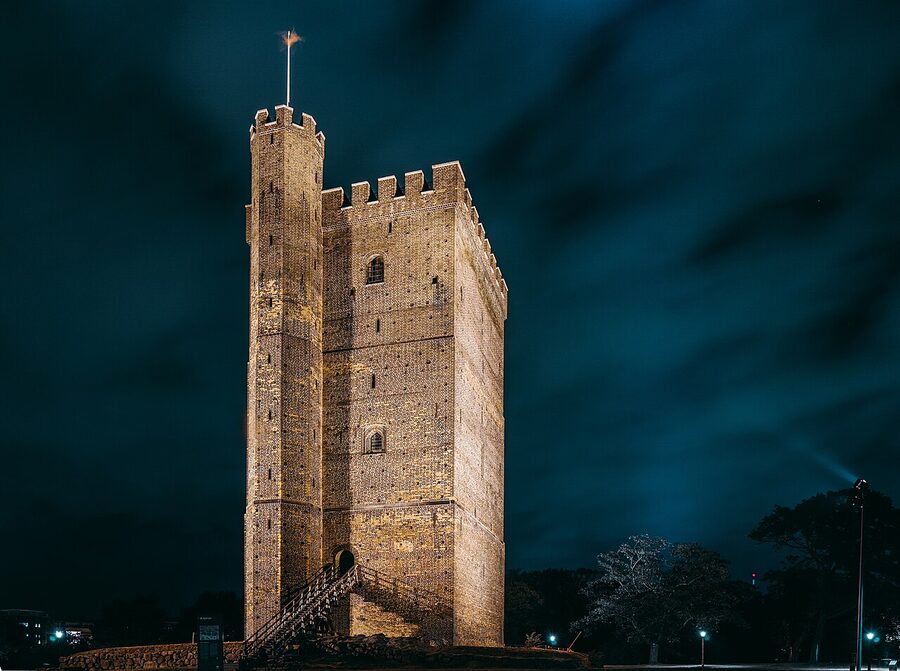
Helsingborg is 65 km north on the Öresundståg, 33 minutes, 90 SEK single. It’s a real city, population 110,000, and was Skåne’s most contested town through the medieval and early modern period because it controls the narrowest point of the strait, only 4 km wide. The 35-metre Kärnan keep at the top of the town is what survives of the Danish fortress that fell to Sweden in 1658. The view from the top of Kärnan goes straight across the water to Kronborg in Helsingør, the castle Hamlet was set in.
The HH Ferries from Helsingborg to Helsingør run every 15 minutes, 24 hours a day, take 20 minutes, and cost 60 SEK pedestrian. So if you’re feeling completionist, take the train Malmö-Helsingborg, walk up to Kärnan, take the ferry to Helsingør, walk to Kronborg, walk back, take the ferry back, take the train back. It’s a lot, but it’s a real day, and you’ll have seen both ends of the Øresund.
Ystad, 50 minutes south-east
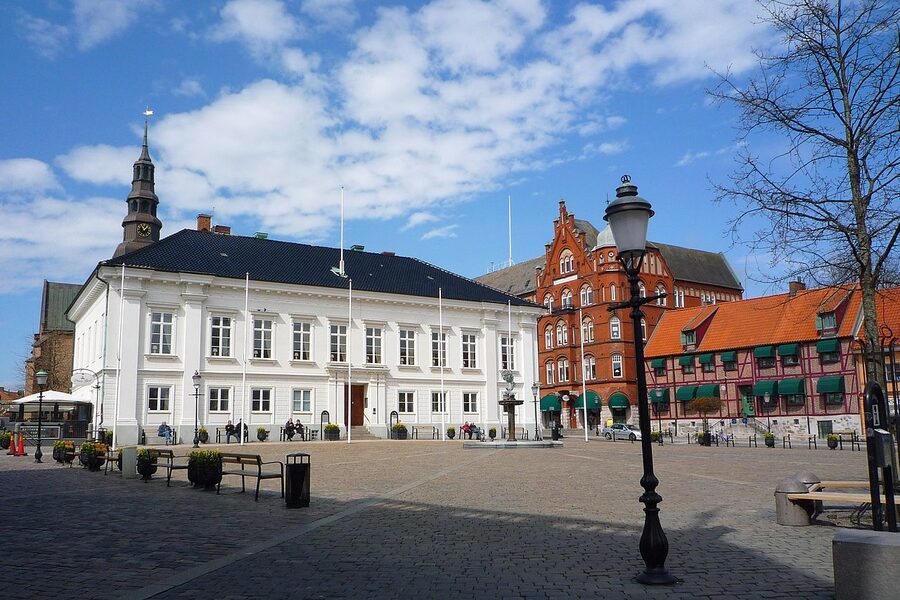
Ystad is 65 km south-east of Malmö on the Pågatåg, 50 minutes, 90 SEK single. The Old Town has 300 surviving half-timbered houses from the 1500s and 1600s, and a continuous night-watchman tradition where a horn is sounded from the Sankta Maria church tower every quarter-hour from 21:15 to 01:00. They do not skip nights. They have not skipped nights since the 17th century.
For most travellers what brings them to Ystad is Henning Mankell. The Wallander novels are set here, and the BBC and Swedish TV adaptations filmed in town, with Mariagatan and the police station being the obvious pilgrimage points. There’s a Wallander walking trail with a leaflet you can pick up free at the tourist office. If you’ve never read Mankell, the town is still excellent on its own terms. Stop at Bagaren och Kocken on Stortorget for the saffranspannkaka with whipped cream, a Skåne speciality found basically nowhere else in Sweden.
Where to eat beyond falafel
Malmö has a real restaurant scene that has been quietly catching up to Copenhagen’s for ten years. A short list:
- Bord 13 on Stora Nygatan is the city’s serious tasting-menu restaurant, six courses for 950 SEK (~€87), Skåne ingredients, no formality, no white tablecloths. Book a month ahead for Saturday, two weeks for a weeknight.
- Salt och Brygga on Sundspromenaden in Västra Hamnen does the most consistent harbour-side seafood meal in the city. Lunch around 250 SEK, dinner mains 280 to 350. Reserve for evening; walk-in works at lunch.
- B.A.R. on Stortorget is the easy-pleasing Italian-Swedish midsized dinner option for nights you don’t want a project. Pasta around 220 SEK. Open until 23:00.
- 400 Grader at Larochegatan 14, woodfired Neapolitan pizza, 18 to 24 SEK margin over a Copenhagen equivalent, queue at 19:30 on a Friday. Worth the queue. Same prices, better dough, less fuss.
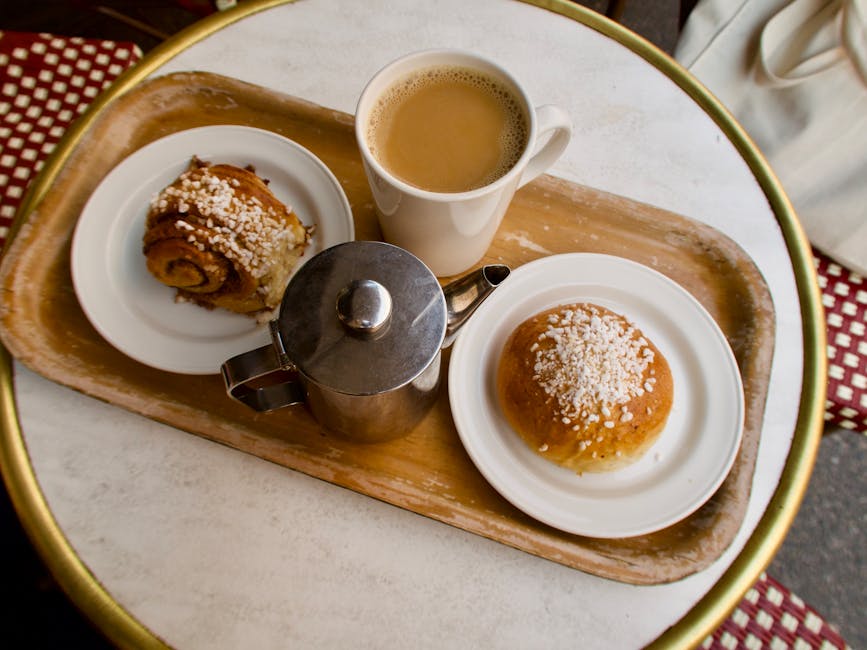
- Café Söderberg & Sara at Mäster Johansgatan 8 (Gamla Väster) and Davidshallsgatan 7 (the second branch) is the city’s best bakery and the answer to where the saffron-glazed cardamom bun is best. 38 SEK a bun. Sit-in or takeaway. The coffee is genuinely good. Open from 07:30 most days.
- Lilla Kafferosteriet on Baltzarsgatan is for serious coffee. Single-origin pour-overs, the roastery is in the basement. 45 SEK a cup, no frills.
- Saluhall i Möllan for the cheap and varied lunch pick-and-mix. Mentioned above. The fish-and-chips counter is unexpectedly good.
One warning, with apologies to its tourist clientele: I’d skip the entire ring of restaurants around Lilla Torg. They’re not bad. They’re charging Stockholm prices for Skåne ingredients in a square that gets photographed for Instagram and they know it. If you want the half-timbered-square experience, sit there with a beer and pay for the beer and the view, then walk three minutes and eat somewhere with a chef in the kitchen.
Where to stay, with verified Booking.com links
The hotel decision frame in Malmö comes down to four areas:
- Around Malmö C if you want to walk to everything in the Old Town and Western Harbour without a tram pass.
- Triangeln if you want to be on the doorstep of Möllevång and the food scene.
- Hyllie if you’re driving in from the airport or staying at the Malmö Arena for an event.
- Västra Hamnen if you want a sea view and don’t mind being a 20-minute walk from the centre.
Specific picks, all slugs verified:
- Story Hotel Studio Malmö on Tyfongatan 1 in Västra Hamnen is a small design-led hotel directly under the Turning Torso. Rooms small but clever, 1,800-2,200 SEK a night midweek. The location is the appeal: you can walk five minutes to the boardwalk, twelve to the cold-water bath, twenty to Lilla Torg.
- Mayfair Hotel Tunneln on Adelgatan 4 is the city’s quirky boutique pick, in a 14th-century cellar building two minutes from Stortorget. Rooms are not large. The vaulted breakfast room is the draw. 1,500-2,000 SEK midweek. Best location of any hotel I’d recommend.
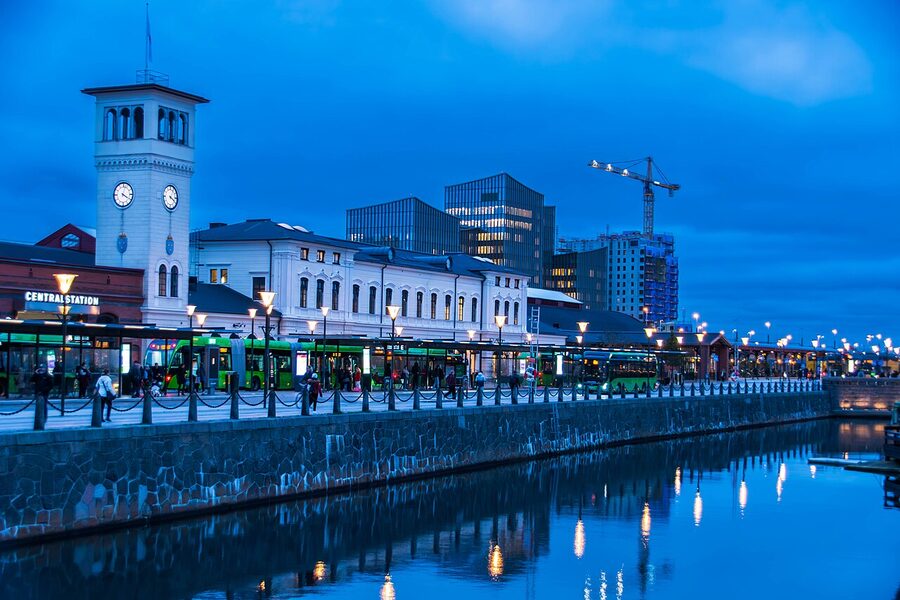
- Clarion Hotel Malmö Live at Dag Hammarskjölds Torg is the big modern conference hotel right next to Malmö C, with a rooftop bar on the 24th floor that’s open to non-guests and is one of the better photo angles for the Western Harbour skyline. 1,400-1,800 SEK midweek.
- Scandic Triangeln on Triangeln 2 is the most walkable hotel for the Möllan food scene. Direct entrance from Triangeln station, big chain reliability, decent breakfast, 1,300-1,600 SEK midweek.
- Elite Plaza Hotell Malmö at Gustav Adolfs Torg 49 occupies a 1893 Art Nouveau building that was the city’s first grand hotel. Rooms vary from genuinely lovely to slightly tired. Good choice for a one-night stay where the building matters. 1,200-1,700 SEK midweek.
- Comfort Hotel Malmö at Carlsgatan 10C is the budget option that doesn’t feel budget. Five minutes from the central station on the harbour side. 950-1,200 SEK midweek. Rooms are functional but the location is good.
If you’re extending into Lund for the night, Hotel Concordia on Stålbrogatan 1 is the small classic central pick, 1,400-1,800 SEK midweek, three minutes’ walk from the cathedral.
Practical bits
- Currency. Sweden uses the krona (SEK), Denmark uses the krone (DKK). Most Malmö places take cards including foreign cards without surcharge. Cash is rare and not necessary. The exchange rate is roughly 11.5 SEK to a euro and 1.6 SEK to a Danish krone, both of which mean Sweden is meaningfully cheaper than Denmark on most line items.
- Transport. Skånetrafiken runs every train and bus in southern Sweden, including the bridge crossings. The Skånetrafiken app is the right one to download; tickets are 30 SEK single zone in central Malmö, 119 SEK to or from Copenhagen, 47 SEK to Lund. A 24-hour pass is 80 SEK and earns out at four rides.
- Bikes. Malmö is genuinely bike-friendly, flatter than Stockholm, properly cycled by locals. The Malmö by Bike share scheme costs 80 SEK for a 24-hour pass, app-based unlock, 200+ stations, the bikes are heavy but functional. If you’re doing the full strait walk, get a bike instead.
- Tipping. Not expected. Round up if service was good. 10 per cent is generous. 15 per cent is foreign-tourist behaviour.
- Tax-free shopping. Sweden’s VAT is 25 per cent on most goods and the tax-free refund kicks in for non-EU residents on purchases over 200 SEK. Most central retailers participate in Global Blue. Worth asking at the counter, irrelevant to most readers.
- Best time to come. Malmö is a summer city in the way Stockholm and Copenhagen are summer cities, but it’s also one of the few Nordic cities that genuinely works in shoulder season. Early May to late September is the long version. Late May and early September are the two-week sweet spots: warm enough for the bath, dry enough for the parks, light enough for the late dinners on Lilla Torg, not so packed that everything is booked. December has a small but proper Christmas market on Gustav Adolfs Torg and Stortorget.
- Worth booking ahead. Bord 13. Bath sauna time-slots at Ribersborg on weekends. Ferry crossings if you’re driving. Almost nothing else; even Lilla Torg café tables free up after a 20-minute wait.
- Tours and activities. If you want a guided introduction, the 3-hour Malmö walking tour on GetYourGuide covers the centre and Western Harbour. From Copenhagen, the Copenhagen + Malmö + Lund day tour is the closest packaged version of the day trip I’d otherwise tell you not to take. The Disgusting Food Museum ticket on Klook is the novelty add-on if you want one, and is more interesting than the name suggests.
How Malmö fits in a wider Nordic trip
If you’re using my Copenhagen city guide as the main framework, the Malmö one or two-night extension slots in cleanly. The most natural pattern: three nights in Copenhagen (Saturday-Tuesday), one or two nights in Malmö (Tuesday-Thursday), back to Copenhagen Airport on Thursday afternoon. The bridge takes 37 minutes either way, your big bag fits on the Öresundståg, and you’ve doubled your trip without doubling its complexity.
For travellers chaining the wider region, Malmö is also a useful staging post for the Stockholm extension. There’s a daily X2000 high-speed train from Malmö C to Stockholm C in 4h20m for around 800 SEK. That sets up the natural longer Nordic itinerary: Copenhagen with a Malmö night, train to Stockholm for the three days I’d recommend in the capital, ferry from Stockholm to Helsinki overnight (the Silja and Viking Line crossings are themselves a good thing, see my comparison of Tallink Silja vs Viking Line on the overnight ferry), then up to Lapland or down to the rest of Sweden depending on the season.
Or use Malmö as the Sweden bookend on a Denmark-heavy trip. Aarhus on the Jutland side, smørrebrød lunches in Copenhagen, then Malmö across the bridge, then back to CPH for the flight. Three Nordic capitals’ worth of food and architecture, no rental car, all on trains.
I have used the Øresund crossing both ways enough times to have opinions about the carriages, who eats Möllan falafel ahead of Copenhagen falafel, and who thinks the 17:24 train back to CPH is the wrong train to be on. The right train is the 22:30 the next night, going home to your hotel in Malmö, which by then will feel like a slightly cheaper, slightly Swedisher, slightly less photographed version of the city you flew into.
The first time across the bridge is the trip. The second time is when Malmö becomes a place in its own right. Stay long enough for the second time.



.jpg)


.jpg)


.jpg)