
Finse Station sits at 1,222 metres above sea level. The highest point on the Bergen Line is a little higher still, 1,237 metres, hidden inside the Finse Tunnel that the train slides through a few minutes after leaving the platform. Roald Amundsen trained his Antarctic dogs up here in 1911 before sailing south to beat Scott to the Pole. Robert Falcon Scott trained here too, and lost. Eighty years later, George Lucas drove a Star Wars film crew into the same valley to shoot the ice planet Hoth. None of that explains why people sit on this train, but it tells you something about the place the railway crosses, which is the closest thing mainland Europe has to a polar plateau.
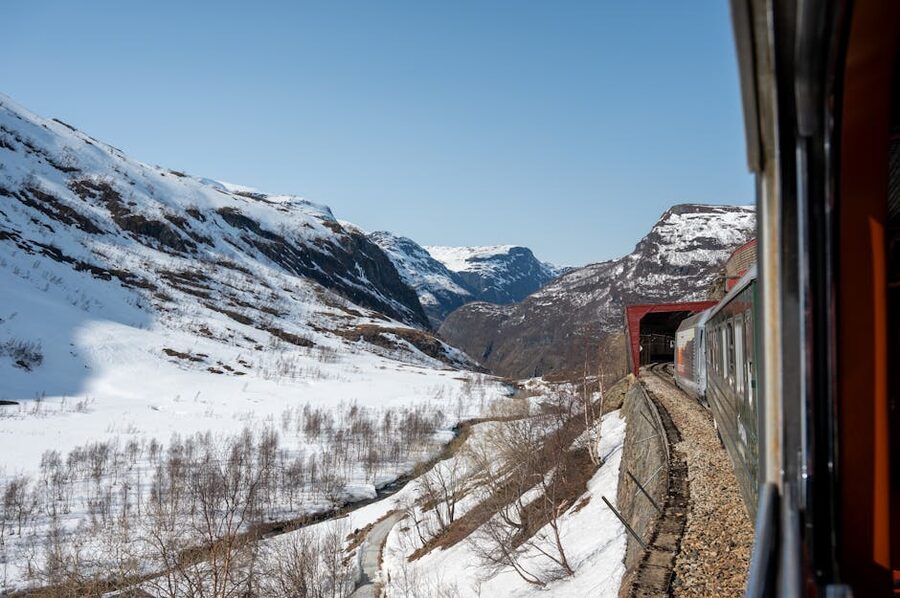
I have done the Oslo to Bergen run three times now. Once mid-summer, when the Hardangervidda is brown and ochre and the small lakes still have ice islands floating on them. Once in late September, when the dwarf birch turns the colour of a struck match. And once in February, when the train spends an hour at a stretch inside snow tunnels and the sound shifts the moment you enter one, like someone has pressed a hand over the carriage. Each run was good. None was the same. This is a guide to deciding which version you want, what you actually pay, where to sit, when the Flåm Railway detour earns its money and when it doesn’t, and why Norway in a Nutshell is mostly a marketing wrapper around tickets you can buy yourself for less.
In This Article
- What the Bergensbanen actually is
- A short history of the line you’re about to ride
- How long it takes and how often it runs
- Day train or night train
- Why I wouldn’t do it as my only crossing
- Which side of the train to sit on
- What you see, hour by hour
- Hour one: Oslo to Hønefoss
- Hour two to three: the Hallingdal
- Hour four: the Hardangervidda crossing
- Hour five: Finse to Myrdal
- Hour six to seven: Myrdal to Bergen
- The Flåm Railway detour: when it’s worth it, when it isn’t
- Norway in a Nutshell: the marketing wrapper you don’t need
- What it costs
- How to book
- When to go
- Mid-summer (June, July, early August)
- Late September to early October
- Mid-winter (January, February, early March)
- Spring (April, May)
- Practical things on board
- Where to stay at each end
- How the Bergensbanen connects to the rest of a Nordic trip
- Worth the time and the money?
What the Bergensbanen actually is
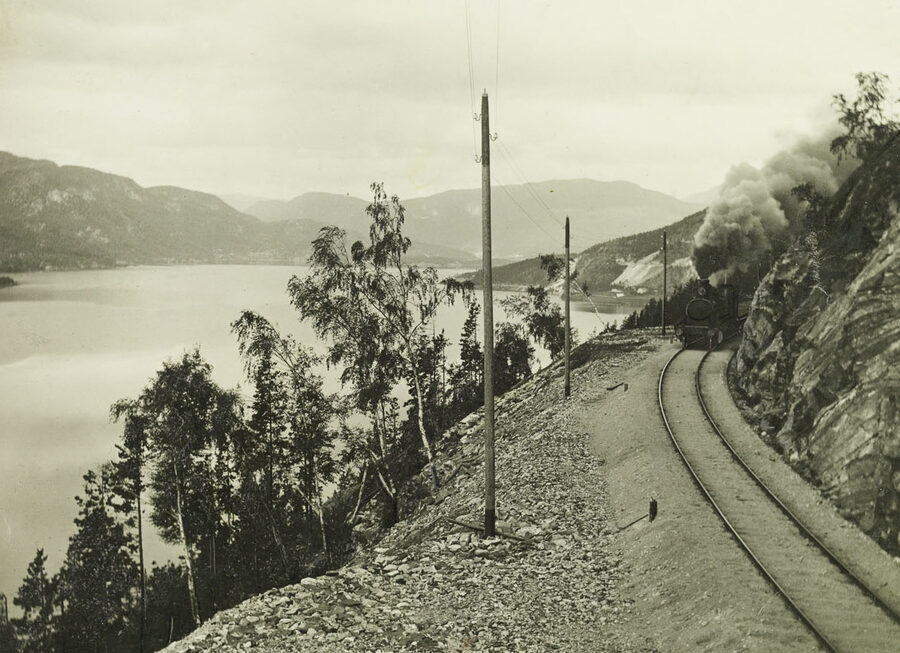
The Bergen Line, Bergensbanen in Norwegian, runs 496 kilometres from Oslo Sentralstasjon (Oslo S) on the east coast to Bergen Station on the west. It opened in 1909 after thirty years of construction by hand, mostly with dynamite, almost entirely above the tree line. King Haakon VII called it the engineering masterpiece of his generation. He was right. 113 tunnels were drilled through the Hardangervidda plateau in the original build, plus dozens more added in the post-1990s upgrades. The longest, Gravehalsen, was the longest tunnel north of the Alps when it opened.
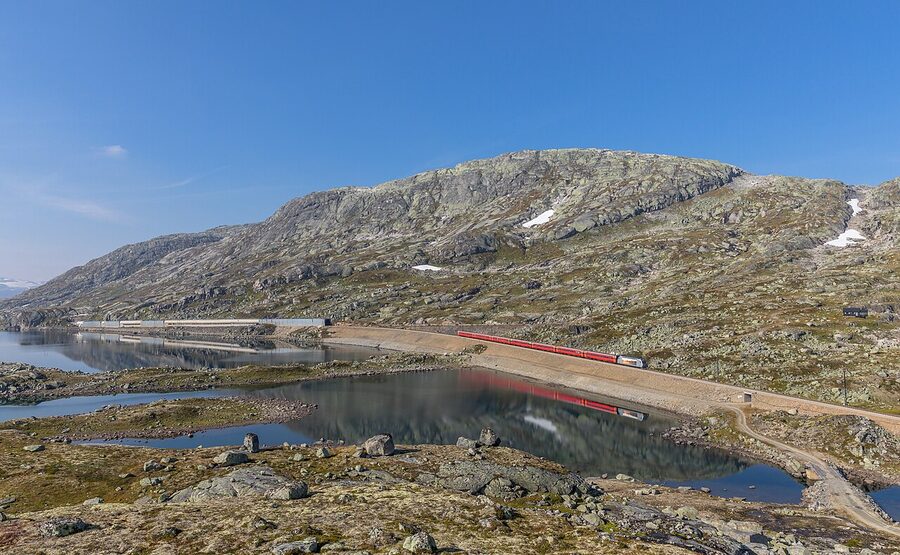
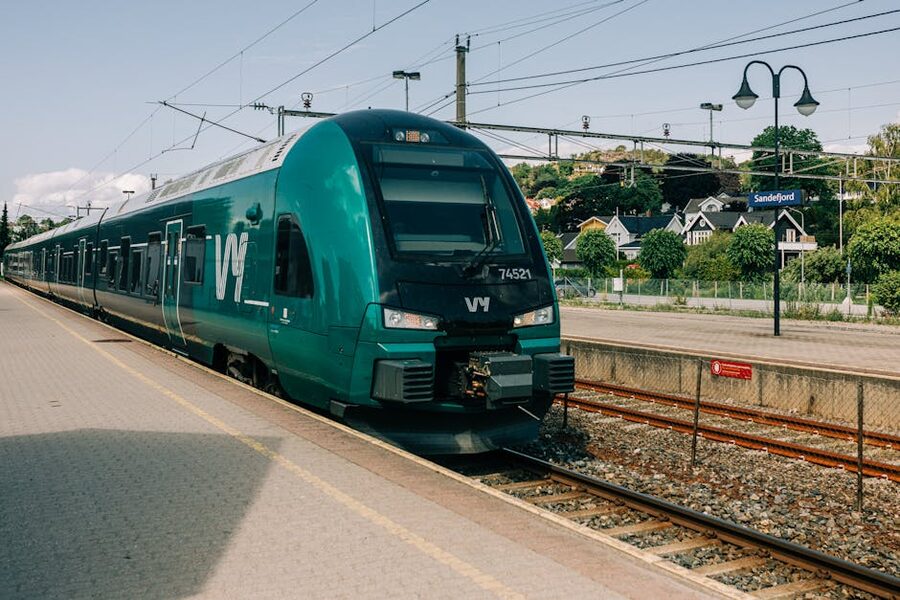
The line is single track and was electrified between 1954 and 1964. Vy, the Norwegian state operator, runs the through-trains today. SJ Nord runs the cross-border Norwegian routes but does not currently operate the Oslo to Bergen service. So the day you ride is a Vy day, on a refurbished Type 73 carriage set hauled by an NSB El 18 electric loco, which is the squat blue and red box you see at the front in the photos.
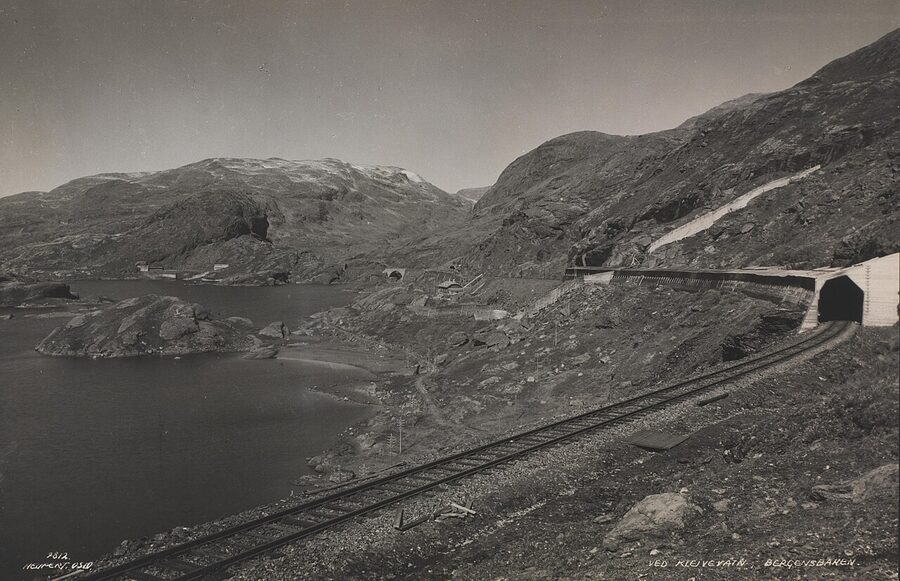
The numbers I keep coming back to: 496 km of track, 182 tunnels in service, 22 stops, one of which (Finse) has no road in or out, and a 6.5 to 7.5-hour run that costs anywhere between 299 NOK (~€26) and 1,498 NOK (~€131) depending on how far ahead you book.
A short history of the line you’re about to ride
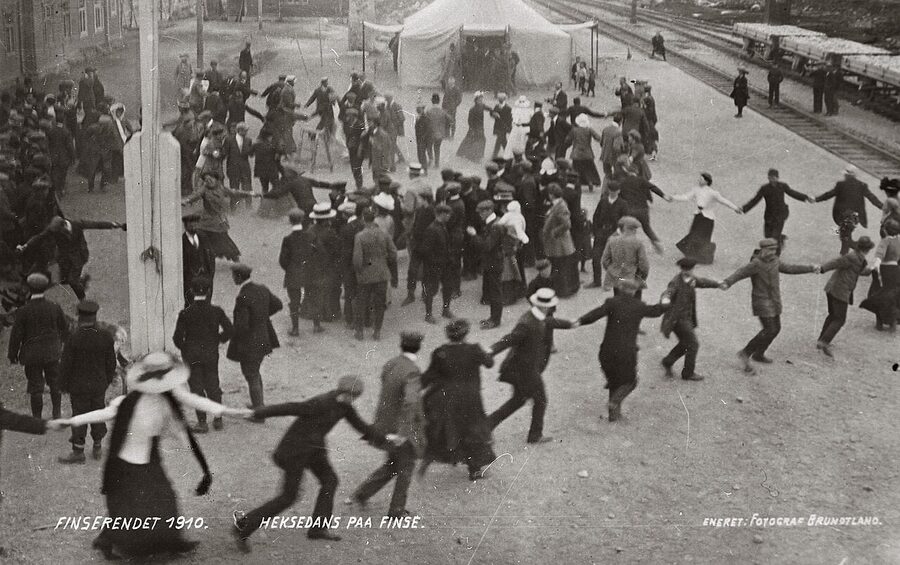
The Bergen Line is older than Norway itself, in a way. The country split from Sweden in 1905. The railway opened on 27 November 1909, opened by King Haakon VII personally, four years into the new monarchy. Construction had taken thirty years. The hardest section, the climb from Voss to Myrdal and the crossing of the Hardangervidda, killed an unrecorded number of the workers (rallar) who blasted the route through with hand drills and dynamite. Their old construction road, the Rallarvegen, still runs alongside parts of the track and is now a popular summer cycling route.
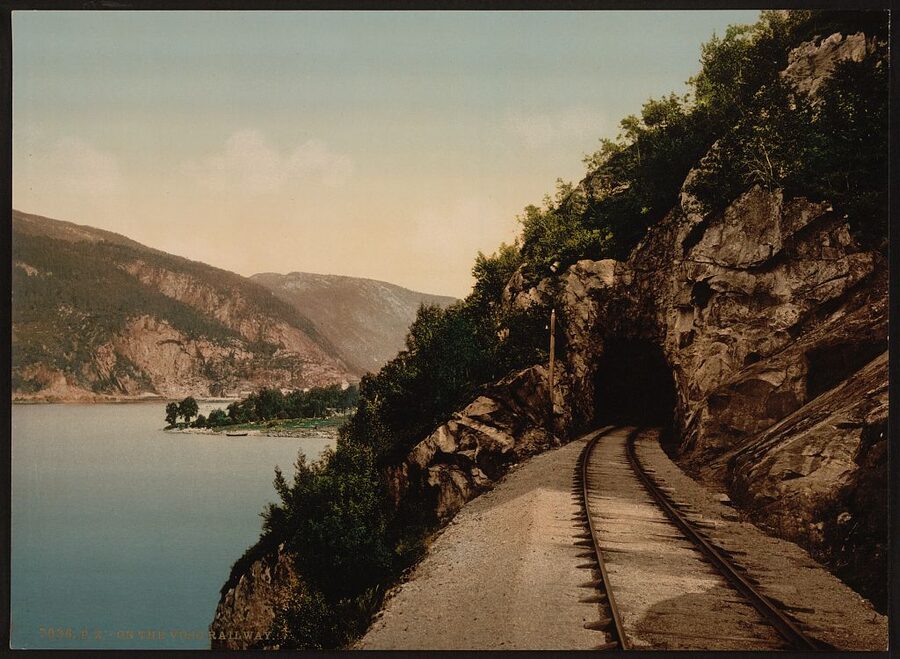
Roald Amundsen used the Hardangervidda as his polar training ground. In the winter of 1910 to 1911 he based his Antarctic team at Finse, training the dogs and trialling sledge equipment in the conditions he expected at the South Pole. The expedition left from Finse and reached the Pole on 14 December 1911. Fridtjof Nansen had used the same plateau for ski training a decade earlier. Sixty-eight years later, the Empire Strikes Back location crew turned up looking for an ice planet. They found Hoth on the snowfields just outside Finse Station and shot the opening sequences in the winter of 1979 to 1980. There is a small Star Wars festival at Finse some years; if it falls on your travel dates it’s a strange thing to coincide with on a Norwegian rail trip.
How long it takes and how often it runs
Four daytime departures, one night train. Times shift slightly with the timetable change in December but the shape stays the same:
- 08:25 from Oslo S, the morning train, the one most travellers want. Arrives Bergen mid-afternoon. Best for first-timers because you cross the Hardangervidda in full daylight even in mid-winter.
- 12:03 from Oslo S, the early-afternoon train. Arrives Bergen evening. In summer this still gives you light over the high section. In November to January, you reach Finse already in dusk.
- 16:25 from Oslo S, afternoon train. Arrives late evening. Worth it only in mid-summer when the days run past 22:00.
- 23:03 from Oslo S, the night train. You arrive Bergen at 06:44 the next morning. You see almost nothing, which is the whole problem with it.
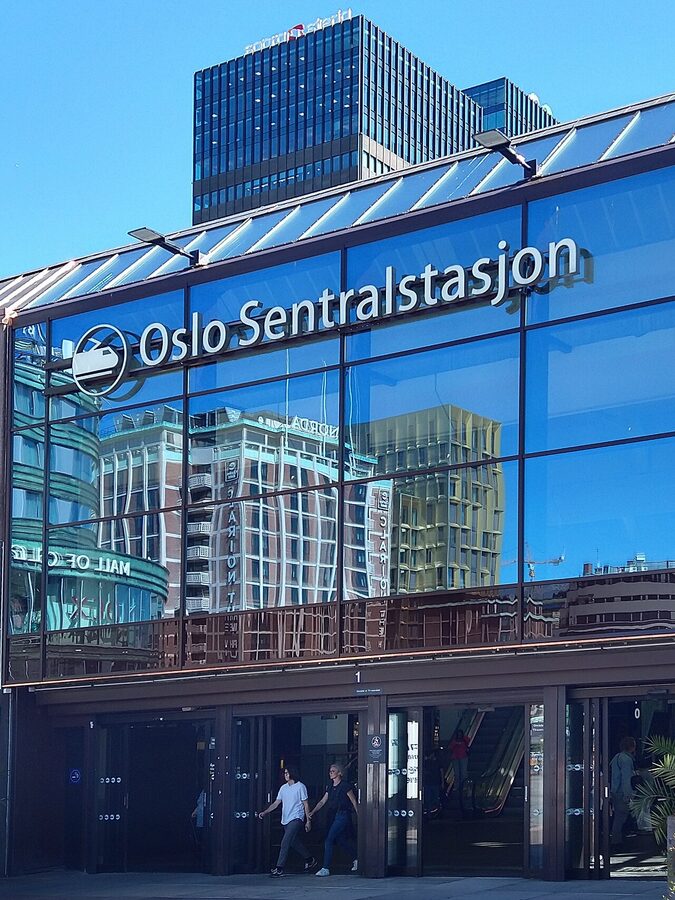
From Bergen the morning departure is 07:58, the second train at 11:59, and so on, mirroring the Oslo schedule. If you are flying in or out of either city, give yourself at least an hour at each end. Bergen Station is a 15-minute walk from the Bryggen waterfront and Bergen Airport is on the FlytogetX bus, 30 minutes south. Oslo S is the central rail station and a 22-minute Flytoget train from Oslo Gardermoen Airport.
Day train or night train
This is not really a debate. Take the day train. The whole point of the Bergensbanen is what’s outside the window, and the night train means you swap a hotel night (Oslo or Bergen at 1,800 NOK to 2,500 NOK, ~€158 to €220) for a flat-bed seat at around 800 NOK (~€70). On paper, that’s clever. In practice you lose the journey and arrive in Bergen at quarter to seven in the morning with your luggage, and Bergen does not really open until 09:00.
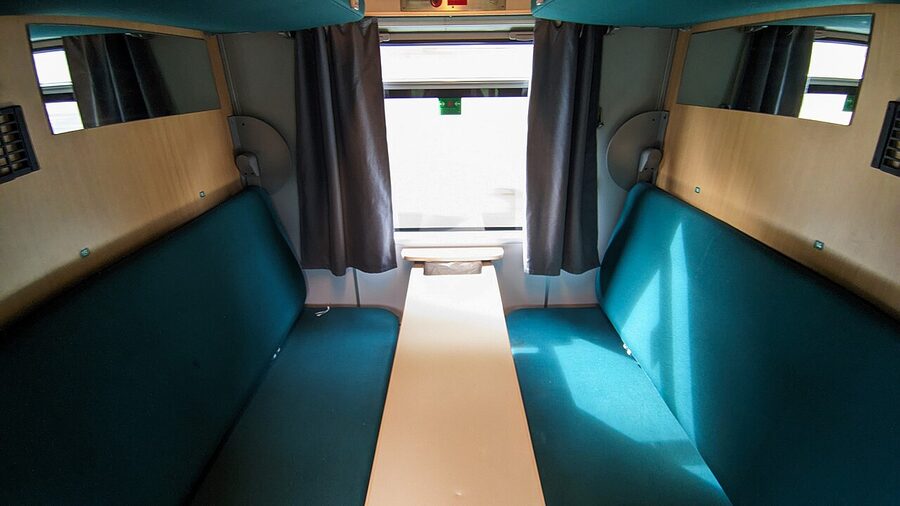
The night train has its uses. If you are tight on holiday days, if Bergen and Oslo are both already booked for full days, if you are a serious sleeper who can drop off in any seat, then yes. Vy sells three night-train fare classes: a standard reclining seat (cheapest), a “PlusNight” lie-flat seat (about 200 NOK extra, my pick if I were doing it), or a two-bed sleeping compartment with sheets and a small bathroom kit (around 1,200 NOK to 1,500 NOK extra per person, sold as a private room). The lie-flat is good. The compartment is comfortable but priced at a level where the maths against a hotel breaks down.
Why I wouldn’t do it as my only crossing
I tried the night train once, eastbound from Bergen, partly out of curiosity and partly because I had a flight out of Oslo at lunchtime. I slept fine. I missed everything. The train rolled past Finse at 02:30 and I half-woke to see a station light pass the window, and that was my entire encounter with the highest mainline station in Northern Europe. If you only do the route once, do it in daylight.
Which side of the train to sit on
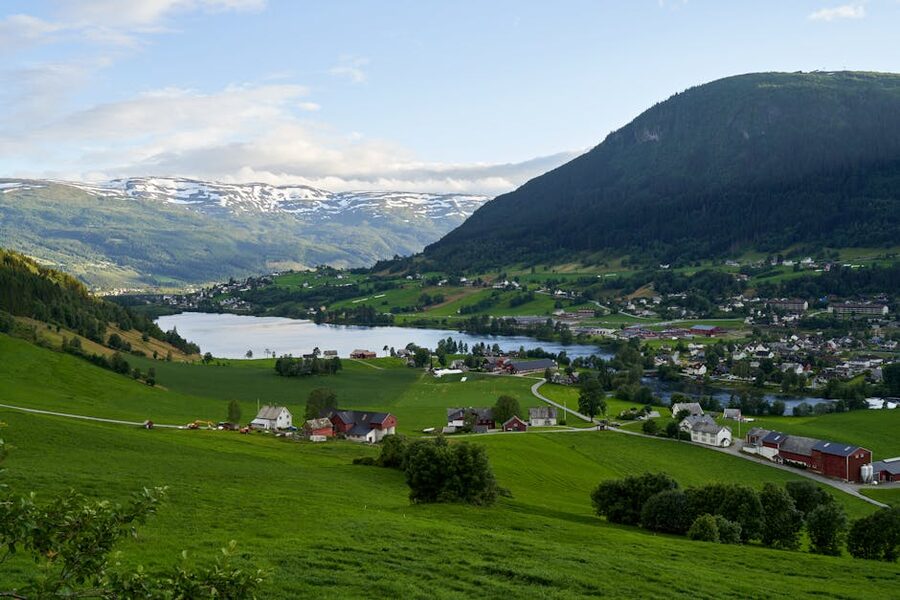
Going west, Oslo to Bergen, the conventional advice is to sit on the right. Going east, Bergen to Oslo, sit on the left. This is what most railway forums tell you. It is mostly true. The right-hand seats westbound get more of the lake views in the first hour out of Oslo, more of the Geilo valley descent, and crucially more of the Voss to Bergen run-in along the lakes.
But the Bergensbanen is not a one-sided ride. The Hardangervidda section between Geilo and Myrdal is treeless plateau on both sides, and for that hour either window works. The Flåm Railway connection at Myrdal is on the south side of the platform, but you’ll be off the train by then anyway if you’re doing the detour. And the train is rarely full enough that you can’t move, especially in the off-peak shoulder seasons. Pick a side, lean towards the front of the carriage so you can see down the track on the bends, and don’t agonise over it.
If you want a guarantee, book seat reservations directly when you buy the ticket on Vy’s website. The seat-map shows the carriage layout and you can pick exactly. Window seats are 11, 21, 31, etc. on one side and 14, 24, 34 on the other. The carriage attendant told me, on my last run, that he tells everyone to sit on the right going west. He has been doing this trip for nineteen years. I’d take his answer.
What you see, hour by hour
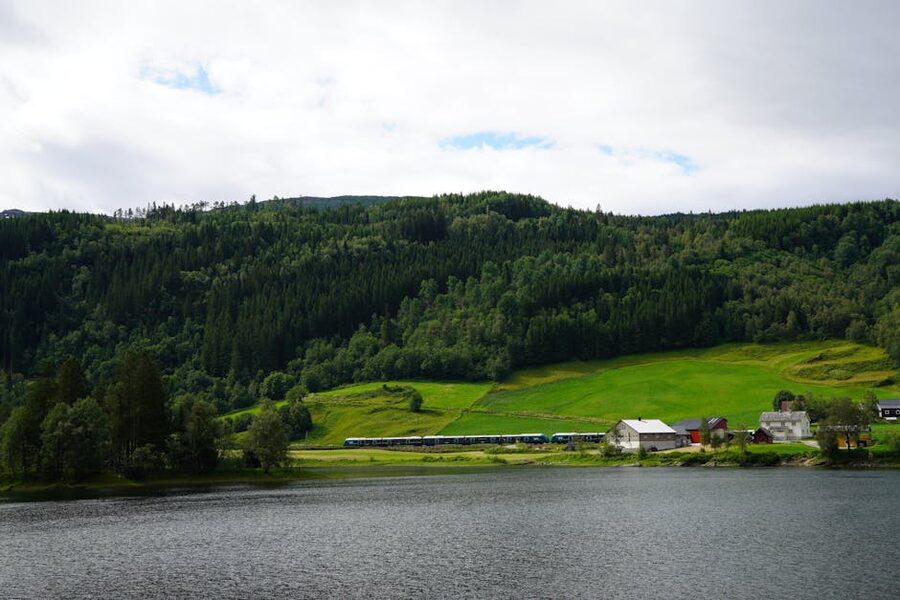
The route divides naturally into five sections, each with its own character. I’ll walk you through it westbound, Oslo to Bergen, because that’s the more common direction for travellers.
Hour one: Oslo to Hønefoss
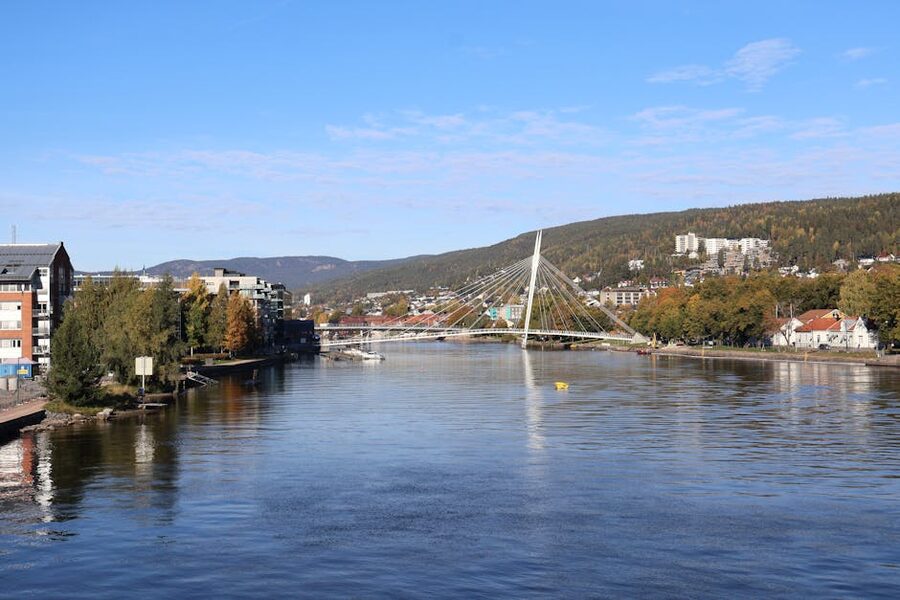
The first thirty minutes are commuter rail. You leave Oslo S, slip through the Oslo Tunnel, and run west along the Drammensfjord through Asker, Sandvika, Drammen. This is suburb and motorway country and you’re not missing anything if you spend it sorting out coffee or your phone. After Drammen the train turns north, climbs along the Drammenselva river, and reaches Hønefoss about ninety minutes in. Hønefoss is a small inland town with a dramatic waterfall right beside the platform. If you’re doing the route at midday in winter, this is when the light is best for photos in the first hour.
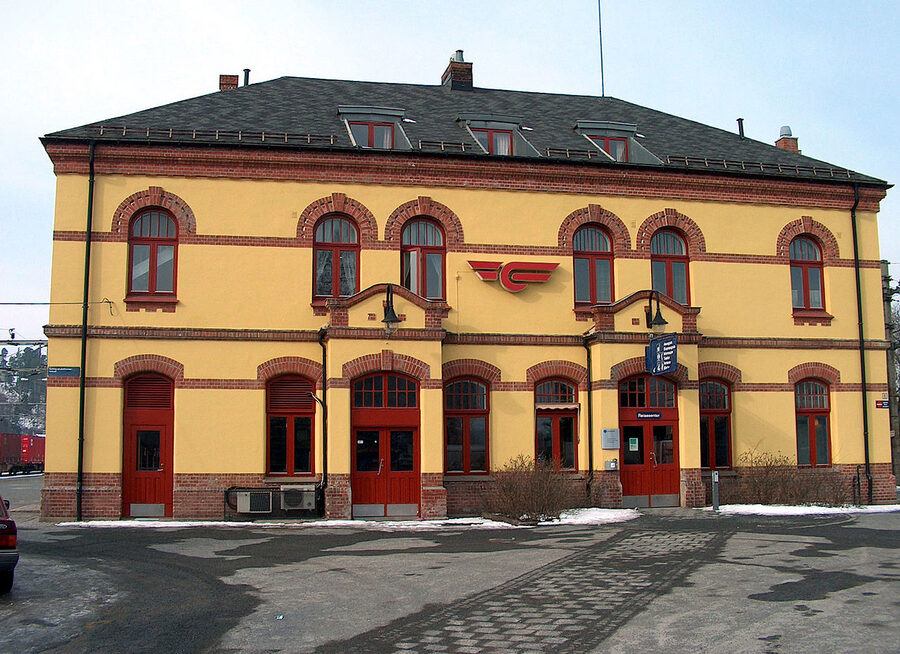
Hour two to three: the Hallingdal
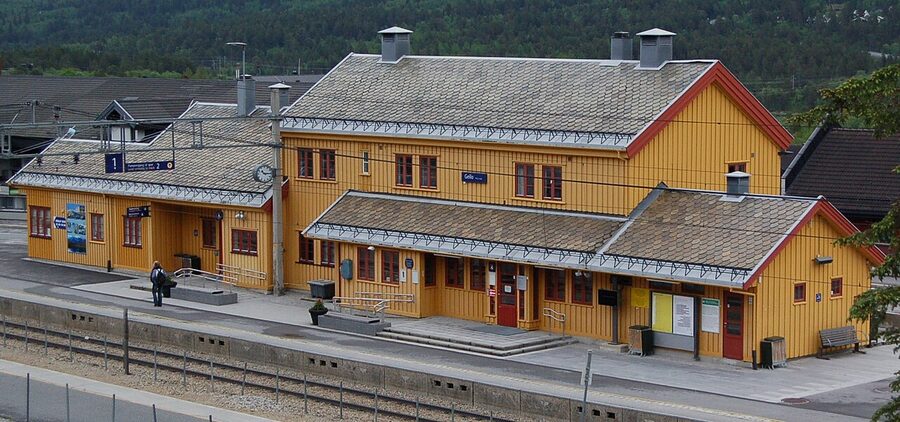
From Hønefoss the line follows the Hallingdal valley northwest, climbing steadily. This is classic Norwegian inland country: long red wooden farmhouses, dairy fields, birch and pine, the river running blue-green beside the track. You pass through Nesbyen, Gol, Ål, and Geilo. Geilo (about 3.5 hours from Oslo) is the major mid-route town and Norway’s oldest ski resort. In winter the platform is full of skiers in salopettes loading bags. In summer the same town pivots to mountain biking and is the start of the Rallarvegen cycling route, the old construction-workers’ road that runs alongside the railway up to Finse and down to Flåm. Worth getting off here? Only if you have ski plans or want to ride the Rallarvegen. Geilo is pleasant but as a town it’s quieter than the brochure promises.
Hour four: the Hardangervidda crossing
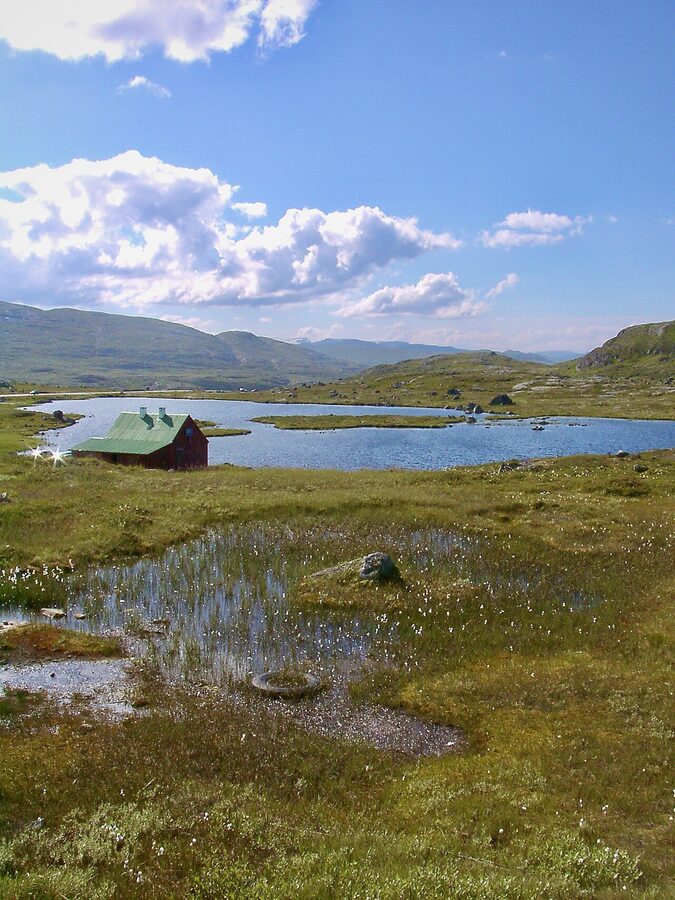
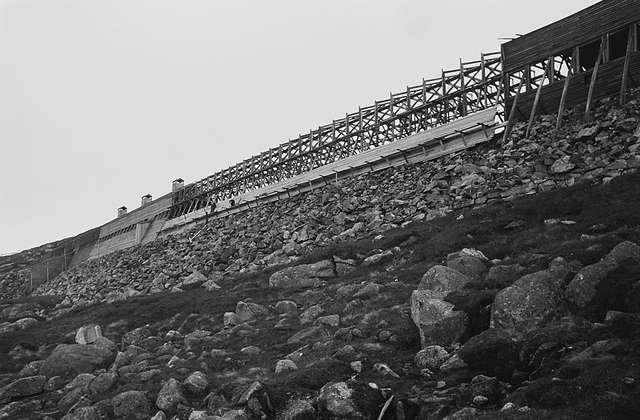
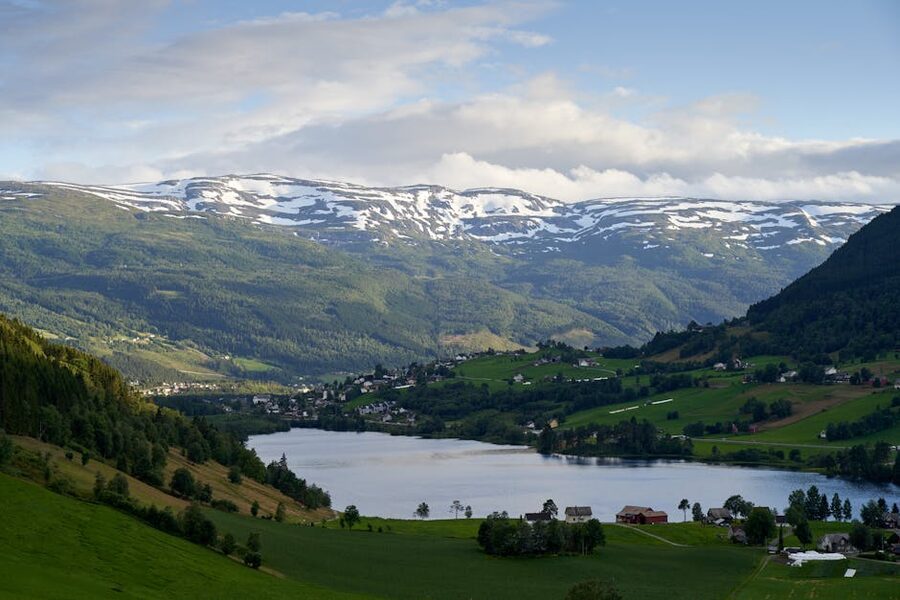
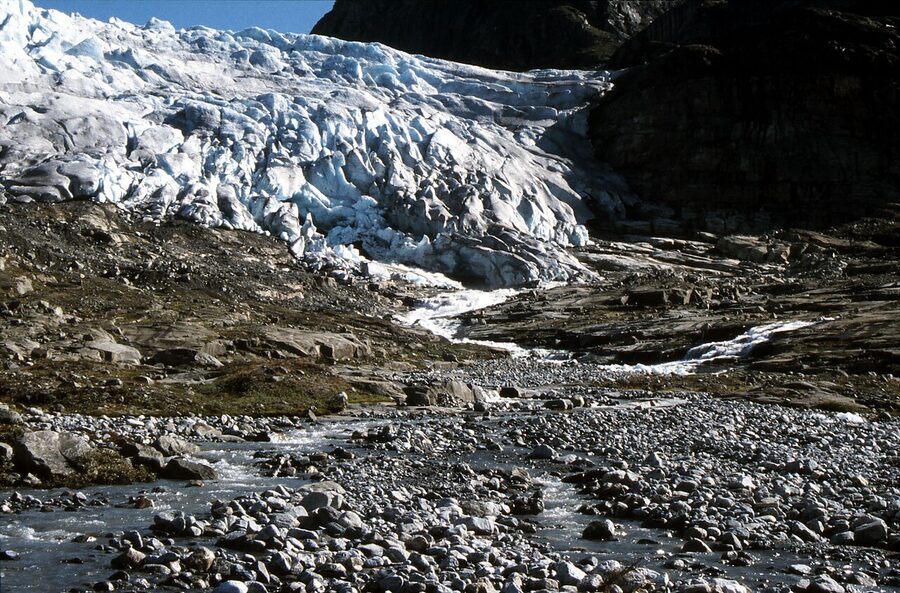
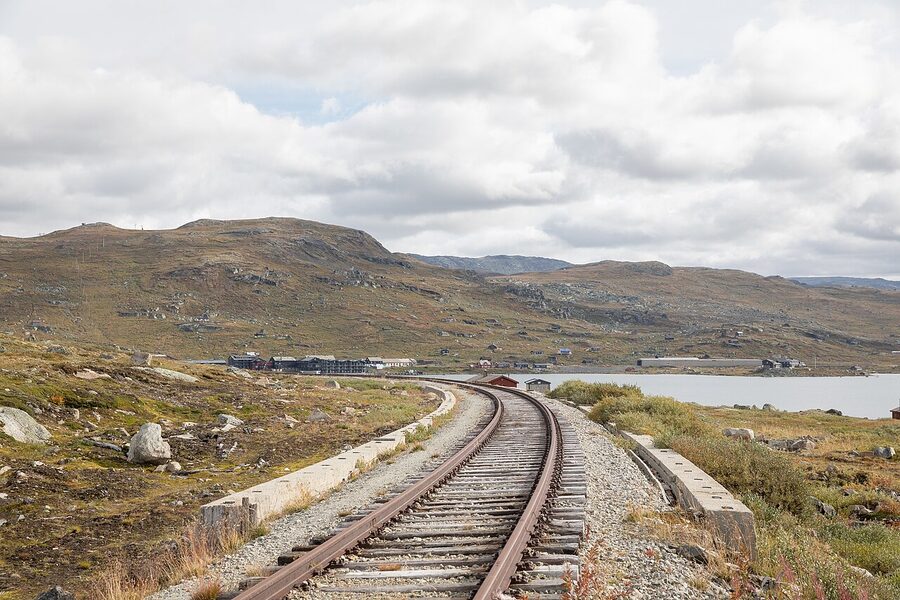
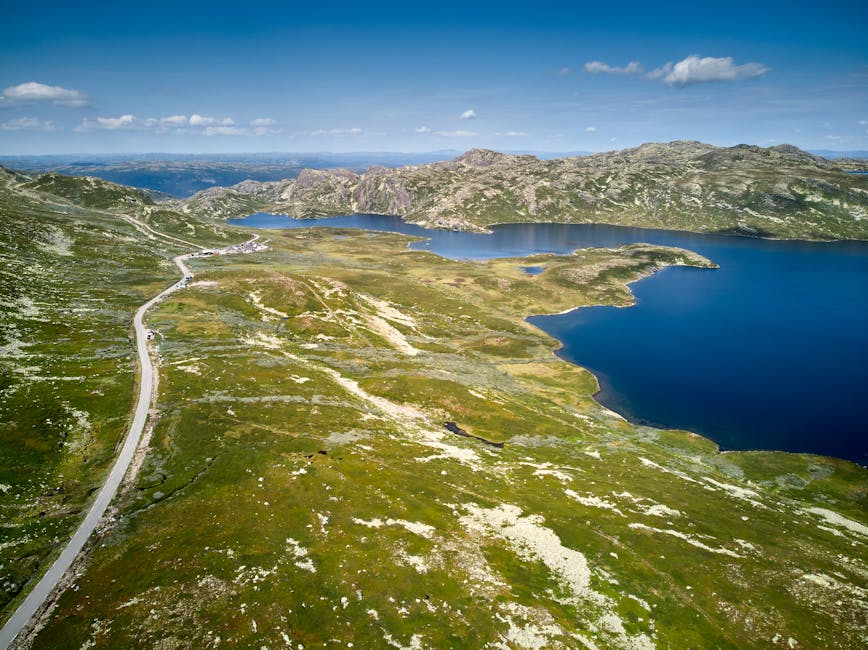
This is the section you’re really paying for. After Geilo the train climbs above the tree line. By Ustaoset it’s all rock and snow and the small lakes that don’t fully thaw even in July. By Haugastøl you’re on the open plateau. By Finse you’re at 1,222 metres, the highest mainline railway station in Northern Europe, and there is genuinely no road in or out of this village. Snow can lie on the ground here in any month of the year. The Hardangerjøkulen glacier sits a few kilometres south of the line, and on a clear day you can see its blue-white edge from the carriage. This is also where the train enters and exits the Finse Tunnel, ten kilometres long, the actual high point of the route at 1,237 metres.
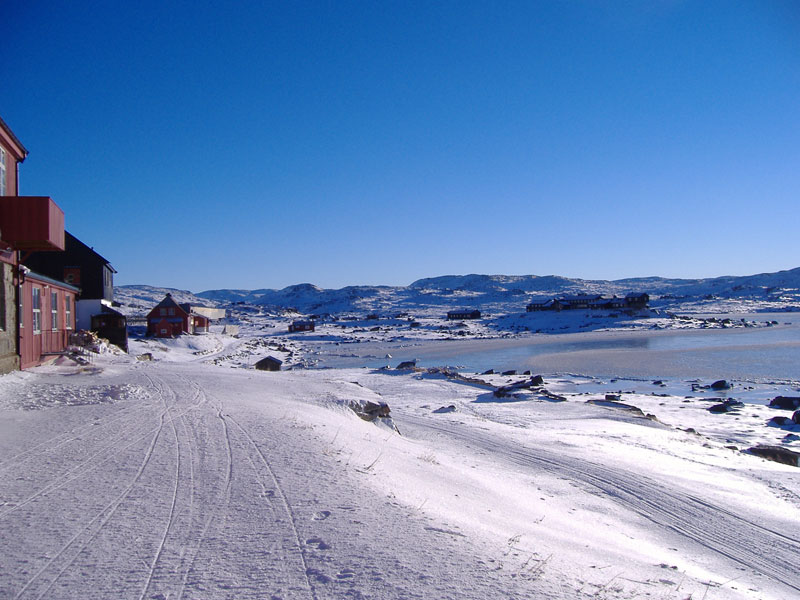
Finse is also the only stop on the route I’d genuinely recommend breaking the journey at. The Finse 1222 hotel sits in front of the platform and is open year-round. In winter the place is a base for cross-country skiing and the closed snow-fields of Hardangervidda. In summer it’s a hub for the Rallarvegen cyclists. Either way you sleep at 1,222 metres in a building that hosted Roald Amundsen’s expedition team and, later, the Empire Strikes Back film crew, who used the area outside as Hoth in the 1980 film. There is a small Star Wars festival here some years.
Hour five: Finse to Myrdal
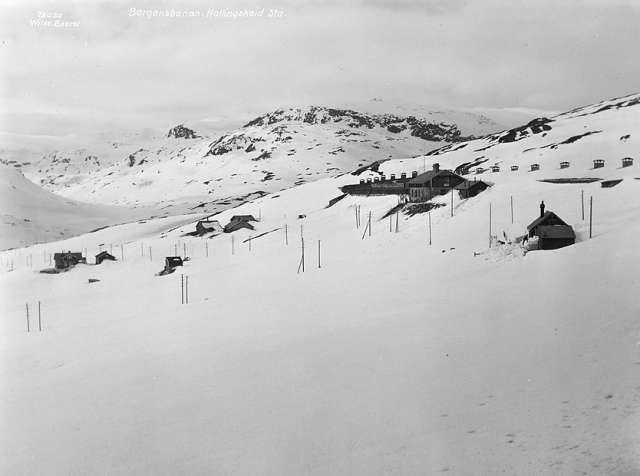
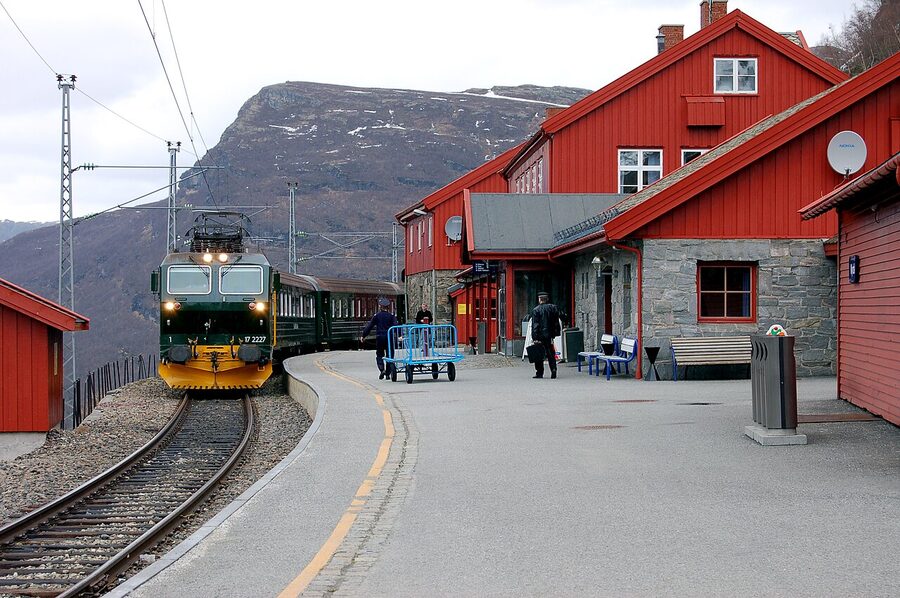
From Finse the line drops west across the plateau through Hallingskeid (a station so isolated it has been built and rebuilt inside its own snow tunnel), then begins the descent towards Myrdal. Myrdal is the junction with the Flåm Railway, the Flåmsbana, and is functionally a station in the middle of nowhere with no town attached. Most travellers either change here for Flåm or watch the platform fill with people doing exactly that. There is no reason to break your journey at Myrdal itself. If you are doing the Flåmsbana detour, this is where you get off (more on that below).
Hour six to seven: Myrdal to Bergen
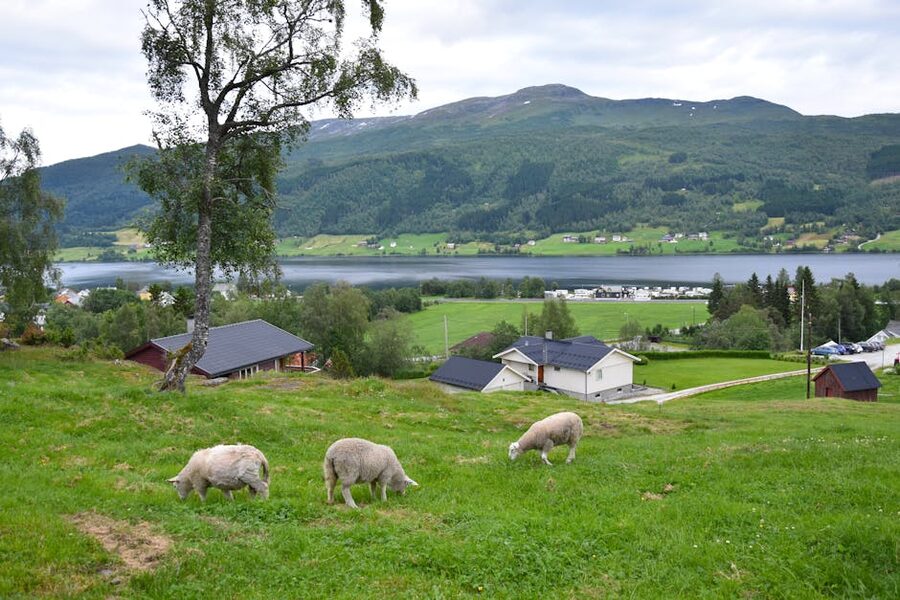
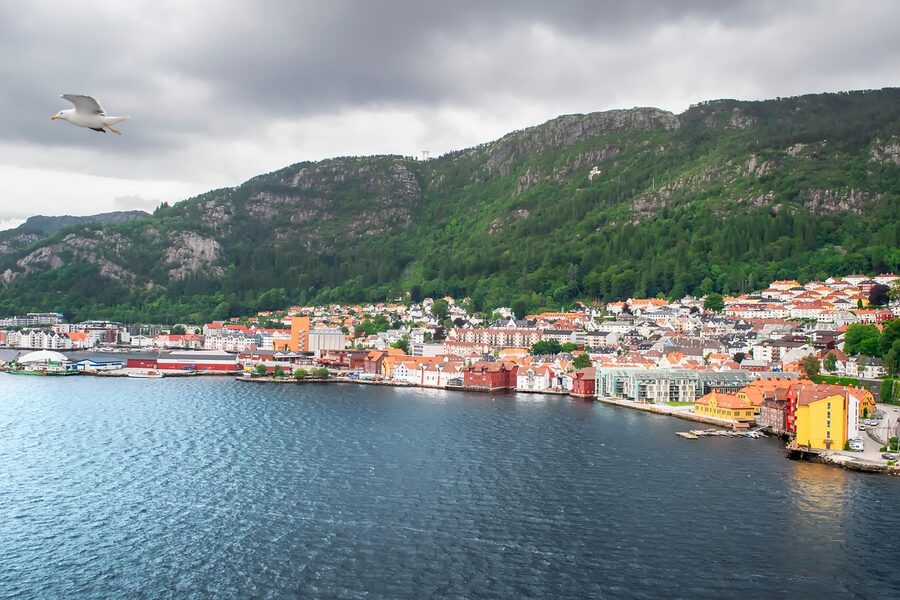
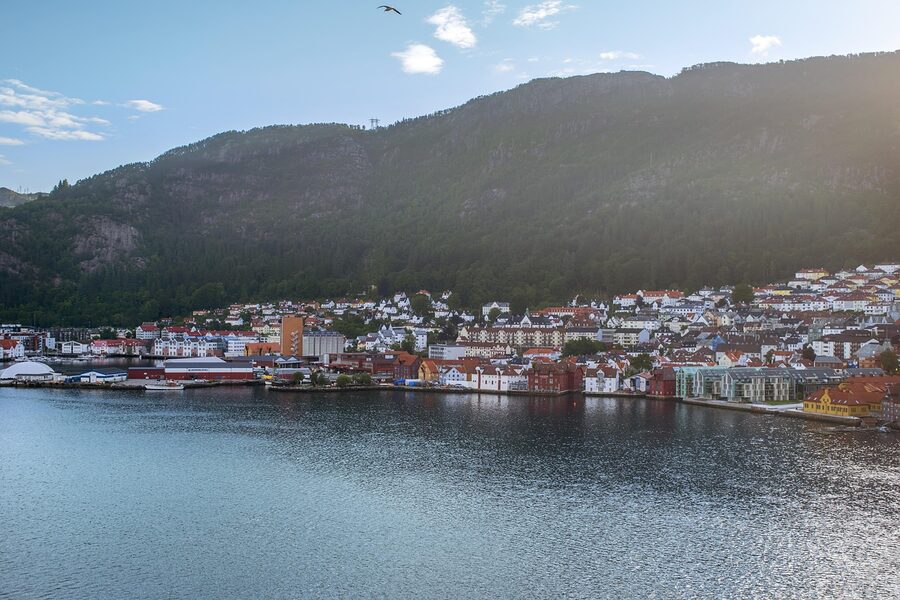
The descent from Myrdal towards Voss is the second-best section of the route, after the Hardangervidda. The line drops through dense conifer forest and a series of waterfalls. Voss appears about 90 minutes before Bergen and is a real town: the self-styled “adrenaline capital of Norway” where rafting, paragliding, and skydiving outfits operate from the lakeshore. Norway in a Nutshell passengers re-board here after the Flåm and Nærøyfjord detour. From Voss the line follows the Vossavatnet lake, then the long Ulriken Tunnel under the mountain into central Bergen. The pull into Bergen Station is undramatic, forest to suburb to terminus in twenty minutes.
The Flåm Railway detour: when it’s worth it, when it isn’t
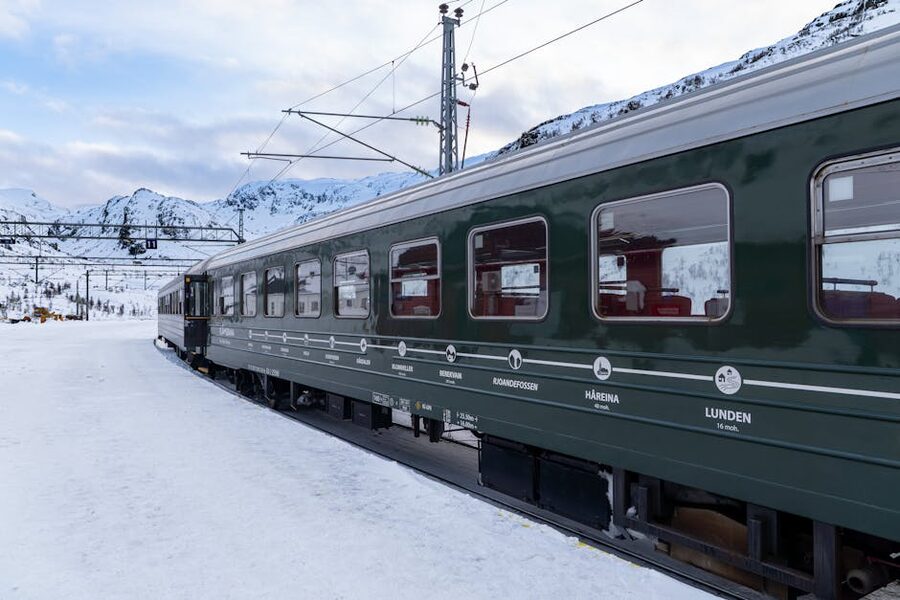
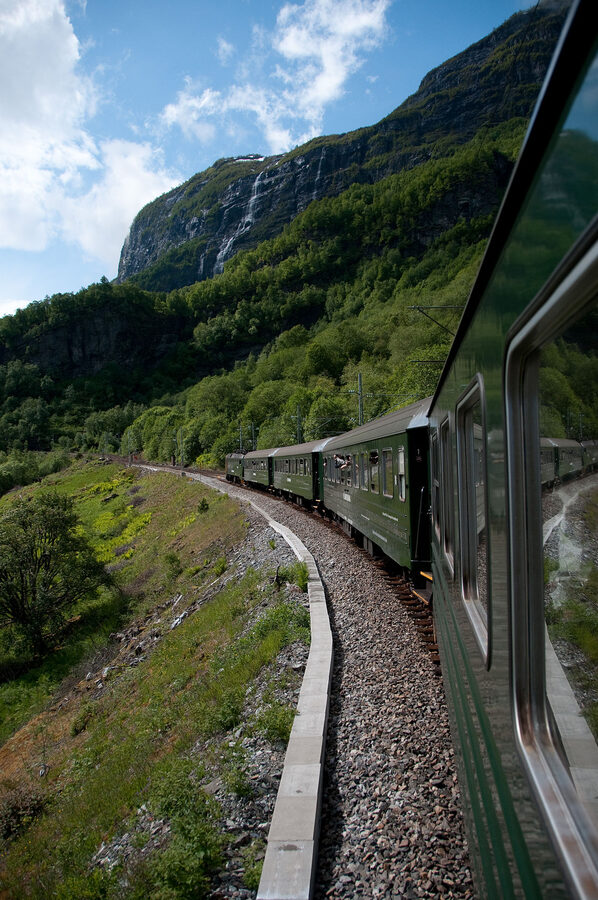
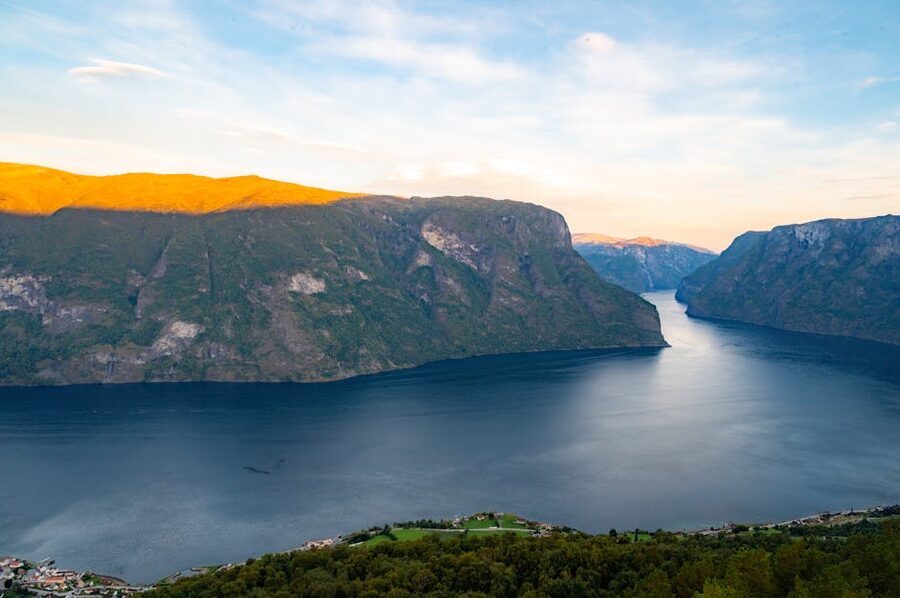
The Flåmsbana, the Flåm Railway, is the famous branch line from Myrdal down to the village of Flåm on the Aurlandsfjord. It is one of the steepest standard-gauge railways in the world (gradients up to 5.5%), it drops 866 metres in 20 kilometres, and it is genuinely beautiful. You can do it in two ways:
- As a return trip from Myrdal: get off your Bergensbanen train at Myrdal, ride the Flåmsbana down to Flåm and back up (one hour each way, 700 NOK / ~€61 return), then catch the next Bergensbanen onwards. This adds about 3 hours to your day. It works, but the timing is tight, the Flåm village fills with cruise passengers in summer, and you do the Flåmsbana twice in one afternoon which is more train than most people want.
- As an overnight stop: get off at Myrdal, ride down to Flåm, sleep there, and continue to Bergen the next day either via boat to Gudvangen plus bus to Voss (the Norway in a Nutshell route) or back up to Myrdal and onwards on the Bergensbanen. This is the better option if you have the day. Flåm itself is a tiny port and has its detractors (the cruise crowd is real), but the village empties at 17:00 when the day-trippers leave and the fjord at sunset is something else.
Skip the detour entirely if you’ve done the Flåmsbana before, if you’re tight on time, or if you specifically dislike crowds in summer. The Bergensbanen on its own, Oslo straight through to Bergen, is the better seven hours.
Norway in a Nutshell: the marketing wrapper you don’t need
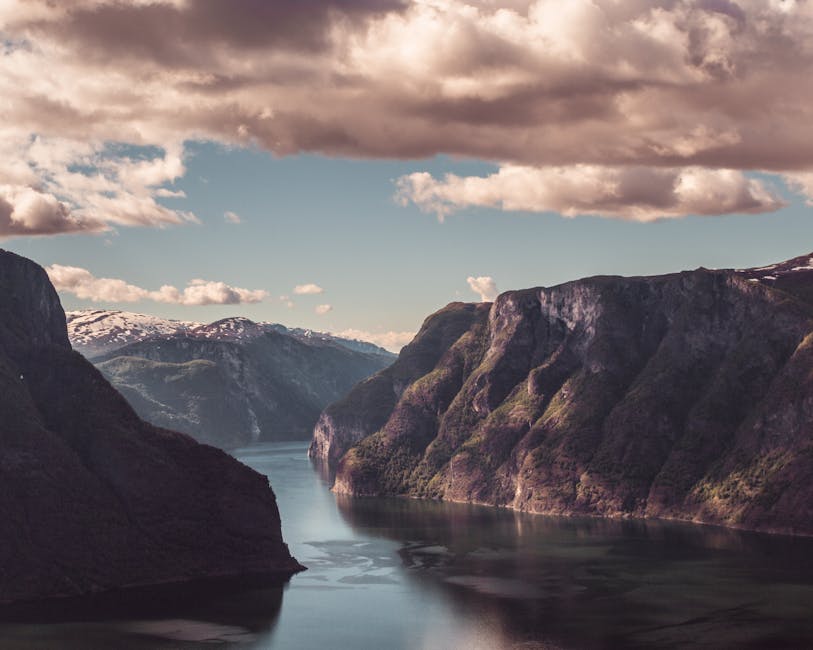
Norway in a Nutshell is the round-trip package sold by Fjord Tours: you ride the Bergensbanen from Oslo to Myrdal, take the Flåmsbana down to Flåm, board a fjord cruise from Flåm through the Nærøyfjord to Gudvangen, take a bus from Gudvangen to Voss, then re-board the Bergensbanen for the final stretch to Bergen. The package starts at 2,585 NOK (~€226) per person and goes up depending on season, class, and additions.
Here is what nobody tells you on the Fjord Tours homepage: the Norway in a Nutshell ticket is the same train ticket, the same Flåmsbana ticket, the same boat ticket, and the same bus ticket you can buy individually. The package is convenient. It is not a different product. If you book each leg yourself on Vy.no, the Flåm Railway website, and the Norled or Skyss boat sites, you can usually save 300 to 600 NOK per person. The catch: you have to manage the timetabling yourself, and if a connection slips you’re on your own.
I’d take Norway in a Nutshell only in two situations. One: if you’re doing the route as a day-trip from Bergen or Oslo (the package handles the round-trip on a single ticket). Two: if you’re travelling in high season and the Vy minipris fares are sold out, in which case the package can occasionally come in cheaper than the flexible-fare individual tickets. In every other case, book it yourself, sleep in Flåm or Voss, and skip the bus from Gudvangen which is the weakest link.
What it costs
Vy uses dynamic pricing on the Bergensbanen. The cheapest “minipris” tickets start at 299 NOK (~€26) for the daytime train and 249 NOK (~€22) for the night train. These are limited, non-refundable, and disappear within a few days of release. Flexible fares run 1,098 NOK (~€96) and up. A typical early-bird booking for an off-peak weekday ends up around 449 NOK (~€39).
The booking window opens 90 days out. To get the minipris fares, set a reminder for the morning your travel date hits 90 days. The fares load at 06:00 Oslo time and the cheap tickets are gone by lunchtime on popular weekend dates. For weekday off-season trips you can sometimes still find them a week out.
Class options on the day train:
- Standard: reserved seat, fold-down tray, power socket. Fine.
- Plus: wider seats, more recline, free coffee/tea. Worth the upgrade if it’s an extra 200 NOK or less.
- Family carriage: small soft-play area, more storage for prams. Free to book if you’re travelling with children, sold separately and fills early.
- Compartment: a private 6-seat carriage you book whole. Works out cheaper per person if there are six of you, and you get your own door.
Compare against alternatives. The 55-minute SAS or Norwegian flight from Oslo Gardermoen to Bergen is currently 600 to 1,400 NOK (~€53 to €123) depending on date, plus airport transfers at both ends. The Nor-Way long-distance bus runs the route in 9 to 10 hours via Hardanger, starts at 404 NOK (~€36), and is the cheapest option but the least comfortable. Driving is 7 to 8 hours via the E16 highway and adds 1,200 NOK to 1,800 NOK (~€105 to €158) of car rental and tolls. The flight wins on speed. The train wins on everything else, including the fact that you actually see Norway.
How to book
Book direct with Vy at vy.no. The English-language site works fine, takes foreign cards, sells seat reservations as part of the ticket (no extra fee), and is the only place you’ll see the minipris fares. Tickets open 90 days before departure.
I do not recommend booking through Omio, Trainline, RailEurope, or any of the third-party sites that show up first in Google. They charge a markup, sometimes 15 to 20%, and their seat-reservation flow is more confusing than Vy’s. The one exception is if you already have a Eurail or Interrail pass. In that case you cannot book the minipris fare anyway (the pass replaces the ticket) and you call Vy customer service to make the seat reservation, which costs 50 NOK (~€4) and can also be done at the Oslo S ticket counter.
If you want the comfort of an organised package, Fjord Tours sells Norway in a Nutshell at fjordtours.com and that’s the official site. Just know what you’re paying the markup for.
When to go
Each season is genuinely different. None is wrong.
Mid-summer (June, July, early August)
The plateau is green-brown and the small lakes are open. Daylight runs to 22:30 in late June so you can take the afternoon train and still see everything. The Flåm Railway is at its busiest and the Flåm village is full of cruise passengers, which is the downside. If you can take the morning train and sleep in Flåm to dodge the day-trippers, summer is the easiest time to do it.
Late September to early October
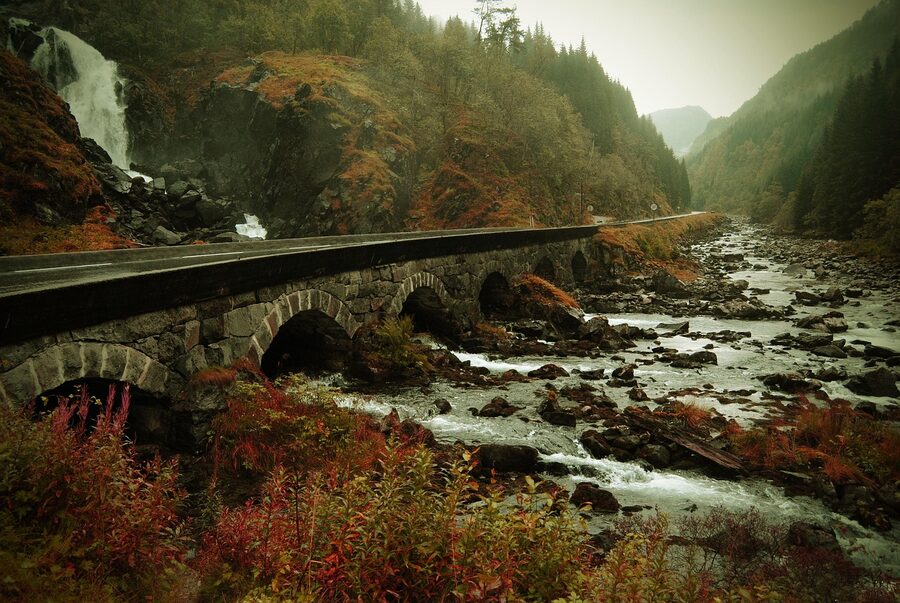
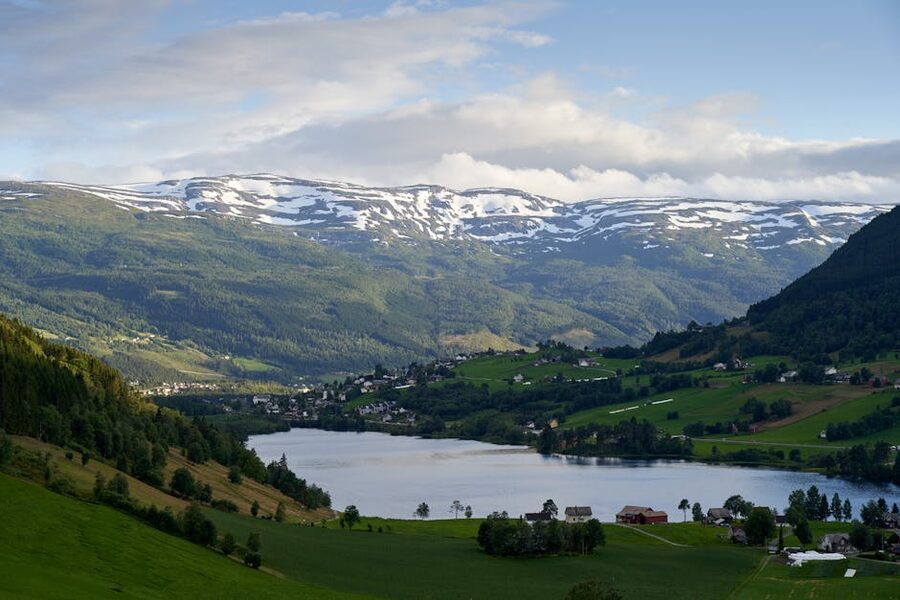
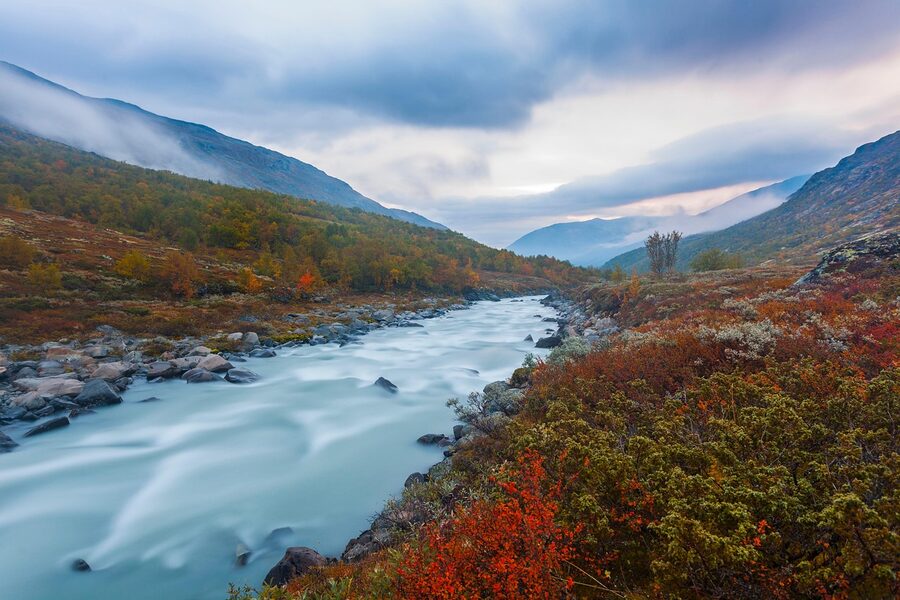
This is my favourite. The Hardangervidda dwarf birch turns gold and red, the bigger forests in Hallingdal and the Voss valley turn the colour of an old penny. The crowds drop off after the school holidays end. The first snow can already be on the high passes from the second half of September. Daylight is still around 12 hours so you have it for the whole journey. Book the morning train.
Mid-winter (January, February, early March)
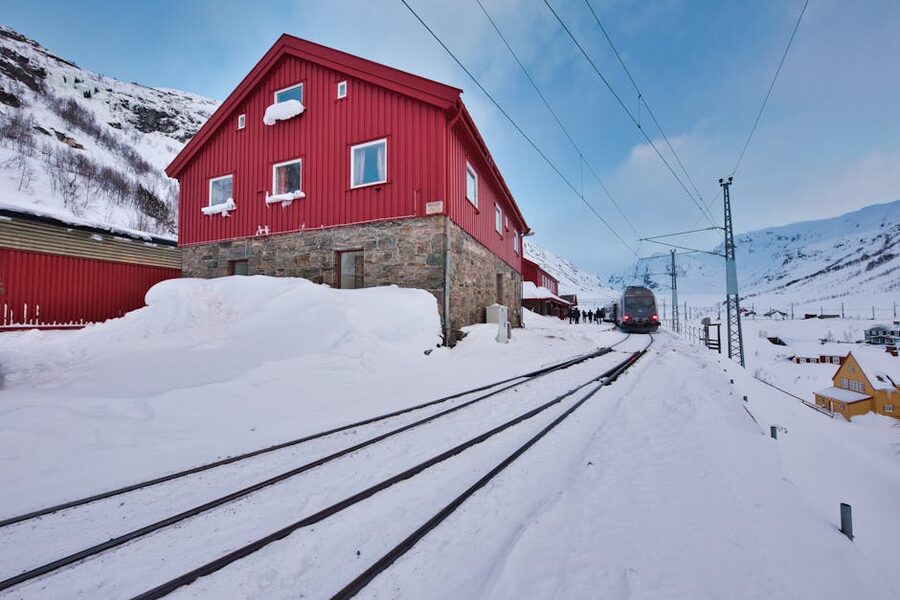
This is the version the marketing photos sell and it really does look like the marketing photos. The whole plateau is white, snow tunnels and snow fences run for hundreds of metres at a stretch, and the train sometimes runs an hour late because they’re clearing drifts. Daylight is short (six hours in late December, eight in February) so the morning train is essential. The downside: you cannot really stop at Finse without serious cold-weather kit, and Flåm in February is closed for half the businesses.
Spring (April, May)
The shoulder season nobody books and probably the worst window. The plateau is in melt, slushy and grey, the waterfalls along the Voss descent are ugly with mud-water, and the Flåm Railway can run on a reduced timetable. Skip April. May warms up by the second half but is still patchy.
Practical things on board
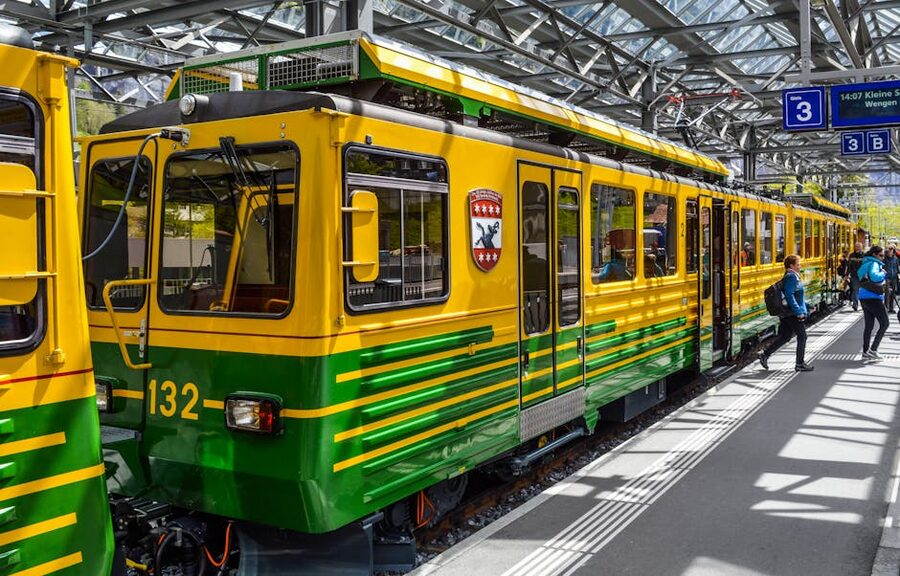
The Bergensbanen carriages are refurbished Type 73 stock with a slight 2017-era cosmetic update. Each seat has a power socket, a fold-down tray table, and a reading light. There is a 2-1 layout in standard class and a 1-1 layout in Plus. The Wi-Fi is officially available and unofficially disappears for the entire Hardangervidda crossing because there are no masts at 1,222 metres. Don’t plan on a video call between Geilo and Voss.
The cafe car sells coffee, sandwiches, the inevitable Kvikk Lunsj chocolate bar (Norway’s answer to Kit Kat, sold by every kiosk in the country and consumed in vast quantities by hikers), and a hot dish or two that runs out by mid-afternoon on the morning train. Prices are Norwegian: 60 NOK for a coffee, 95 NOK for a sandwich, 165 NOK for a hot meal. Bring food on board if you’re price-sensitive. There’s a Joker or Coop supermarket two minutes from Oslo S where you can buy smoked salmon, a small block of brunost (the brown caramelised goat cheese, weird but worth trying), bread, and a 25 NOK Kvikk Lunsj for 200 NOK total, which is less than one cafe-car sandwich.
Luggage: you can take three pieces up to 30 kg each provided you can handle them yourself, and that includes skis and snowboards. Storage racks at the carriage ends fit large suitcases. The smaller overhead racks fit a daypack. There are no luggage restrictions on the Flåm Railway either, but the carriages there are smaller and the racks fill quickly in summer.
Where to stay at each end
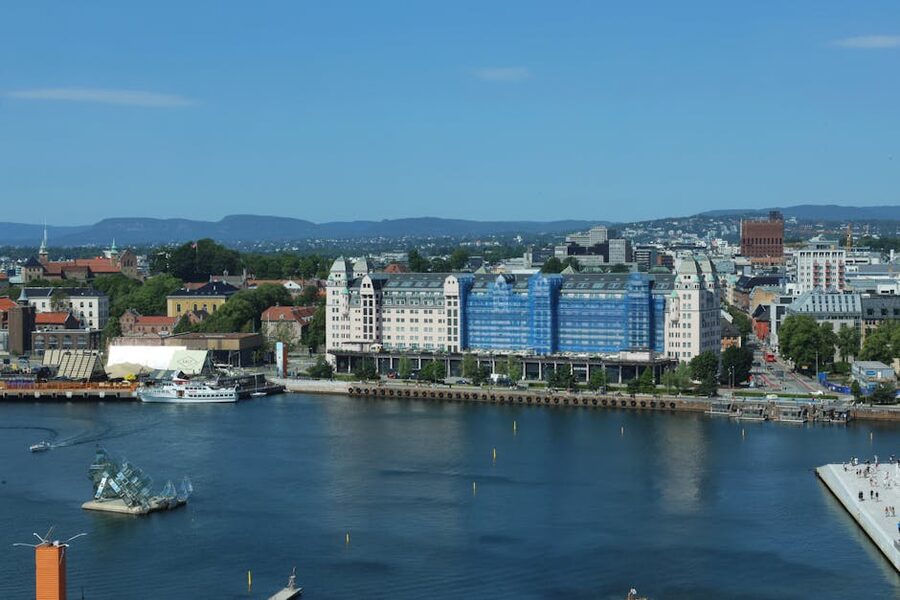
If you’re booking a hotel for the night before or after, the practical picks:
In Oslo: stay within ten minutes of Oslo S. The Thon Hotel Opera is the closest, on the same block as the station, with views over the Opera House. Comfort Hotel Grand Central is inside the station building (literally, you walk through the ticket hall to reception), which is unbeatable for an early train. Thon Hotel Opera on Booking.com | Comfort Hotel Grand Central on Booking.com
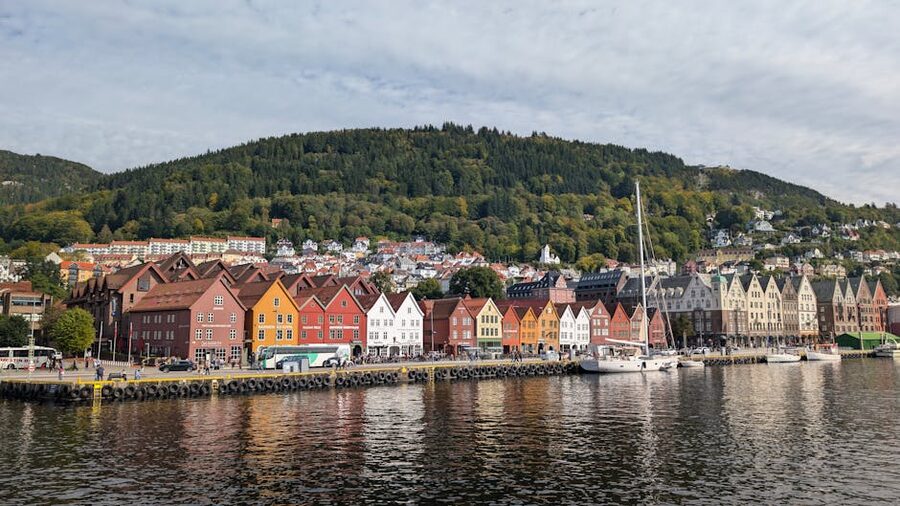
In Bergen: the Bryggen waterfront is the heart and is a 15-minute walk from Bergen Station. Hotel Park Bergen, a few streets up the hill in a converted 19th-century townhouse, is the quieter option I keep going back to. Hotel Park Bergen on Booking.com | for the standard waterfront stay, Clarion Collection Hotel Havnekontoret on Booking.com sits directly on Bryggen.
In Finse (if you’re stopping): the Finse 1222 hotel is the only option and you book direct at finse1222.no. Year-round, full board included on most rates, around 1,650 NOK (~€145) per person per night.
In Flåm (if you’re doing the detour): Fretheim Hotel is the historic option in the village centre, Flåmsbrygga is the harbour-side option with the on-site Ægir microbrewery. Fretheim Hotel on Booking.com
How the Bergensbanen connects to the rest of a Nordic trip
The Oslo to Bergen train is the obvious centrepiece of a Norway-only trip, but it slots well into longer Nordic itineraries. From Bergen you can carry on north along the Hurtigruten coastal ferry route or fly up to Tromsø for the aurora season. From Oslo you can connect into the rest of the Nordics: the night train northbound to Trondheim and Bodø, the day train to Stockholm (the Vy/SJ joint service, about six hours), or onwards to a wider Nordic plan.
If you’re combining this with another Nordic itinerary, the obvious neighbours are the Lofoten Islands road trip (a contrasting Norway journey, by car not train, north of the Arctic Circle) and the Iceland Ring Road 7-day itinerary (the other great scenic Nordic route, again by car). The Bergensbanen is the most accessible of the three: no driving, no airport hopping, just a single train ticket and a window seat. If you’re starting from Norway’s capital, my Oslo city guide covers what to do with the day before you board, including the practical bit about getting to the station from Gardermoen in time for the 08:25.
Worth the time and the money?
Yes. With one caveat: don’t do it as a same-day round-trip from Oslo. I have met travellers who flew into Oslo, did Oslo to Bergen and back the same day, then flew home. They saw the train, sort of, and remember almost none of it. The Bergensbanen earns its money when you take it as a one-way leg, sleep at the other end, and let yourself notice the route changing under the window. Eight hours on the rails should bookend a real Norway visit, not punctuate a transit.
And if you’re choosing between the train and the flight on time-served grounds, run the numbers carefully. Flight: 55 minutes in the air, plus an hour at each airport, plus the airport transfers. That’s about four hours total. Train: 6.5 hours, station to station, both stations city-centre. The difference is two and a half hours and the difference in what you remember is the whole point.
The 08:25 from Oslo S is sold by the morning. Book early.

_(cropped).jpg)


.jpg)

