
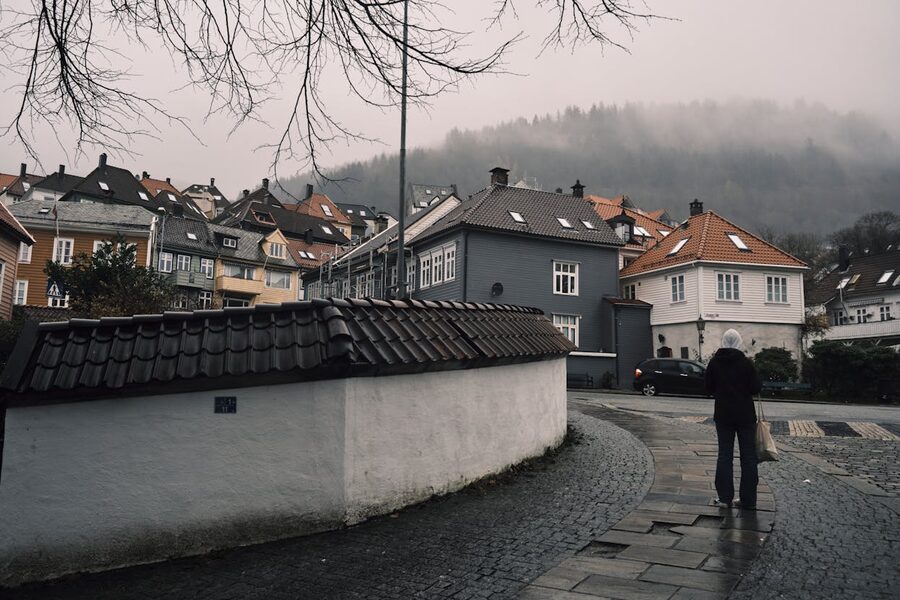
The smell on Bryggen at 06:30 on a wet October morning is the first thing nobody warns you about. It is creosote and tarred wood and salt, with a faint cured-fish note from the warehouses behind the painted facades, and the planks underfoot creak the way ship decks creak because the buildings have been listing for six hundred years. Walk the alleys before the cruise ships dock and you have the place to yourself. Walk them after eleven and you are queueing for a photograph behind 4,000 people from a Carnival ship.
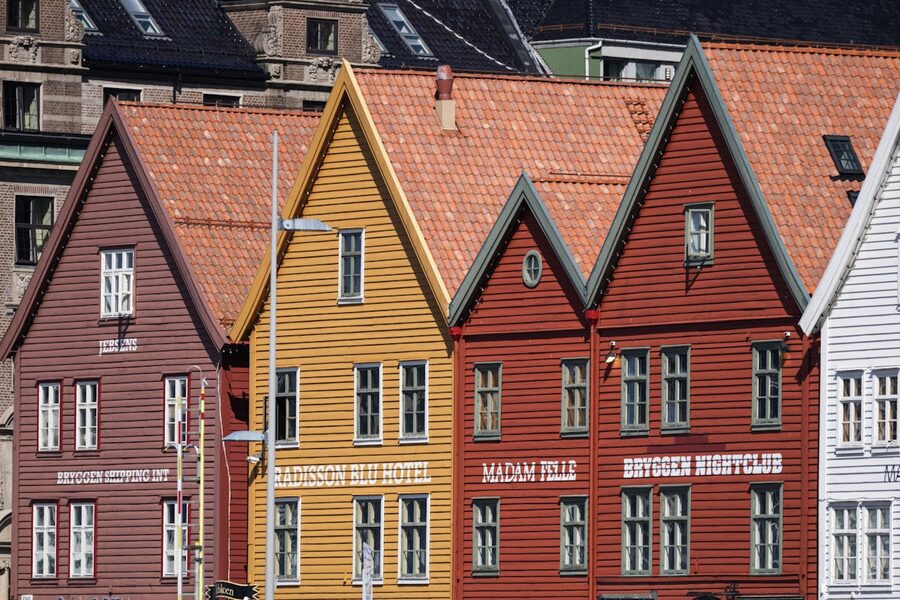
This is the Bergen the cruise listicles flatten. UNESCO-listed Bryggen, 240 wet days a year, a working harbour that still loads stockfish bound for Italy, an art museum quartet that holds Munch’s The Sick Child, a funicular that goes up Mount Fløyen in seven minutes and a path that walks back down in forty, the world’s only city of its size where the locals genuinely see the rain as part of the place rather than a thing to apologise for. I have spent four separate weeks in Bergen across different seasons, three of them under the kind of sustained drizzle that makes Londoners go quiet, and the city only got better as I learned to dress for it. This is what a Bergen guide looks like once you stop trying to fit it into three sunny days.
In This Article
- Bergen, in the time it takes to drink a coffee
- The Hanseatic warehouses, walked one shop at a time
- What the Hanseatic warehouses actually were
- The fires that built the modern site
- The Fløibanen funicular and the path most visitors miss
- Walking down from Fløyen
- Mount Ulriken, the better view
- The Fish Market is touristy. The indoor Mathallen is the answer.
- KODE 1, 2, 3, 4: a half-day at four art museums for one ticket
- Bergenhus, Håkonshallen and the Rosenkrantz tower
- Mariakirken, the city’s oldest building
- The composer homes: Troldhaugen, Lysøen, Siljustøl
- The cruise-ship reality nobody talks about
- Where to stay in Bergen, by neighbourhood
- The hotels worth booking
- Eating in Bergen, the four-meal version
- Getting to Bergen from Oslo: the train, the flight, the sleeper
- Day trips from Bergen worth taking
- The seasons in Bergen, briefly
- Practicalities most guides skip
- What to skip, said plainly
- Final scene
Bergen, in the time it takes to drink a coffee
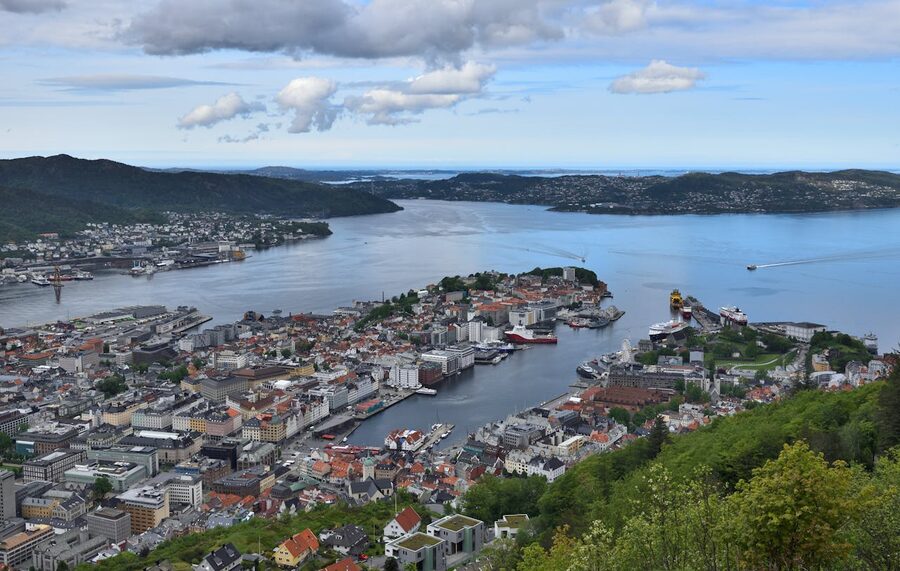
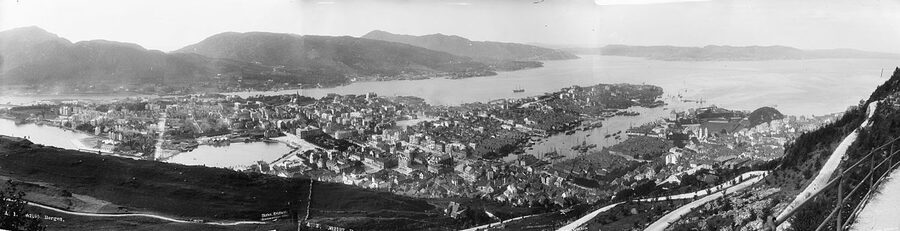
Norway’s second city, 290,000 people, the western terminus of the Bergen Line from Oslo, the cruise capital of the country (more than 600 ship calls a year, occasionally 12 in a single day), and the city Norwegians point to when they want to argue that Oslo is not really representative. The geography is the first thing that explains Bergen. It is built into a tight horseshoe of harbour with seven hills around it, the inner harbour called Vågen pointing north into the city, the Bryggen wharf running along its eastern shore, the Fish Market at its head. You can walk the entire central peninsula in 90 minutes if you do not stop. Most people stop a lot.
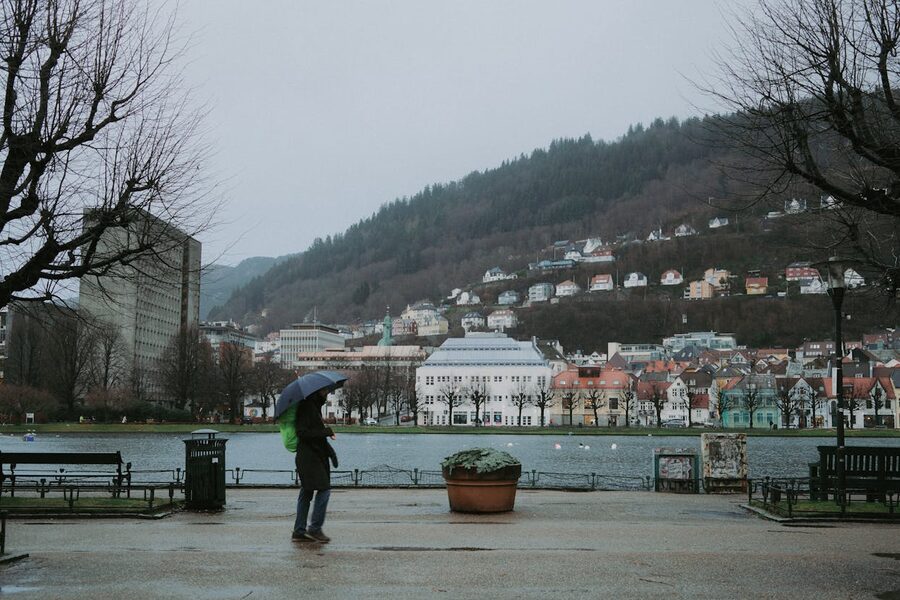
The wet matters because nothing else here makes sense without it. Bergen averages 240 days of measurable rain a year and roughly 2,250 mm of precipitation, which makes it the wettest city of its size in Europe. A “dry week” in local conversation means three consecutive days without rain. The standard joke is that Bergeners do not get sunburn, they get rust. Most of the city’s defining institutions exist because the rain pays for them: the wooden Bryggen survived because the climate keeps the hardwood damp enough to resist beetle, the cable cars exist because walking up the hills in October is a different proposition, the indoor Mathallen exists because the outdoor fish market is a sodden ordeal seven months of the year. Plan for rain, dress for it, and the city makes more sense.
The Hanseatic warehouses, walked one shop at a time
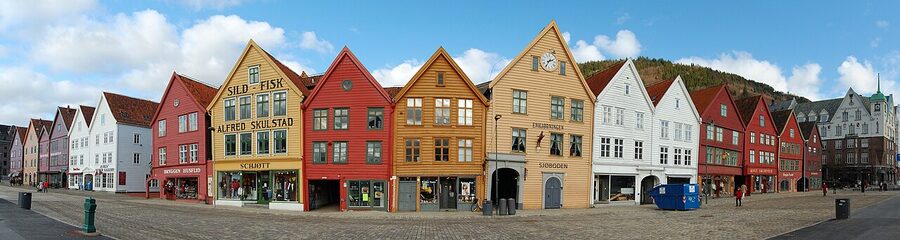
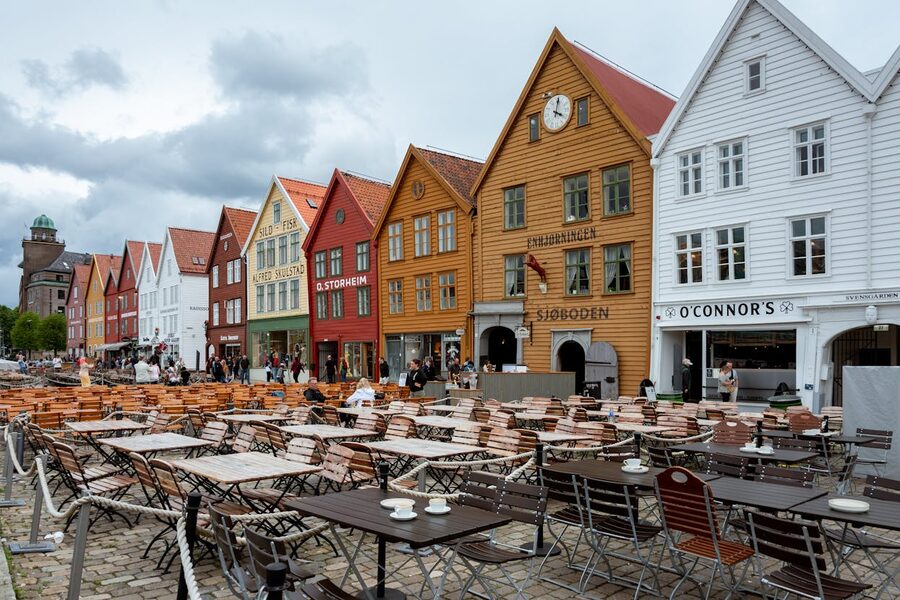
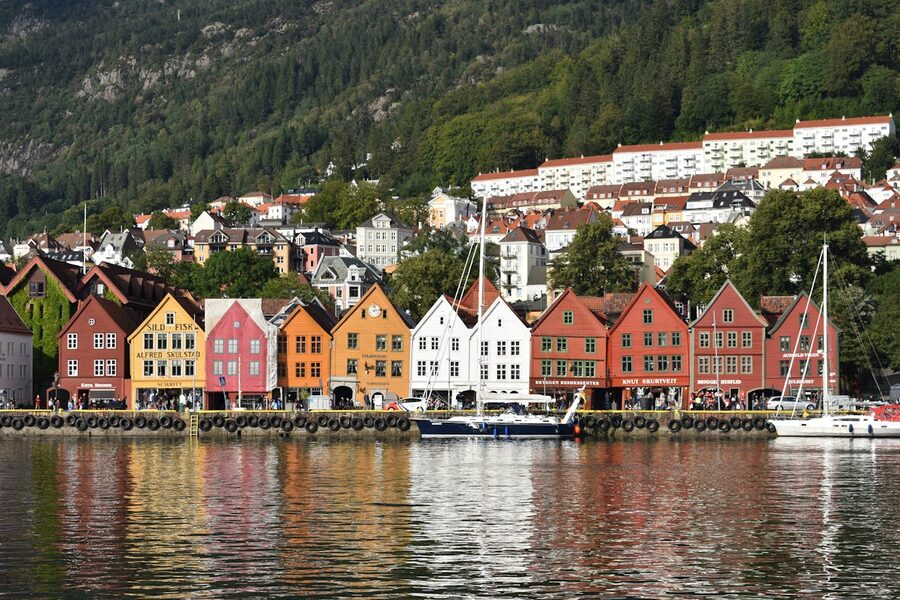
Bryggen is not a museum. That is the thing that took me a few visits to understand, and that almost every guide online still gets wrong. It is a working block of wooden warehouses, gable-end-on to the harbour, that has been the merchants’ quarter of Bergen since around 1100 and the operational nerve of the German Hanseatic trade in stockfish since 1360. There are 62 surviving wooden buildings here today, all behind a single UNESCO listing, and inside about half of them are workshops, jewellery studios, ceramicists, a printer, two textile makers, a pewter caster, a sandwich shop the locals queue at, and the offices of a couple of fish-export companies that still ship cured cod to Lisbon and Genoa.
The trick to Bryggen is to walk it in two passes. First the front: the painted gable ends along the wharf, lit hardest in the morning, photographed best from across the water at Torget. Then the back: turn 90 degrees and walk into the alleys between the buildings, the passasjer. There are nine of them, all running perpendicular to the harbour, all narrow enough that two people meeting have to turn sideways, all paved in the same grey stone slab the city used in the 17th century. They smell of wet pine and pitch. They are also, between 11:00 and 14:30 on cruise-ship days, the most uncomfortable place in central Bergen because every shore-excursion guide leads their group down the same alley at the same hour.
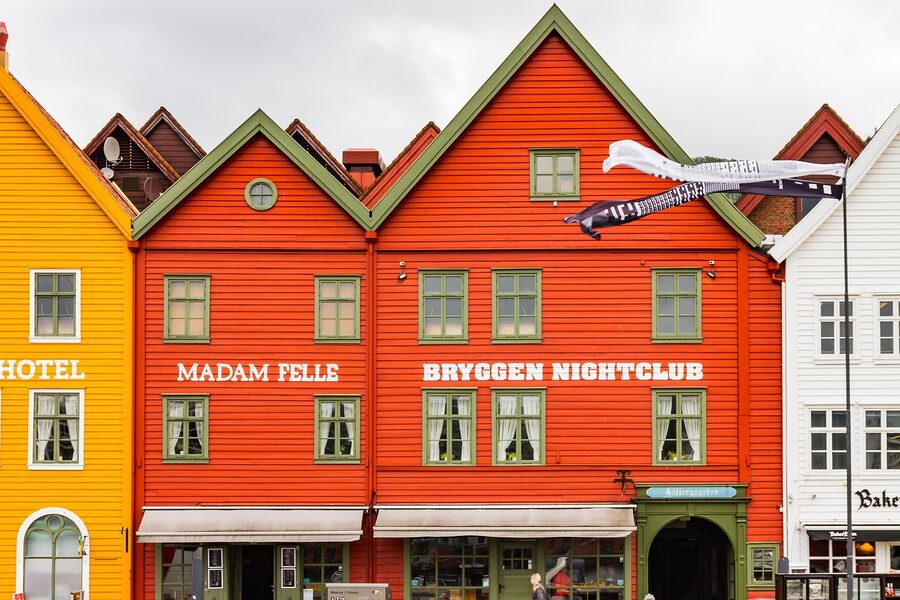
The alleys are open as long as the shops are. Most of the workshops keep 10:00 to 17:00 in summer and 11:00 to 16:00 winter, with Sunday closures common. None of them charge admission. You can walk straight in, watch a jeweller hammer a brooch, watch the pewter caster pour a candleholder, and walk out again without buying. It is a strangely intimate experience for a UNESCO site receiving 1.4 million visitors a year. The reason it works is that the buildings are still owned by the Bryggen Foundation and rented to working craftspeople below market rate as a condition of the listing. Anyone selling factory-made souvenirs gets pushed out.
What the Hanseatic warehouses actually were
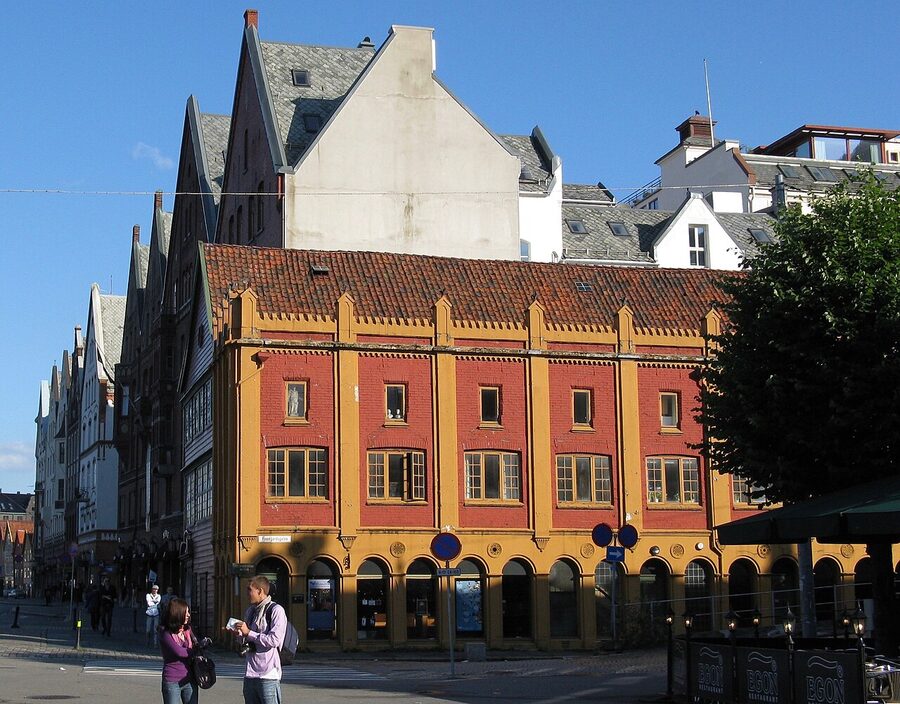
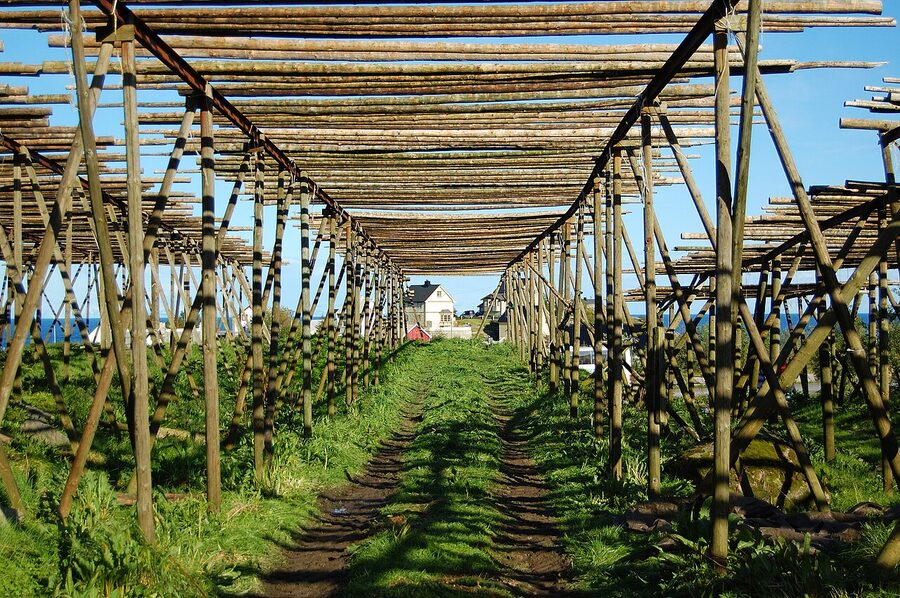
The Hanseatic League ran Bergen from 1360 to 1754. At its height there were 2,000 German merchants and apprentices living in Bryggen, all male, all unmarried by Hanseatic rule, all forbidden to mix with the locals beyond what business required. Each warehouse housed a “stue” (a partnership of merchants) on the ground and first floors and a series of cell-like sleeping chambers on the upper floors, each chamber called a schötstuen. The merchants traded German grain and beer northward in exchange for stockfish from the Lofoten and Finnmark coast, and that stockfish was then shipped onward to Catholic southern Europe, where Friday fish demand kept the route profitable for four hundred years. The fact that the same trade still operates from the same harbour, in much-reduced form, is the single most useful thing to remember as you walk the alleys. You are inside a working medieval supply chain.
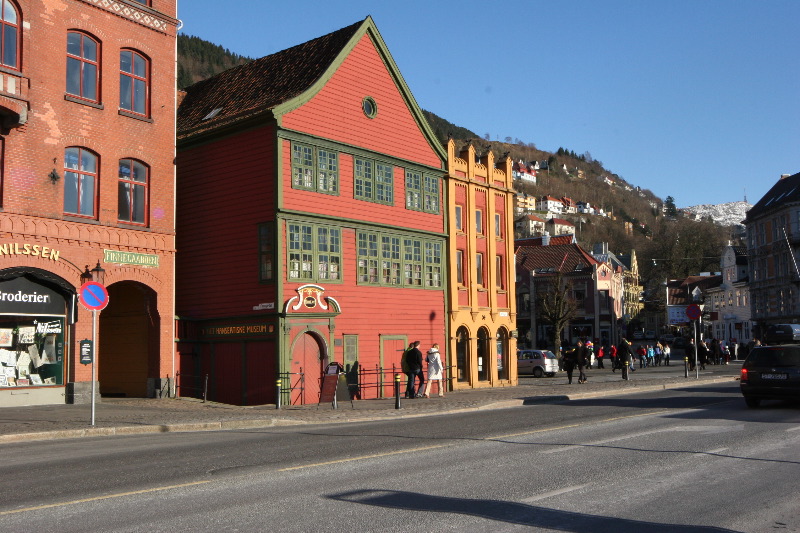
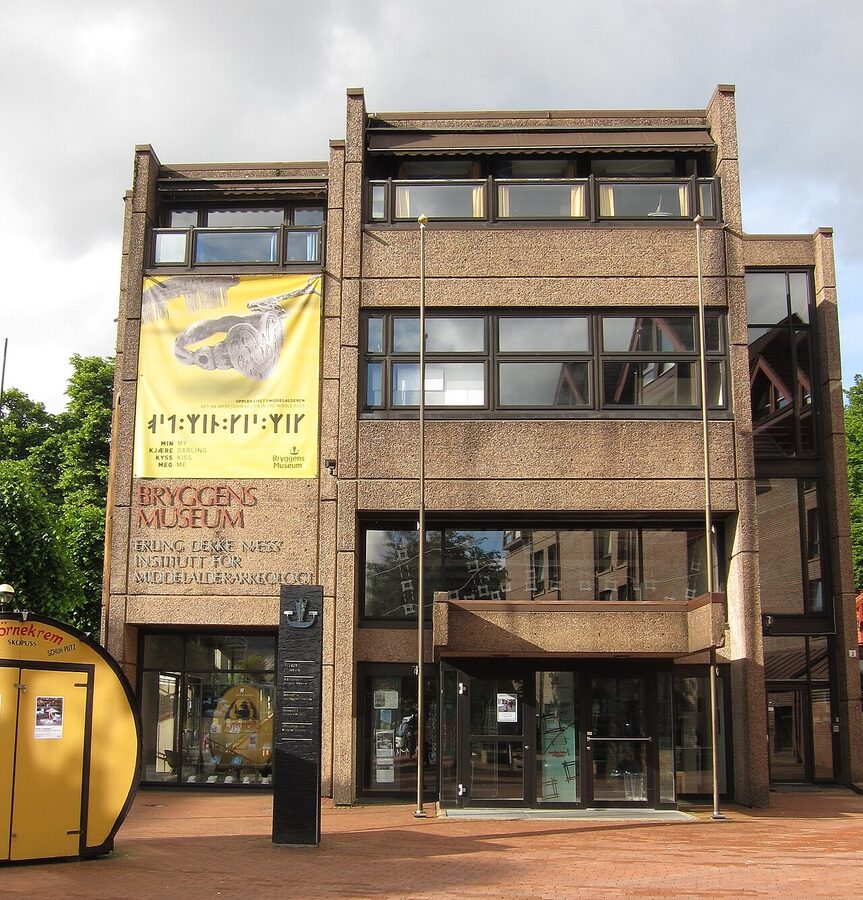
Two museums explain this in detail and they are different enough that doing both is not redundant. Bryggens Museum (300 NOK ~€26 adult, includes Schøtstuene; open daily 10:00 to 17:00 in season, reduced winter hours) is the archaeology museum, built directly on top of the medieval foundations exposed by the post-1955 dig. The exhibition runs at floor level, you walk on glass over the actual 12th-century timbers, and the building’s lower floor is essentially a trench through 800 years of fire layers. The Hanseatic Museum on Bryggen itself, which is the surviving Finnegården warehouse from 1704, was closed for major restoration from 2020 and reopened phased through 2025. It shows the merchant rooms exactly as the last Hanseatic occupants left them. Together they cost about half a working day. Skip the audio guides, the printed booklets are better.
The fires that built the modern site
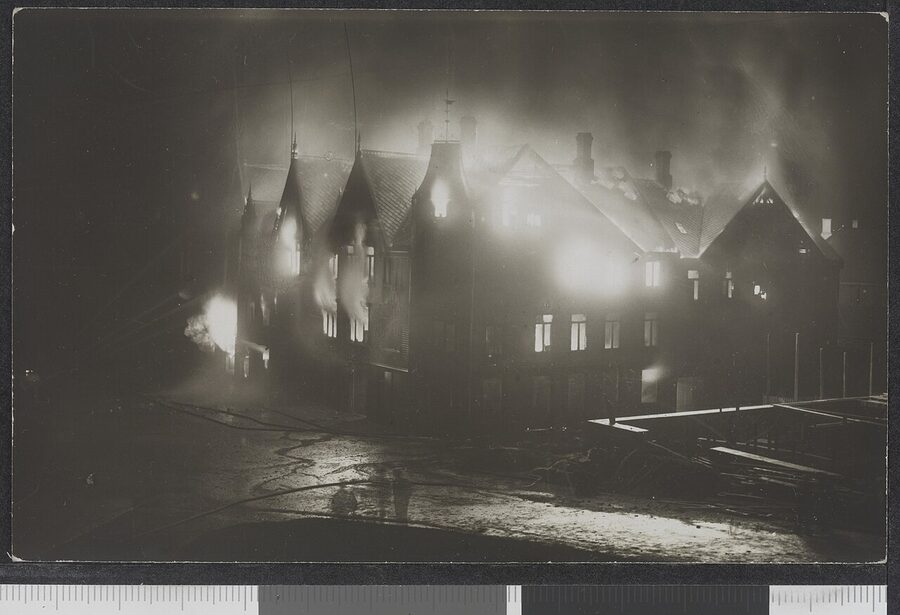
Bryggen has burned at least 13 times since 1170. The two fires that matter for what you see today are 1702 and 1955.
The 1702 fire flattened the entire wharf in a single night. Strong wind, dry June, a cooking accident in a Hanseatic kitchen, and the warehouses went up like a row of matchsticks. Every building you walk past today was rebuilt after that fire, on the same medieval foundations and to the same plan, between 1702 and roughly 1740. The walls lean because of subsidence on those medieval foundations, not because of anything done in the 18th century. The famous photo of Bryggen leaning sideways is geology, not bad carpentry.
The 1955 fire burned the northern third of Bryggen, a whole row of about 18 warehouses gone in eight hours. What followed is the reason the site is UNESCO-listed today. Norwegian archaeologists, led by Asbjørn Herteig, used the cleared site for a 13-year excavation that ran through the 1960s and exposed runic inscriptions, leather shoes, wooden combs, and a complete set of merchant trade tags from the 12th to 15th centuries. The Bryggens Museum is built directly over that excavation. The Hanseatic-Italian stockfish trade is documented today, in detail no other Hanseatic city has, because the 1955 fire happened. It is a strange thing to be grateful for. Bergeners are not, particularly. They lost businesses they had run for generations.
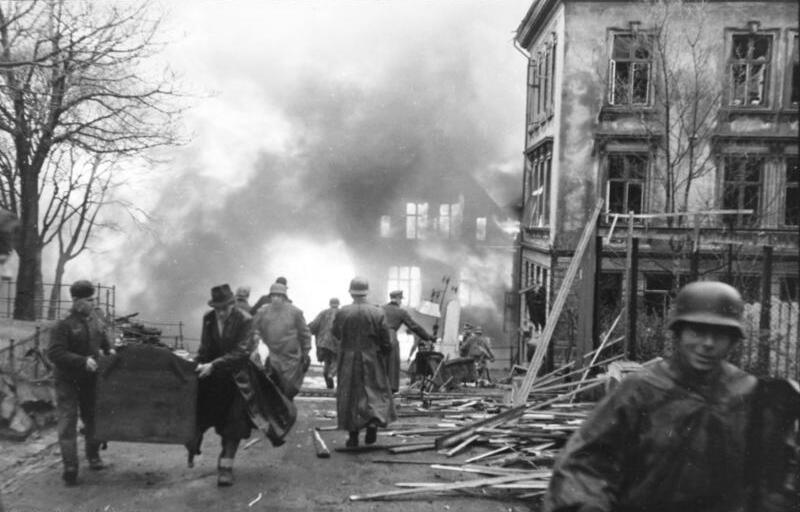
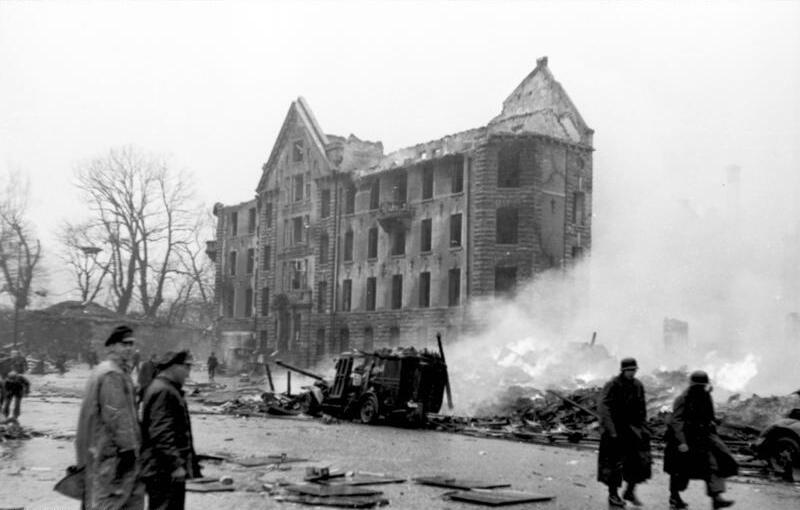
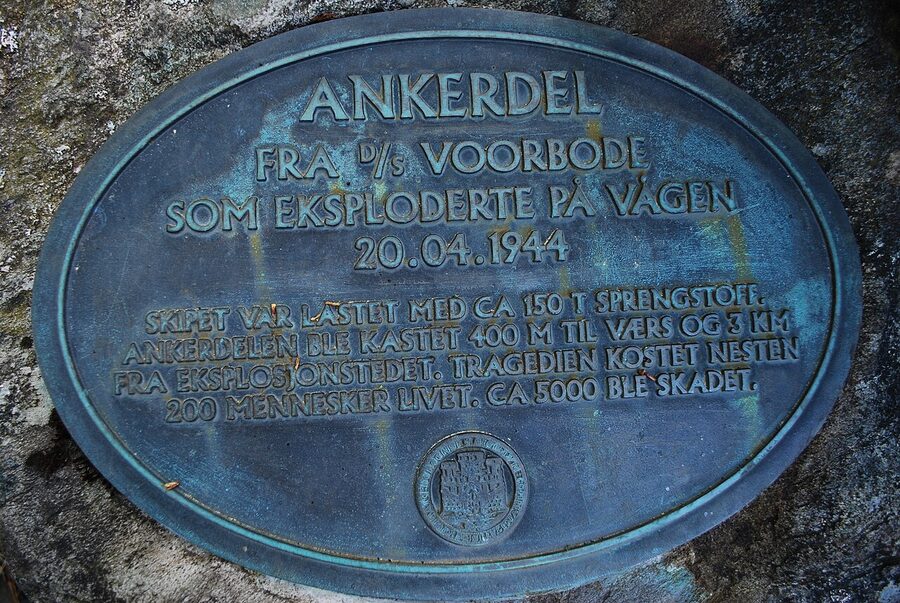
The third fire that shaped the city is the 1944 Voorbode explosion. The Dutch cargo ship Voorbode, loaded with 124 tonnes of explosives requisitioned by the German occupiers, detonated in the harbour at 08:39 on 20 April 1944, killed 124 people including 60 children at a school 800 metres away, and damaged or destroyed roughly 5,000 buildings across the city centre. Bergenhus took a direct hit. The blast also shattered every window in Bryggen on the harbour side, which is why the painted gable ends you photograph today are painted with post-war restoration colours rather than the originals. There is a small memorial plaque at Festningskaien on the harbour, easy to miss, with the date and the cargo manifest on it.
Walk Bryggen with that history in your head and the buildings stop being a row of pretty wooden facades. They are a 900-year-old harbour-trade infrastructure that has been blown up, burned down, rebuilt, archaeologically dissected, restored, and is still in commercial use. There is nothing else like it in northern Europe.
The Fløibanen funicular and the path most visitors miss
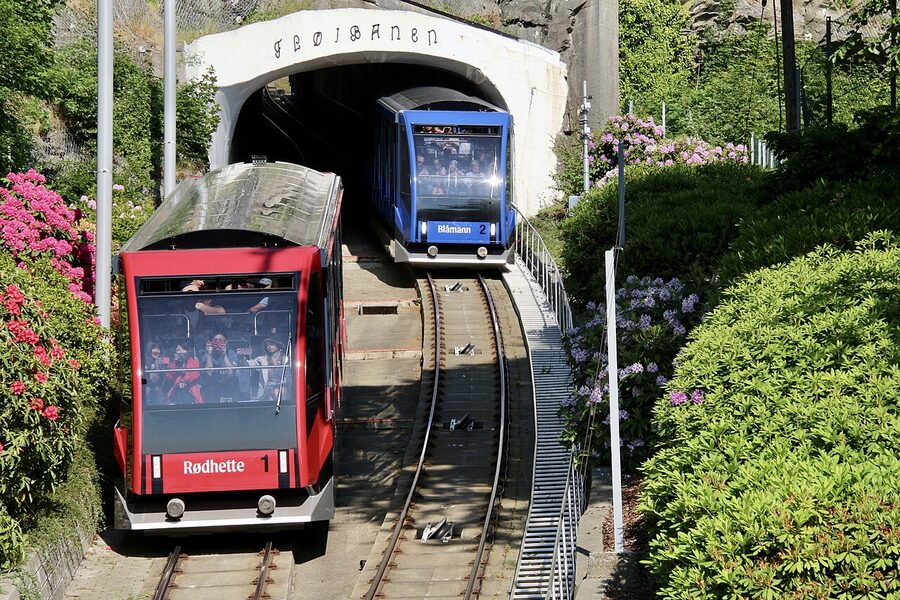
Fløibanen is the funicular up Mount Fløyen, opened in 1918, 850 metres of track at a 26 percent gradient, a journey of about seven minutes from the lower station near Bryggen to the top at 320 metres. Adult return is 220 NOK (~€19) in 2026, single 130 NOK (~€11), kids half. It runs every 15 minutes in summer (07:30 to 23:00) and every 30 minutes in winter, and the queue at the lower station between 11:00 and 14:00 from June to August is genuinely awful. Twice I have walked away rather than wait an hour for a seven-minute ride.
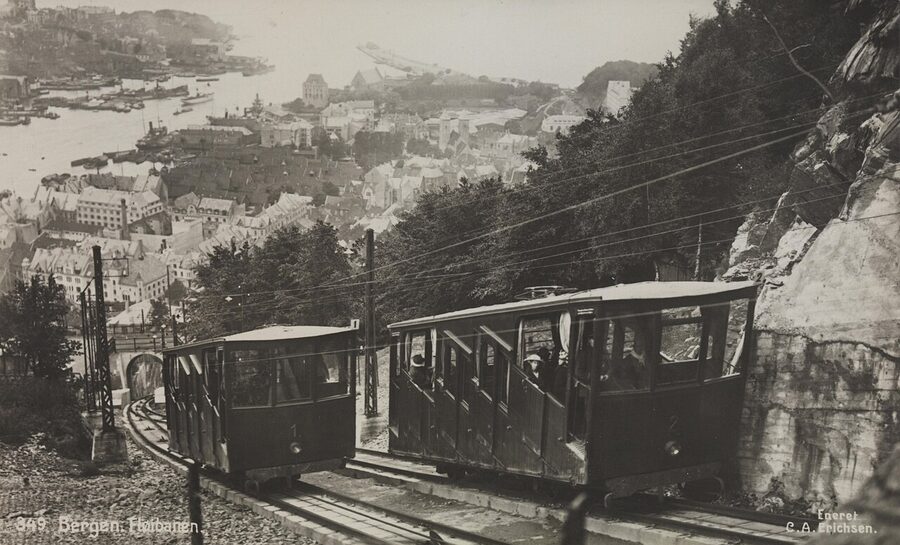
The thing every guide tells you (take the Fløibanen up for the view) is correct. The thing few guides tell you is what to do at the top. The platform itself is fine, with the city laid out below and the harbour visible all the way out to Askøy. There is a café and a souvenir shop and a children’s playground that is unreasonably good. But the actual reason to be up there is the path network behind the platform.
Walking down from Fløyen
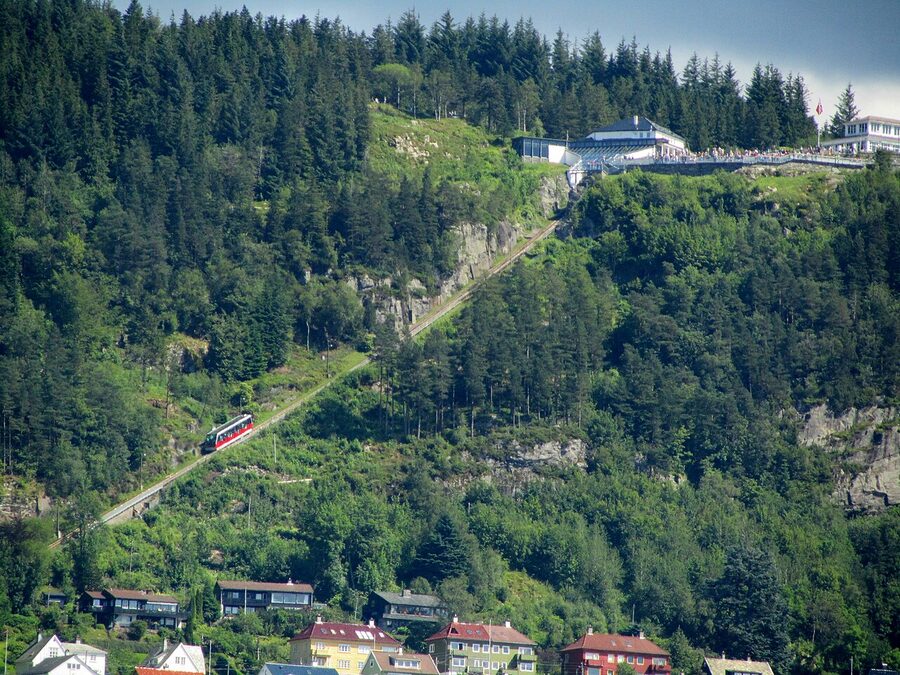
Three Sherpa-built stone-step paths descend from the Fløyen platform back to the city. The shortest, signposted “Mot Bergen sentrum” (towards Bergen centre), takes about 40 minutes and emerges at Skansen above the cathedral. The longer one through Skomakerdiket lake adds another 25 minutes and is the one to take if it is not raining. The longest, called Stoltzekleiven, drops via 880 stone steps to the Sandviken neighbourhood and is the local fitness path; the record is around 7 minutes; do not attempt this in wet weather, two or three people are seriously injured on it every year.
The system that works for most people is up by funicular, walk down. The total cost is the 130 NOK one-way single rather than 220 return, the descent gives you the better photographs (you see the city the whole way down rather than approaching the top platform), and you skip the queue at the upper station for the return ride. Tell the funicular staff you want a one-way; they will sell it without comment.
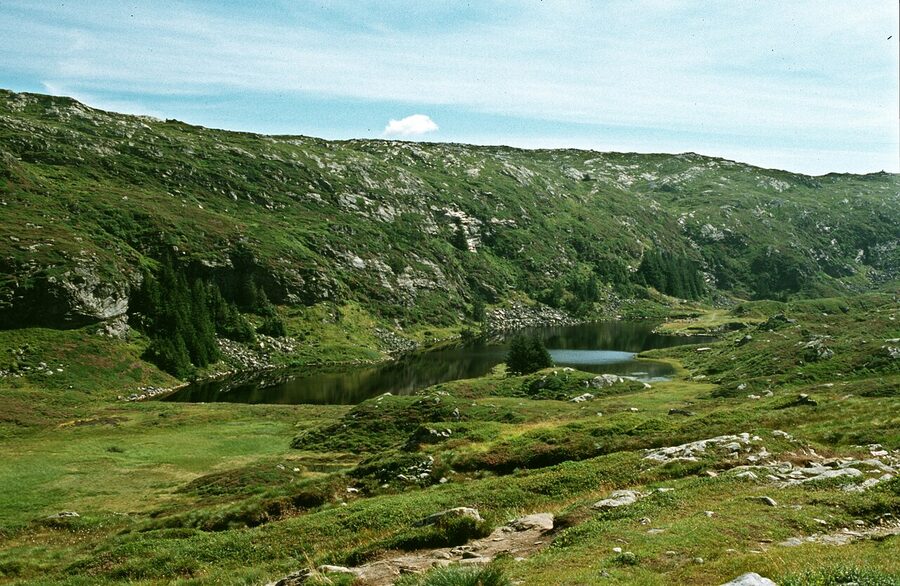
Beyond the platform there are about 18 km of marked paths up to the alpine lakes and goat pasture behind Fløyen. The Skomakerdiket lake (45 minutes from the platform) has a small jetty for swimming in summer (the water sits at about 14°C in August, brace yourself), and the path onwards to Brushytten goat farm and the Brushyttenrunden loop is 9 km return, well-signposted, properly Norwegian: rocky, mossy, with two boardwalk sections over bog. The signs are red T-marks painted on rocks. Pack a sandwich, allow a half-day, and treat it as the hike it is.
Mount Ulriken, the better view
If you only have one half-day for a high view, take Ulriken instead. It is the second of Bergen’s seven hills, at 643 metres almost twice the height of Fløyen, and the cable car (Ulriksbanen) lifts you to the summit in seven minutes for 395 NOK return (~€34). The panorama is better. From the top you see all seven hills, the open sea past Askøy, the runway at Flesland airport when planes are landing, and the city laid out below with Fløyen looking strangely small. The catch is location: the cable car base station is at Haukelandsbakken, 3.5 km east of the centre and not a walkable distance with luggage.
The combined ticket called Ulriken Round Trip includes a bus from Torget to the lower station, a cable car up, and the return. It costs 595 NOK in 2026 (~€51). Worth it if the day is clear, not worth it in rain (the platform is exposed, the cable car runs in heavy weather but you see nothing). The path between Fløyen and Ulriken, called Vidden, is the most popular day-hike in the city: 13 km of high open plateau, 5 to 6 hours one way, and you finish by riding the Ulriken cable car back down to the bus. Do this in clear weather only and not before mid-June, the upland snow lingers.
The Fish Market is touristy. The indoor Mathallen is the answer.
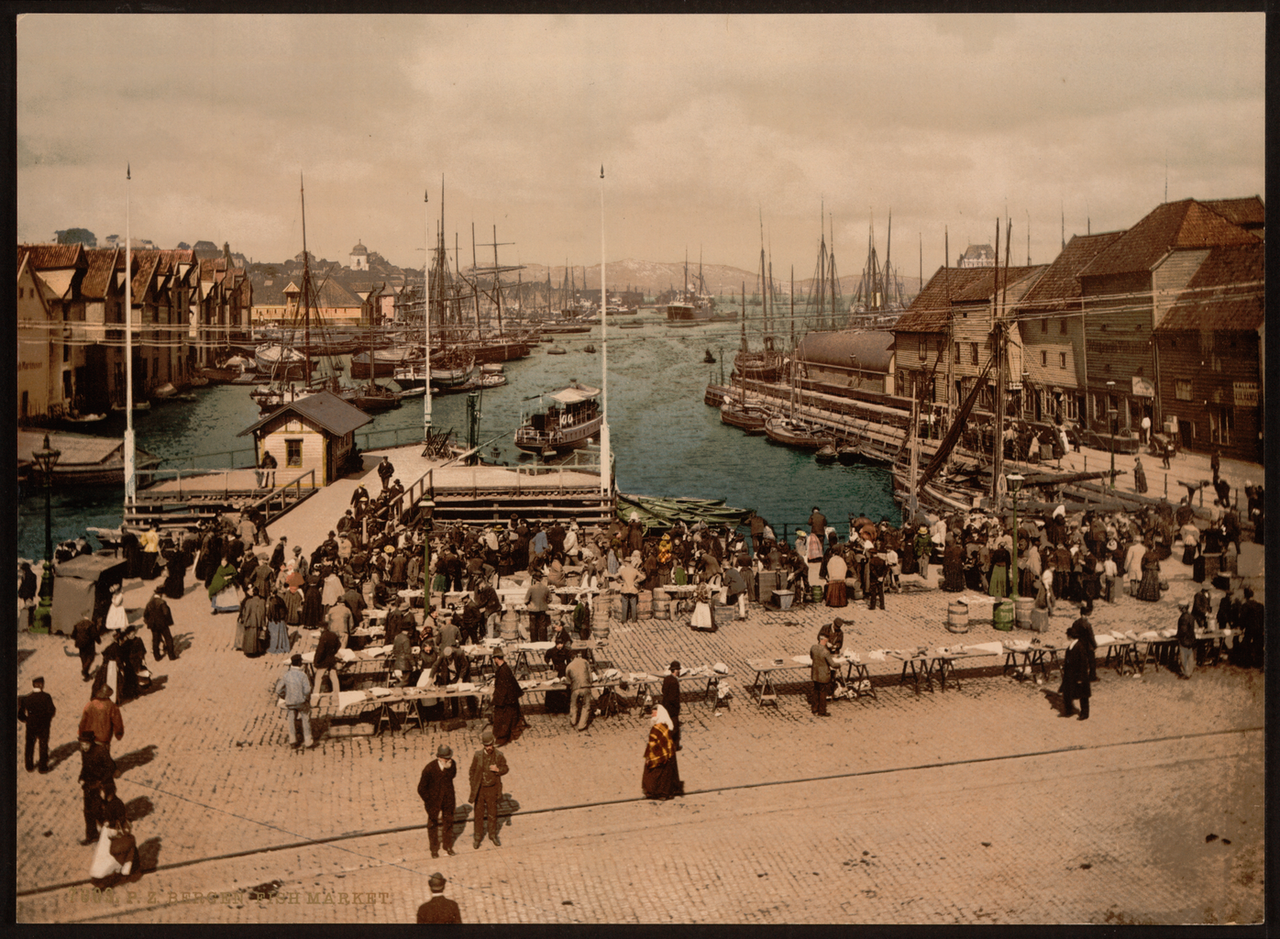
Bergen’s Fisketorget at the head of the harbour has been the city’s fish market since at least 1276. By the 19th century it was the largest open-air fish market in Norway. Today it is a tourist trap and I will say that plainly because most guides will not. There are 12 stalls left in the open-air section. Roughly half sell magnets and Viking helmets. Two stalls sell fresh catch at prices that genuinely shocked me on my last visit (490 NOK for two king crab claws ~€42, when the same crab is 280 NOK at the indoor Mathallen). The reindeer-burger stalls are aimed entirely at cruise passengers off ships in port for six hours.
The actual Bergen fish-market experience is 30 metres further, inside the Mathallen building (the indoor food hall, opened in 2012, glass-fronted, hard to miss). On the ground floor there are eight permanent fishmongers, three of them selling directly off the boats. The catch on the slab is what came in that morning from Hjellestad, Sotra and the smaller Hardangerfjord harbours. Halibut, monkfish, ling, the local crayfish, and from late August the langoustine catch from Glesvær. Prices run 200 to 350 NOK per kilo (~€17 to €30) for fresh catch, half what the outdoor stalls quote. Several of the stalls will fillet for you for free or cook a portion to order for around 250 NOK.
The upstairs of Mathallen is the Bergen Tourist Information office (the one good thing about the building’s other half). The basement has a small fishmonger queue at lunch, six tables, and the city’s best fish soup at 195 NOK (~€17) served in a chunky white bowl with a slice of dark bread. It is the dish I order every single time I am in Bergen, and the dish I would walk in the rain to get to.
The outdoor Fisketorget is open daily 09:00 to 18:00 in summer, shorter winter hours. Mathallen is open Monday to Saturday 10:00 to 18:00, closed Sunday. If a cruise ship is in (you will see it from anywhere on the harbour) the outdoor market is heaving and Mathallen still has a seat. That is the rule. Skip the outdoor stalls, eat at Mathallen.
KODE 1, 2, 3, 4: a half-day at four art museums for one ticket
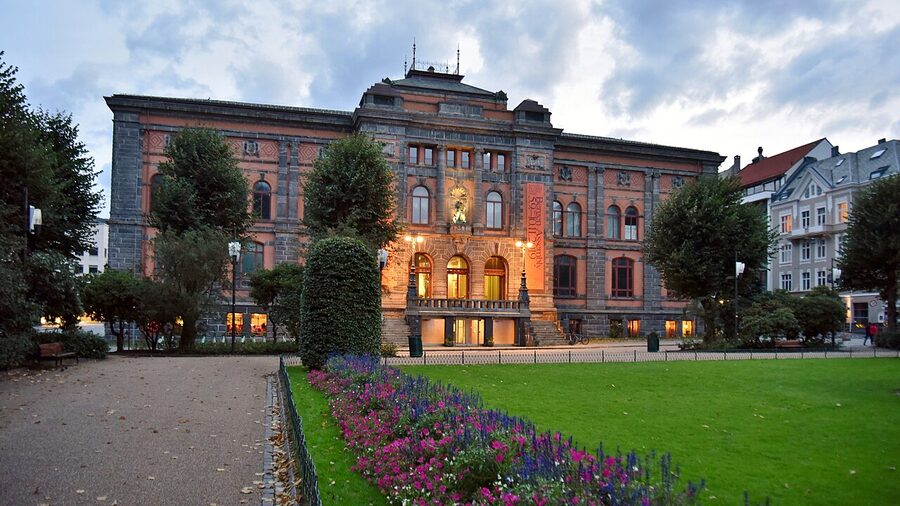
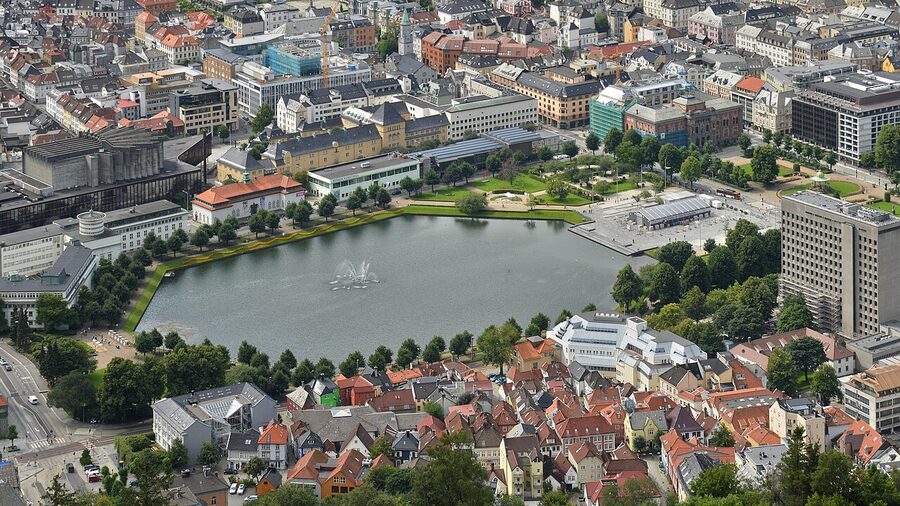
The four KODE buildings (named KODE 1, 2, 3 and 4) sit around the south end of the small ornamental lake Lille Lungegårdsvann, two minutes’ walk from the cathedral and four from the harbour. The complex is the largest art museum in Norway outside Oslo, holds the second-largest collection of Edvard Munch in the country, and one ticket at 220 NOK (~€19, valid two days, kids free) covers all four. They are open daily 11:00 to 17:00, Tuesdays closed in winter only.
If you only have time for one, make it KODE 3. This is the Munch and Astrup floor. The Munch holdings include early portraits, four versions of the Melancholy series, and the 1907 oil The Sick Child in its KODE iteration (the National Museum in Oslo holds the original 1885 version; KODE has the 1907 reworking, which Munch considered the better painting). The Nikolai Astrup floor is the surprise. Astrup was a contemporary of Munch, painted the same coastal Sogn region for his entire career, and his colour-saturated late landscapes are some of the strangest, brightest paintings you will see in any Nordic museum. Most overseas visitors have never heard of him; most Bergeners think Astrup is the better painter.
KODE 4 holds the modern collection (post-1945 Norwegian) and is the building most likely to be skipped by Munch-pilgrims. It rewards an hour. The Bjarne Melgaard installations on the second floor are properly aggressive and not for everyone, which is the point. KODE 1 is the older European collection, has a small but fierce J.C. Dahl room (the Norwegian Romantic painter is the artist who taught the country to see its own landscape), and a Picasso room that is mostly graphics. KODE 2 hosts rotating exhibitions; check the current programme on the day, sometimes worth it, sometimes not.
The complex also runs the three composer homes (Troldhaugen, Lysøen and Siljustøl), which are not on the central ticket but linked organisationally. More on those below.
Bergenhus, Håkonshallen and the Rosenkrantz tower
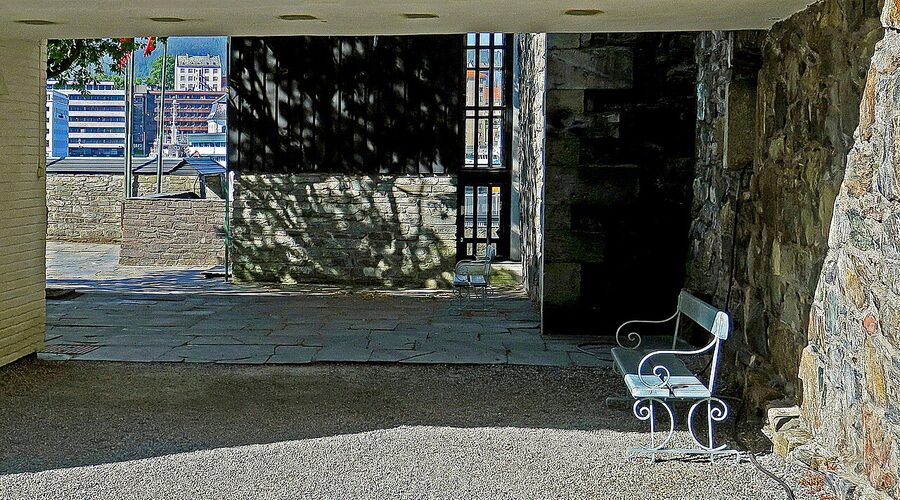
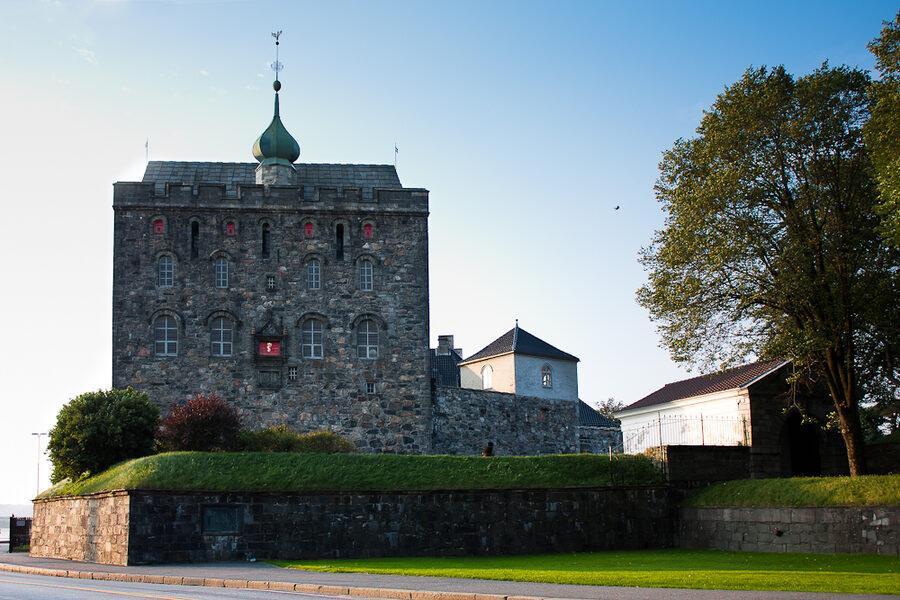
Bergenhus is the fortress at the harbour mouth, on the headland that closes Vågen at its northern tip. The two buildings worth going inside are Håkonshallen, the great royal hall built between 1247 and 1261 by King Håkon Håkonsson, and the Rosenkrantz Tower, a 16th-century keep built on top of an earlier 13th-century castle. The grounds are free; the two buildings together cost 130 NOK (~€11) on a combined ticket.
Håkonshallen is the older of the two and the more affecting once you know the story. It was built as Bergen’s royal residence when Bergen was Norway’s capital (yes, Bergen was the capital before Oslo, from roughly 1217 to 1314). The hall hosted the wedding of King Magnus Lagabøte to Princess Ingeborg of Denmark in 1261, the largest medieval royal event in Norwegian history. It then served as the royal seat for another 50 years before the kings shifted to Oslo. The interior you walk through today is a reconstruction. The 20 April 1944 Voorbode explosion blew the building’s roof off, and the medieval interior was so completely destroyed that the post-war reconstruction (1948 to 1961) is essentially a 20th-century interior inside 13th-century walls. Most of the wood, the wall paintings and the furniture date from the late 1950s. The Norwegian state was upfront about it from the start, which is why the explanation panels are so detailed.
The Rosenkrantz Tower next door is the keep added in 1565 by the Danish governor Erik Rosenkrantz on top of a much older castle that had been part of the royal residence. The tower interior is steep stone stairs, four floors, a rooftop terrace with one of the best low-angle views of Bryggen across the water (this is the photograph you have seen, every cruise brochure uses it). Allow about 40 minutes for the tower, an hour for Håkonshallen.
The fortress grounds are open free of charge from 06:30 to 23:00 in summer, slightly reduced winter hours. They are also the city’s military headquarters; you will see uniformed personnel on the parade ground. They are not actors. Stay off the marked army-only sections.
Mariakirken, the city’s oldest building
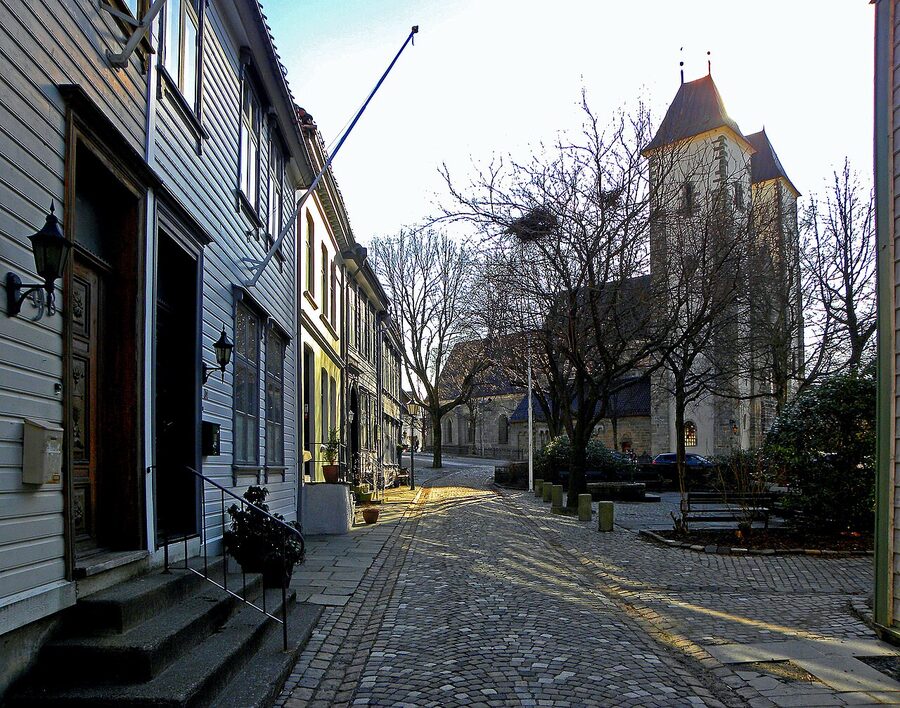
Set behind Bryggen, hidden by the warehouses if you walk the wharf, is Mariakirken (St Mary’s Church), built between roughly 1130 and 1180 in late Romanesque style. It is the oldest standing building in Bergen, predates the Hanseatic occupation, and was the official German Hanseatic parish church from 1408 until the trade ended in 1754. The interior has a 1480 altarpiece bequeathed by the Lübeck merchants, an extraordinarily well-preserved Renaissance pulpit covered in tortoiseshell panels (1676), and the thickest stone walls of any building in the city.
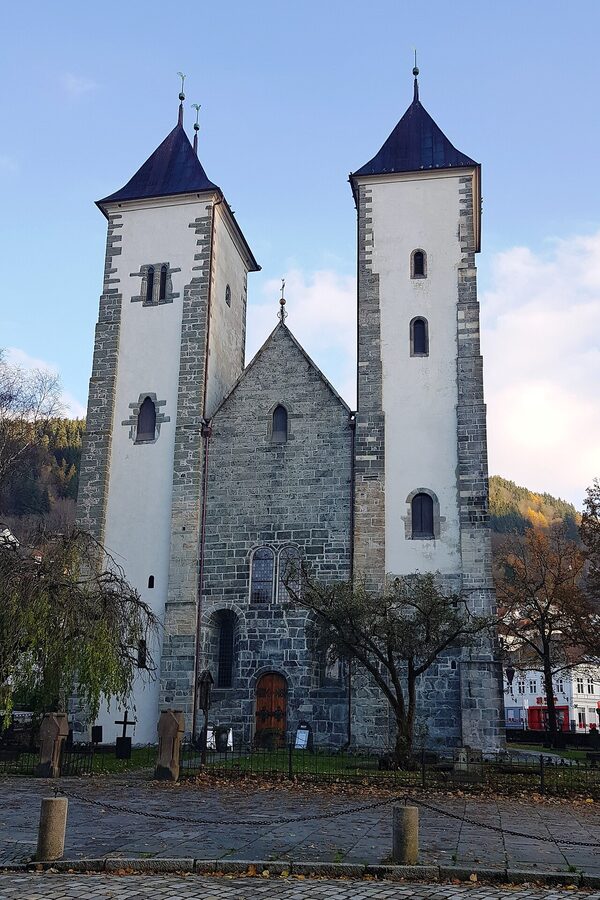
Entry is 60 NOK (~€5), or free with the Bergen Card. The church is open weekday afternoons 12:00 to 16:00, Saturdays 11:00 to 14:00, and is closed Sundays except for the 11:00 service. There is no audio guide; there is a bilingual leaflet at the door. Twenty minutes inside is enough. The reason to come is the contrast with Bryggen: you walk out of the painted-wood Hanseatic facade and 100 metres later you are inside a 12th-century stone Romanesque church that survived everything that levelled the wood. The two together explain Bergen’s history more efficiently than any museum panel.
The composer homes: Troldhaugen, Lysøen, Siljustøl
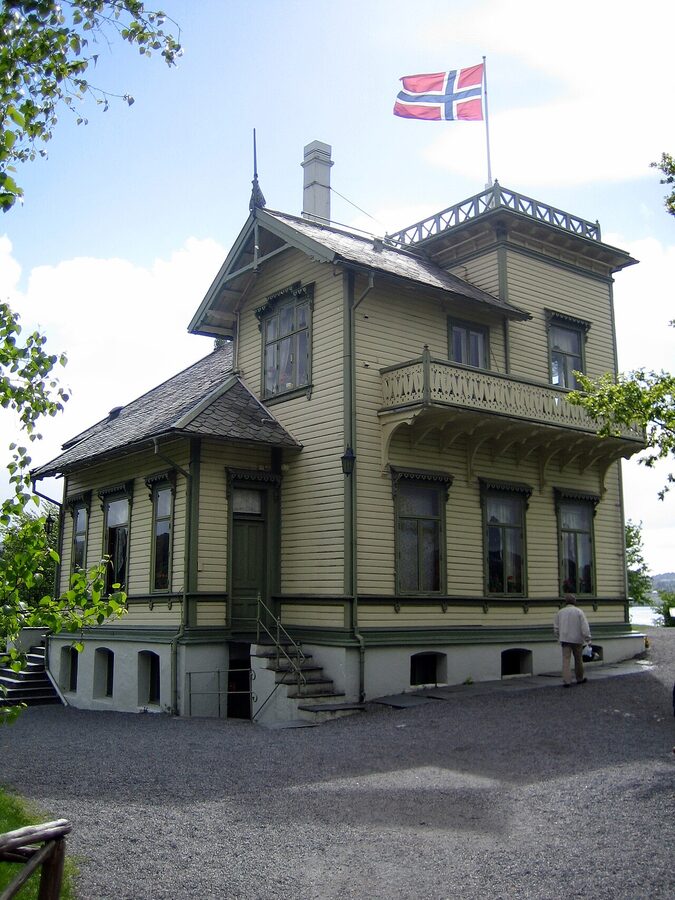
Bergen produced two major 19th-century musical figures and one near-major one, and all three of their homes survive on the city’s outskirts as small museums. They are not the obvious stop on a city break. They are the obvious stop if you have spent any time at all with Norwegian music, or if you want a half-day out of the city centre that is not a fjord cruise.
Troldhaugen is Edvard Grieg’s villa, 8 km south of the centre on the shore of Lake Nordås. Grieg lived here from 1885 until his death in 1907, composing in a small wooden hut at the bottom of the garden (the main house was reserved for his wife Nina, who could not work with the piano going). The hut is 12 square metres, built directly on rock, with a single window overlooking the lake. He could be in it within seconds of waking. The site includes the villa itself (open as a museum), the composing hut, the burial vault where Edvard and Nina are interred together in the cliff face above the lake, and a 200-seat concert hall where lunchtime piano recitals run daily in summer at 13:00 (245 NOK ~€21, includes museum entry). Bus 23 from Bergen Storsenter to Hop and a 20-minute walk, total an hour each way. Allow a full half-day with the recital.
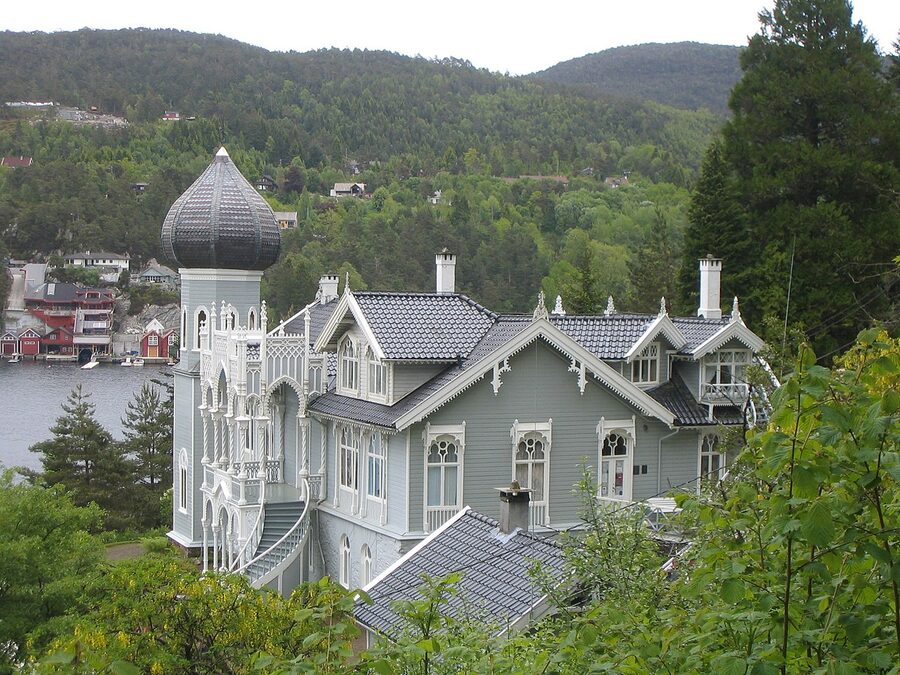
Lysøen is the violinist Ole Bull’s island villa from 1873. Bull was a 19th-century concert phenomenon (Liszt’s contemporary, Wagner’s drinking partner, briefly the most famous Norwegian alive after Henrik Ibsen) and he commissioned a wooden mansion on a small private island south of the city in a Russian-Moorish style that has no precedent or imitator. Onion domes, carved tracery, a music room with parquet floor and 80-seat capacity, all built from Norwegian pine. It is the strangest building you will see in this part of Norway. To reach it, take bus 67 from the Bergen bus terminal to Buena Kai (about an hour) then a 10-minute private boat across to the island. The boat runs Tuesday to Sunday from May to early September; in winter the island is closed. Allow most of a day. Entry plus boat is around 250 NOK (~€21).
Siljustøl is the composer Harald Sæverud’s home, a 22-hectare wooded estate at Rådal, 12 km south of the centre. Sæverud (1897 to 1992) was Norway’s most prominent 20th-century composer after Grieg, and his Siljustøl symphonies are the soundtrack of post-war Norwegian classical radio. The house and grounds are open Sundays only, 12:00 to 16:00, May to September, with summer concerts in the music room. It is the least visited of the three. Worth the trip if you have the time and you know the music.
The cruise-ship reality nobody talks about
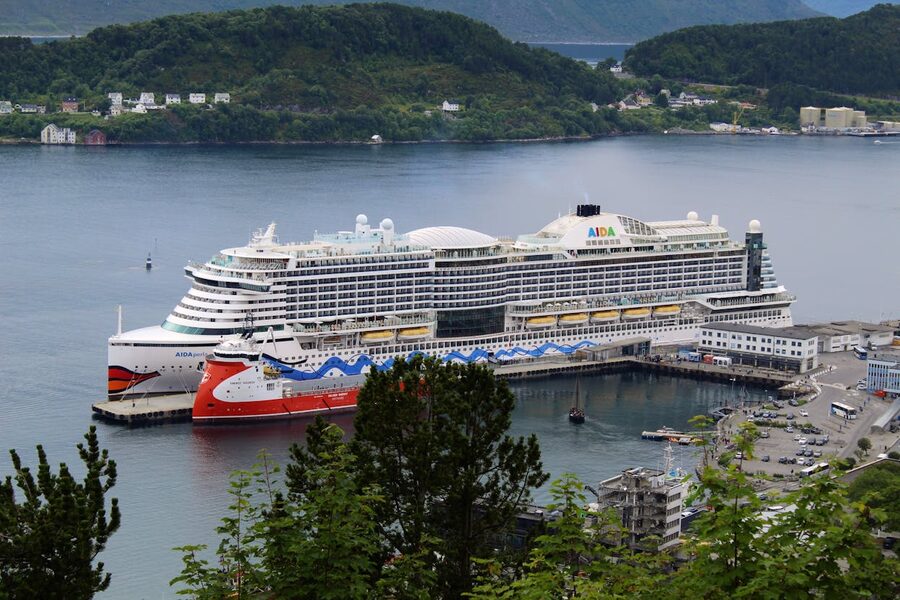
Bergen receives roughly 600 cruise calls a year, almost all of them between May and September. On peak days, six to twelve ships dock at Skoltegrunnskaien (the Bryggen-side terminal) and Jekteviken (the south terminal across the harbour). Those ships unload a combined 15,000 to 30,000 passengers in the morning and reload them in the late afternoon. The city’s permanent central population is about 80,000. The arithmetic is what shapes the centre.
What this means for you: on a cruise-heavy day, the Bryggen alleys are impassable from about 10:30 to 14:30, the Fløibanen queue runs over an hour, the Fish Market is unworkable, and the cafés all run a 30-minute wait. After 16:00, when the ships re-board, the city empties so completely that the same alleys you fought through at noon are silent at 17:00. By 19:00 the city centre is properly quiet, locals walk dogs along Bryggen, the cafés re-open table service.
The straightforward solution is timing. The Bergen Cruise Network publishes a port calendar online, with the daily schedule of which ships dock and how many passengers are aboard. You can check it the night before. On a heavy day, do Bryggen and Fløibanen at 07:30 to 10:00, retreat to a museum or the KODE complex from 11:00 to 15:00, and re-emerge for the evening. On a no-ship day, the city is yours all morning. There are no-ship days even in July, more frequent than you would expect, often Mondays.
The longer-term solution Norway is now imposing: from January 2026 the Bergen harbour is part of the new Geirangerfjord and Bryggen low-emission zone. Cruise ships not equipped for shore power are being progressively excluded; by 2032 only zero-emission vessels will be permitted. This will reduce ship calls considerably. Bergen’s tourism office welcomes it; the harbour cafés that depend on the lunch trade do not. Both can be true.
Where to stay in Bergen, by neighbourhood
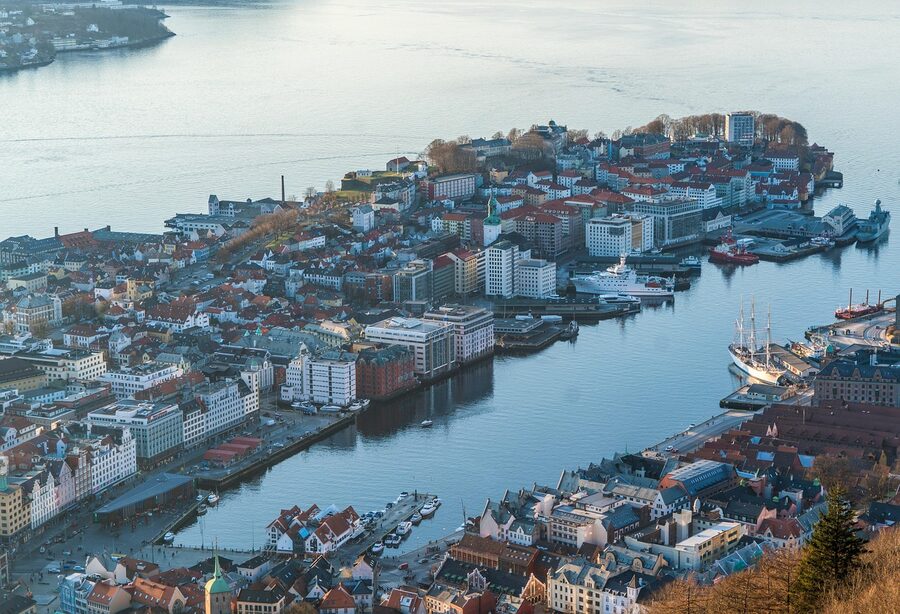
Bergen’s centre is small enough that distance is not the question. The question is what you want to wake up to. Three areas make sense for most visitors.
Bryggen-side means the Sandviksveien strip that runs north along the harbour from the wharf, plus a couple of hotels embedded in Bryggen itself. The view is the wooden warehouses; the trade-off is street noise from the bars on Bryggen on weekend nights and the cruise terminal directly opposite (you will hear engines from May to September). Torget side is the head of the harbour, around the Fish Market, slightly quieter, equally central, ten minutes’ walk to anything. Nygård is the residential quarter south of the centre, a 12-minute walk from the harbour, where Bergeners actually live; cheaper hotels, no view but better breakfast. Pick by what matters to you.
The hotels worth booking
Det Hanseatiske Hotel is the only hotel inside a Bryggen warehouse, the 1704 Finnegården building, 37 rooms with original beam ceilings and tilted floors. Rates run 2,400 to 3,800 NOK (~€210 to €330) for a double in shoulder season and substantially more in July. It is the most atmospheric room in the city; it is also the building moving slightly in the wind. Light sleepers should book the ground floor.
Opus XVI is a 4-star boutique inside the former Bergens Privatbank building from 1876, three minutes from Bryggen. Edvard Grieg’s family had a flat in the same building in the 1880s, which the hotel uses in its branding. 65 rooms, polished walnut, the best in-house breakfast in the centre. 2,200 to 3,200 NOK in shoulder season.
Bergen Børs Hotel occupies the old stock exchange (1893), directly on Torget. The lobby is the trading floor, with the original marble desks. 127 rooms, very good restaurant in the basement (Bare Vestland), three minutes from anything. 2,400 to 3,400 NOK shoulder season.
Hotel Norge by Scandic is the city’s grande dame, refurbished in 2018, 415 rooms on Ole Bulls plass, the central square. The rooftop bar (level 14) has the best non-funicular view in the city; non-guests can come up if a table is free. 1,800 to 2,800 NOK shoulder.
Clarion Hotel Admiral sits across the harbour at C. Sundts gate, looking directly at Bryggen. The view rooms are the reason to book here; the trade-off is being on the wrong side of the water for the morning Bryggen walk. 1,900 to 2,900 NOK shoulder.
Thon Hotel Rosenkrantz is the workhorse mid-range, two streets behind Bryggen, 129 rooms, free afternoon waffles in the lobby (this is a Norwegian thing). Reliable, central, slightly anonymous. 1,500 to 2,200 NOK.
Klosterhagen Hotell is the unusual one. It is a small 19-room hotel in a quiet courtyard at Klosteret in Nordnes (the old fishing quarter west of the centre), and it is run as a vocational training centre by a non-profit that employs young adults coming out of substance recovery. The breakfast is genuinely good, the rooms are simple and clean, and you are doing some quiet good. 1,200 to 1,600 NOK. The catch is the location, eight minutes’ walk to Bryggen, fifteen to the train station.
Citybox Bergen is the budget option that does not feel like a budget option. Self-check-in via app, 91 minimalist rooms in the old Hotel Augustus building, eight minutes to Bryggen. 900 to 1,400 NOK depending on season. Book the courtyard side; the front rooms hear the Saturday-night trams.
For the airport hotel needs only, Comfort Hotel Bergen Airport at Flesland is the obvious one (200 metres from the terminal, 1,000 to 1,400 NOK). Otherwise stay in town and take the Bybanen tram to the airport in 45 minutes.
Eating in Bergen, the four-meal version
Bergen punches well above its size on food. There are four meals worth planning around.
The fish soup at Mathallen already covered above (195 NOK ~€17, lunch only, no booking) is the city’s signature lunch. It is the cheapest world-class meal you will eat in Norway.
For a casual evening, Pingvinen on Vaskerelven (a five-minute walk south of Bryggen) is the local pub-restaurant that serves Norwegian comfort food: lapskaus (a slow-cooked beef stew, 195 NOK), reindeer cakes with potato and lingonberry (270 NOK), and the kjøttkaker (Norwegian meatballs, 215 NOK) that Bergeners argue about. No booking, plain wooden tables, three local beers on tap. Open from 14:00 to midnight.
For a serious dinner, Lysverket in the KODE 4 building is one of two Michelin-listed restaurants in the city (the other is Bare Vestland in the Børs Hotel). Lysverket runs a tasting menu at 1,495 NOK (~€129) that leans entirely on Vestland produce, particularly the small-boat catch from the islands west of Bergen. Book three weeks out for a weekend. The wine list is heavy on Western European whites and the staff will steer you well.
For the unusual one, Trekroneren is a hot-dog cart on Kong Oscars gate, near the cathedral, that has been in the same family for four generations and serves reindeer sausage (98 NOK ~€8.50) on a soft bun with crispy onions. Locals queue at lunch; tourists rarely find it. Open Tuesday to Saturday, 11:00 to 18:00, cash only on the dining-customers side. It is the cheapest reindeer you will eat in Bergen and probably the best.
For coffee, Det Lille Kaffekompaniet at Nedre Fjellsmug above Skansen is the small roastery the locals use; Kaffemisjonen on Øvre Korskirkeallmenningen is the city-centre alternative. Avoid the chain coffee on Bryggen; both the Espresso House and the Starbucks there are tourist-priced.
For takeaway when you are tired, every Rema 1000 supermarket in the centre sells a packaged smoked salmon and pickled herring sandwich for around 50 NOK. It is the cheap dinner Bergeners actually eat.
Getting to Bergen from Oslo: the train, the flight, the sleeper
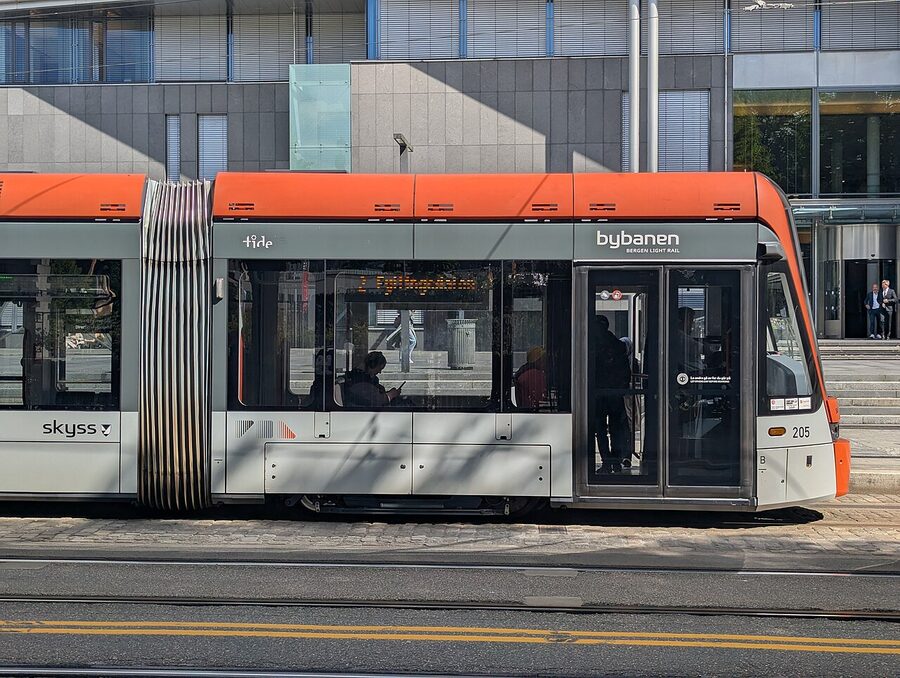
From Oslo you have three options. They are not equivalent, and the right one depends entirely on what you want from the journey.
The Bergen Line train is the canonical journey. Six and a half hours from Oslo S to Bergen, four daily departures, the world’s highest mainline railway (1,237 metres at Finse), and the journey itself is the reason most people take this route. Standard fare 999 NOK (~€86) booked seven days out, drops to 449 NOK if you book 90 days out, climbs to 1,499 NOK if you book the day before. Vy.no is the only place to book; the Eurail and Interrail passes are valid and worth using if you have one. We have a separate piece on this train if you want the through-by-through detail; see the Oslo to Bergen train guide for what to bring, where to sit, and where the Flåm branch goes off.
The flight takes 55 minutes, costs 600 to 1,400 NOK on SAS or Norwegian, and lands you at Flesland (BGO) 18 km south of the centre. The Bybanen light rail from the airport to the city is 45 minutes and 50 NOK; the airport bus (Flybussen) is 30 minutes and 159 NOK; a taxi is 800 to 1,000 NOK. Take the Bybanen unless you are running for a hotel check-in. The flight is the right choice if your trip is short and the train is not the point.
The night train to Bergen runs once daily from Oslo S, departs around 23:00, arrives 07:00. The standard sleeper compartment is 1,250 NOK (~€108) including breakfast, the double cabin is 2,250 NOK. You wake up rolling into Bergen at first light. This is genuinely a good way to do it if you would otherwise lose a half-day to the train. The compartments are small but well-designed, with reading lights and a private door that locks. Book the upper bunk for the better window; the lower bunk has more headroom.
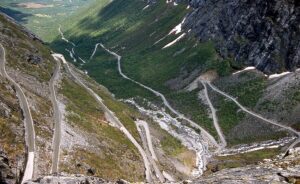
If you are coming from Oslo by car, allow seven hours via the E16, eight hours in winter, ten hours if any of the high passes are closed and you have to detour via Stavanger. The Hardangervidda is the most reliable of the cross-country roads but closes in heavy snow. The route is beautiful; it is also long. Most people who do it once would say once was enough; the train and the night train are properly more comfortable. For drivers who want to keep the car after Bergen, the city has long-stay car parks at Bygarasjen at the bus terminal (320 NOK per day) and underground parking at the centre.
From Oslo the standard pivot to Bergen is the Bergen Line train; from Lofoten the standard route is to fly back to Bergen via Oslo or Tromsø. Bergen is also the western anchor of the Norway road trip route; the southern spur at Stavanger is reachable in about five hours by car or by Fjord Line ferry direct from Bergen.
Day trips from Bergen worth taking
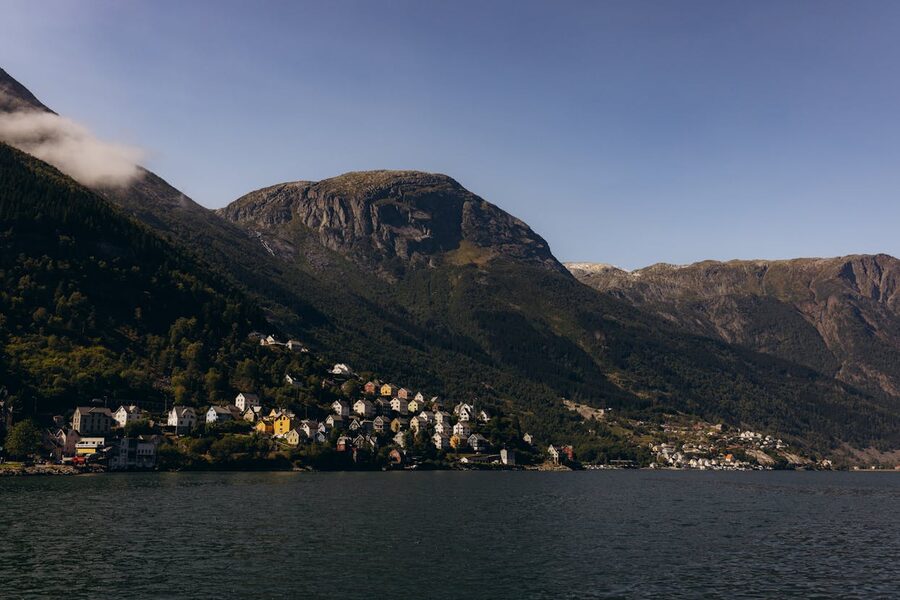
Bergen is the western fjord-country base, and the day-trip options are genuinely spoiled for choice. The verdicts:
Sognefjord-in-a-Nutshell is the most-marketed day trip. Train from Bergen to Voss, bus to Gudvangen, electric ferry through the UNESCO Nærøyfjord to Flåm, Flåm Railway up to Myrdal, Bergen Line back to Bergen. About 12 hours, 2,500 NOK (~€215) booked through Fjord Tours, 1,700 NOK if you DIY the same legs through Vy and the local ferry operator. The DIY saves 800 NOK and works fine if you can read a Norwegian timetable. The trip itself is genuinely good; it is also a long day. The Flåm Railway guide covers the whole thing in detail if you want the schedule.
Mostraumen rib tour is the three-hour boat trip through the Mostraumen tidal narrows, with seal sightings and a stop at the Mostein gorge. Around 850 NOK adult (~€73), runs daily from May to September from the harbour at Strandkaiterminalen. It is the active, less-known option and the one I prefer to the bigger fjord cruises. The boat is small (24 passengers), you wear waterproof overalls and a life jacket, and the wind hits you in the face for the full duration. Bring a hat.
Glesvær langoustine boat is the local-favourite trip nobody markets. Glesvær is a tiny fishing village on the island of Sotra, 25 km west of Bergen by car, and from August to October the village runs a langoustine boat that goes out at 09:00, hauls the pots, brings the catch back, and serves langoustine at the dockside restaurant Cornelius for 595 NOK (~€51) the same evening. You need a car, you need to book at least a week ahead, and the boat does not run if the weather is bad. It is one of the best meals in Norway.
Hardangerfjord from Bergen is doable as a day trip but it is a long day. The Norled express boat from Strandkaiterminalen runs to Norheimsund and Eidfjord in summer, with the journey in around four hours each way. If you have the time, two days is better; if you have one day, do Sognefjord-in-a-Nutshell or Mostraumen instead.
The seasons in Bergen, briefly
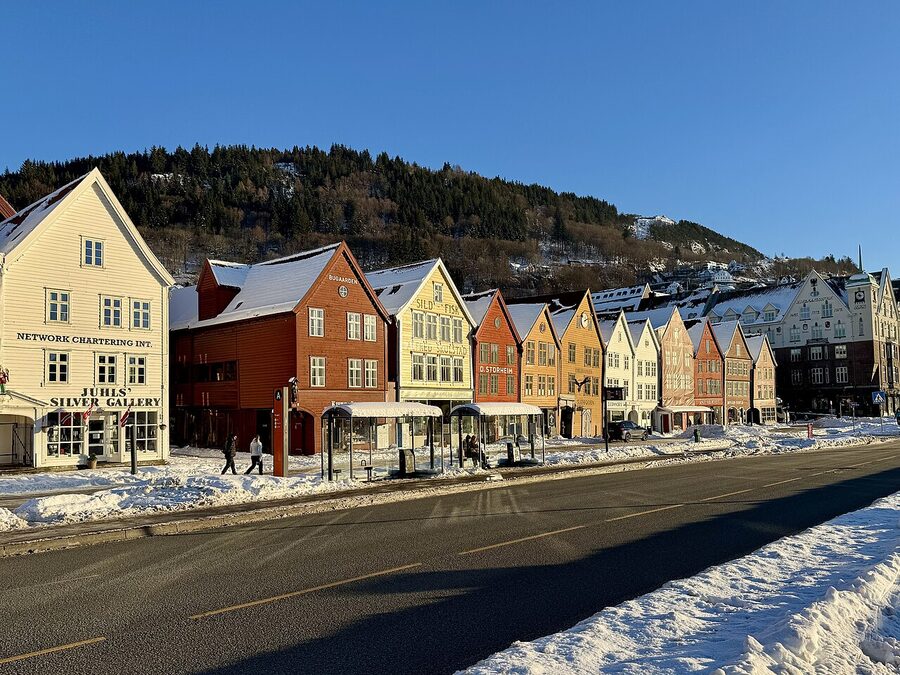
June is the hardest to beat. Long evenings, daylight from 04:30 to 23:30 at the solstice, the Bergen International Festival (Festspillene) from late May into early June with classical, jazz and theatre, average highs of 17°C, average rainfall of 130 mm (yes, even in June). The crowds are heavy from mid-June onwards, but the weather is the best it gets and the daylight extends every walking day.
September and October are the underrated months. The cruise season tapers from late September; by mid-October there are no ships at all. The light is autumnal and cinematic, the rain is statistically heavier than summer (October averages 270 mm) but the temperature still sits at 8 to 12°C, and the city’s interior life (museums, restaurants, the Grieg recitals) all run. This is when the city is most itself.
December works for a specific kind of traveller. The Christmas market (Pepperkakebyen, the gingerbread city) at the Krohnhallen runs from mid-November to the end of December; it is the largest of its kind in the world (every gingerbread house is built by a local family or business), genuinely charming, kids love it. The actual outdoor Christmas market is small. Daylight in December is six hours (about 09:30 to 15:30), it rains as much as October, and the Fløibanen runs reduced hours. Hotel rates drop noticeably in early December and rise hard from 23 December.
January and February are the quiet months. Some days are extremely beautiful (clear, cold, snow on the hills, no crowds anywhere), most days are wet and grey. The Bergen Card pays for itself faster in winter because museums and the funicular are the indoor rotation.
March to May is the awkward shoulder. The weather is improving but unreliable, the cruise season has not started, the spring cherry blossom around Lille Lungegårdsvann is brief and pretty, and the daylight is climbing. Hotel rates are at their lowest. If you are on a budget, this is the window.
Practicalities most guides skip
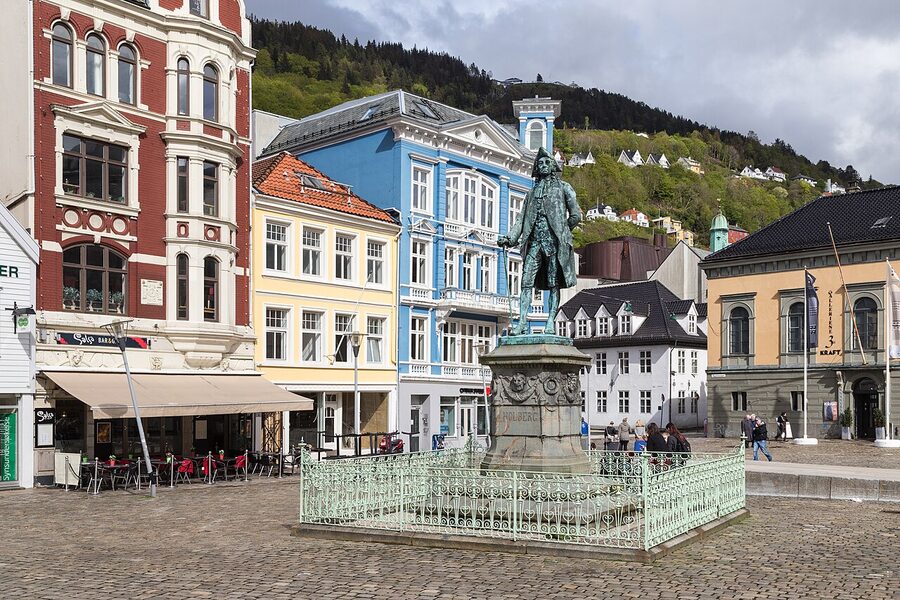
The Bergen Card (530 NOK / ~€46 for 24 hours, 695 / ~€60 for 48 hours, 815 / ~€70 for 72 hours, kids half) covers the Fløibanen, all KODE buildings, the Hanseatic Museum, Bryggens Museum, Mariakirken, Håkonshallen and the Rosenkrantz Tower, all Bergen city buses and the Bybanen light rail, and gets you 20 to 50 percent off most other attractions. If you are doing the funicular plus two museums in 24 hours it pays for itself. Buy it from the Tourist Information at Mathallen.
Cash is irrelevant. Bergen is functionally cashless. Every cafe, museum, bus, taxi, and even the Trekroneren hot-dog cart takes contactless cards. ATMs exist but you will not need one. Small businesses occasionally still have a 50 NOK minimum for card; rare.
Tipping is not expected. Round up at restaurants if the service was good (5 to 10 percent if you really enjoyed yourself), and that is generous. The bill always includes service.
Tap water is excellent and free everywhere. Fill a bottle. Bottled water in Bergen costs 35 to 50 NOK and is identical.
The Bergen dialect (bergensk) drops the trill on the R, sounds noticeably more guttural than Oslo Norwegian, and is internally a source of pride. Locals will switch to English the moment they hear an accent; do not feel bad about it.
Public toilets are at the bus terminal, the train station, on Torget by the Fish Market, and inside Mathallen. Most cost 10 NOK by card. Cafés will let you use theirs if you buy something, not otherwise.
The 17 May national day is the busiest day of the year for accommodation, regardless of season. Booking three to six months out is normal. The constitution-day parade through the centre at 11:00, with the children’s parade in national dress, is one of the genuinely affecting public events I have seen in Europe; if you are anywhere near western Norway on 17 May, come to Bergen for it.
What to skip, said plainly
The VilVite Science Centre is good for kids in a downpour and is otherwise skippable.
The Old Bergen Open Air Museum at Sandviken is fine if you have not been to Skansen in Stockholm or Norsk Folkemuseum in Oslo. If you have, this is a smaller version of the same idea. Skip unless you have a half-day to spare.
The Bergen Aquarium on Nordnes peninsula is the answer when it has rained for three days straight and you have small children. It is otherwise nothing remarkable.
The outdoor Fish Market stalls, as covered above, are a tourist trap. Mathallen instead.
The Floibanen souvenir shop and gift kiosks on Bryggen sell wool sweaters at twice the price of Husfliden on Vågsallmenningen. Buy at Husfliden if you are going to buy a Dale of Norway.
The Norway in a Nutshell branded fjord cruise is fine but expensive; the unbranded version of the same trip is 800 NOK cheaper. See above.
The “medieval banquet” tourist evenings with costumed servers and mead is exactly as bad as it sounds.
Final scene
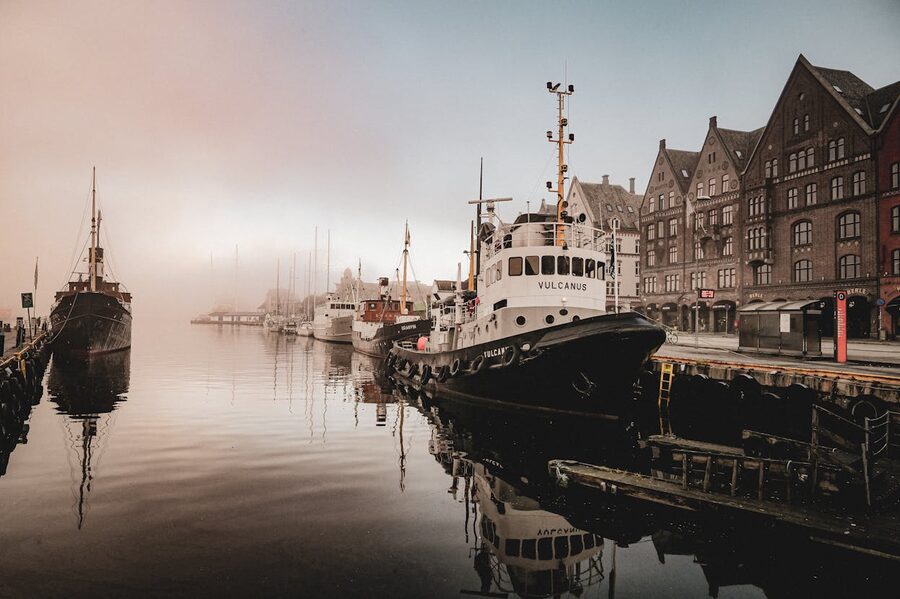
The Bergen I keep coming back for is the 06:30 walk along Bryggen on a wet October Tuesday. The cruise terminal is empty. The cafés are not yet open. The cathedral bell at Domkirken rings six times. A man in a yellow Sydvesten coat, a fish merchant on his way to Mathallen, walks the alley I am walking in the opposite direction and we both raise a hand without speaking. The air smells of woodsmoke from the morning chimneys above Skansen and creosote off the planks. The painted gable ends are still half-asleep in the dark. By 09:00 it will be a different place. By 11:00 it will be a UNESCO site full of tour groups. But right now the city is the city, the rain is the rain, and the water at the foot of the alley is moving the way it has moved here for nine hundred years.
Bring the right coat. Walk slowly. Let the rain do what it does.


.jpg)


.jpg)


.jpg)