Iceland has roughly 120 public swimming pools, one for every 3,100 people. Britain has one for every 25,000. The reason is geothermal water; the result is a culture you can walk into for 1,300 ISK (~€9) and a willingness to shower naked first. The locals call it the sundlaug, and it is the actual everyday Iceland that the Blue Lagoon is not.
Iceland is a country where the local pool replaces the local pub. People go after work to argue about football, gossip, and sit in the 42°C hot pot for forty minutes. School kids are taught to swim from age five. The pools open early and close late, run year-round, charge less than a coffee, and the water is geothermal and clean enough that the chlorine count is a fraction of what a chemically-treated UK pool needs. If you have spent any time at all in Helsinki and remember how the public sauna works there, the Icelandic sundlaug is the same idea on the other end of the Nordic arc: a public-good ritual, run cheaply, used by everyone, dressed up by nobody.
This is the guide to using one. Six pools in Reykjavík that matter, six regional standouts that are worth a detour, the etiquette that trips up visitors, and a reality check on whether the famous lagoons are actually better than the city pool half a kilometre from your hotel.
In This Article
- The thing nobody tells you: it’s not a spa
- The naked-shower rule, dealt with once
- The Reykjavík six
- Sundhöll Reykjavíkur: the 1937 Functionalist landmark
- Laugardalslaug: the big one
- Vesturbæjarlaug: the locals’ favourite
- Sundlaugin í Árbæ: the family one
- Klébergslaug: the small village pool inside the city
- Grafarvogslaug and Breiðholtslaug: the suburban two I’d skip
- The Snorralaug, the saga, and the 13th-century pool
- The regional pools worth a detour
- Hofsós: the infinity edge on Skagafjörður
- Krossneslaug: the Atlantic-edge one in the Westfjords
- Mývatn Nature Baths: the northern Blue Lagoon
- GeoSea Húsavík: saltwater on the cliff edge
- Reykjafjarðarlaug: the Westfjords cliff pool
- Drangsnes: the three roadside hot pots on the beach
- Seljavallalaug: the 1923 pool you have to walk to
- Sundhöll Hafnarfjarðar and the other near-Reykjavík pools
- What to bring, and what not to
- When to actually go
- The Blue Lagoon question, asked once
- Aurora, hot pots, and the photograph
- The detail nobody tells you about the locker tag
- The list of pools that aren’t worth it
- One last thing
The thing nobody tells you: it’s not a spa
The Icelandic sundlaug is a swimming pool. That sounds obvious; it’s not, because half the visitors who come to Iceland have been told to expect a Blue-Lagoon-style spa experience and arrive at Vesturbæjarlaug expecting one. They get a 25-metre lap pool, a kids’ slide, four hot pots at staggered temperatures (38, 40, 42, 44°C), a sauna and a steam, and a cold-water plunge. There’s a cafeteria selling hot dogs and ice cream. The changing rooms are functional, not luxurious. The locker tags are on a rubber wristband. Nobody is bringing you a robe.
This is the point. The Icelandic public pool is the cheap, daily, plain-clothes version of what gets sold to tourists for 60 euros at the lagoons. The water is exactly the same source. The hot pots run hotter than the Blue Lagoon’s. The cold plunge is colder. There are more locals. And it costs 1,200 ISK (~€8) instead of 12,990 ISK (~€88).
The naked-shower rule, dealt with once
The single hardest thing for visitors to do is the mandatory pre-pool shower. Without a swimsuit. With soap. In front of strangers. There are signs in eight languages on the changing room walls; there is sometimes a member of staff actually checking. This is not optional, it is not negotiable, and the entire reason Iceland’s pools can run with so little chlorine is that everyone in the country was raised to do this from age five.
Here is what the rule actually looks like in practice. You buy your ticket, get given a wristband or a key. You go to the gendered changing room (men’s on one side, women’s on the other; sundlaug changing rooms are not mixed). You take everything off, hang it in the locker, walk to the open communal shower. There are bottles of liquid soap on the wall. You wash, properly, and you wash all five of the spots that the diagram on the wall labels: armpits, groin, feet, hair, and face. Then you put your swimsuit on and walk through to the pool. Reverse on the way out, with another shower in the swimsuit first to rinse the chlorine and hot-pot mineral water off your skin.
Nakedness in the changing room: standard, normal, not noticed, not stared at. Nakedness in the pool itself or the hot pots: not done, swimsuit only. This trips people up because they assume the rules at, say, Yrjönkadun uimahalli in Helsinki (where you can swim naked in some sessions) apply here. They don’t. Iceland’s public pools are swimsuit-on for the actual swim, swimsuit-off for the wash. Treat the changing room as the locker stage, not the social one. Nobody is looking, the Icelanders genuinely don’t care, and the staff are watching for hygiene compliance, not for tourists feeling self-conscious.
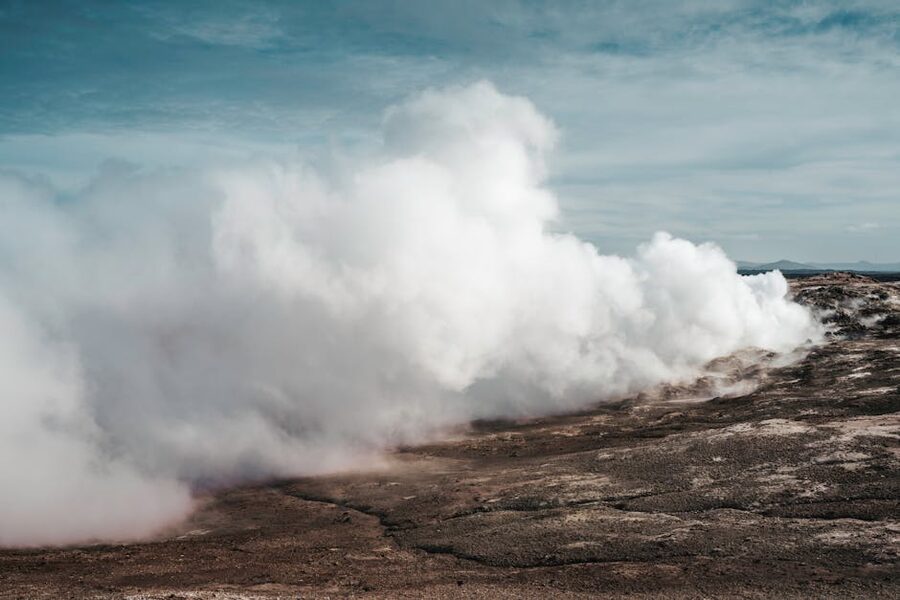
If the rule is a hard psychological no, you have one practical option: the family-only family changing rooms exist at a few of the bigger pools (Laugardalslaug has them, Sundhöll Reykjavíkur added them in the 2017 renovation), with private cubicles. You will pay no more than the standard ticket. You will still need to walk through the communal shower area to get to the pool, but you can do the actual showering inside a cubicle.
The Reykjavík six
The city operates seven public pools, run by the Sundlaugar Reykjavíkur department. I’d cover six of them. The seventh, Breiðholtslaug, is the suburban one I’d skip unless you happen to be staying in Breiðholt, in which case it’s perfectly fine and very cheap. Same goes for Grafarvogslaug; functional, no reason to travel for it. The six below are the ones that actually reward a detour from a downtown base.
Sundhöll Reykjavíkur: the 1937 Functionalist landmark
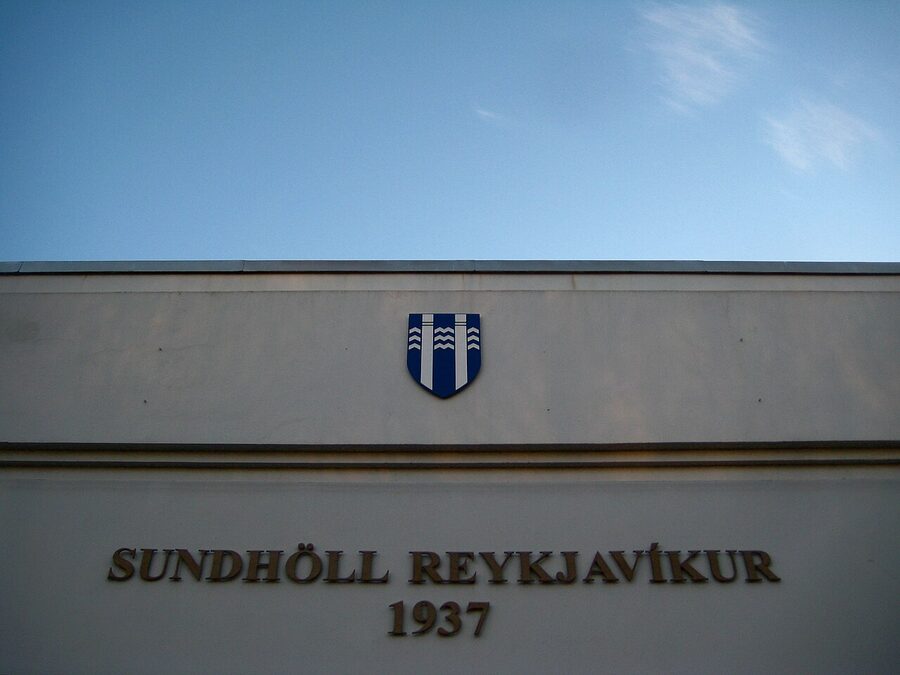
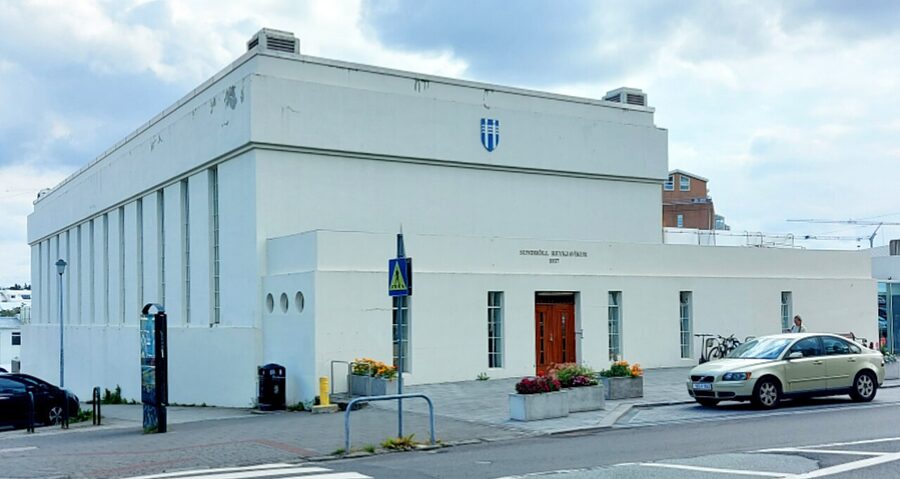
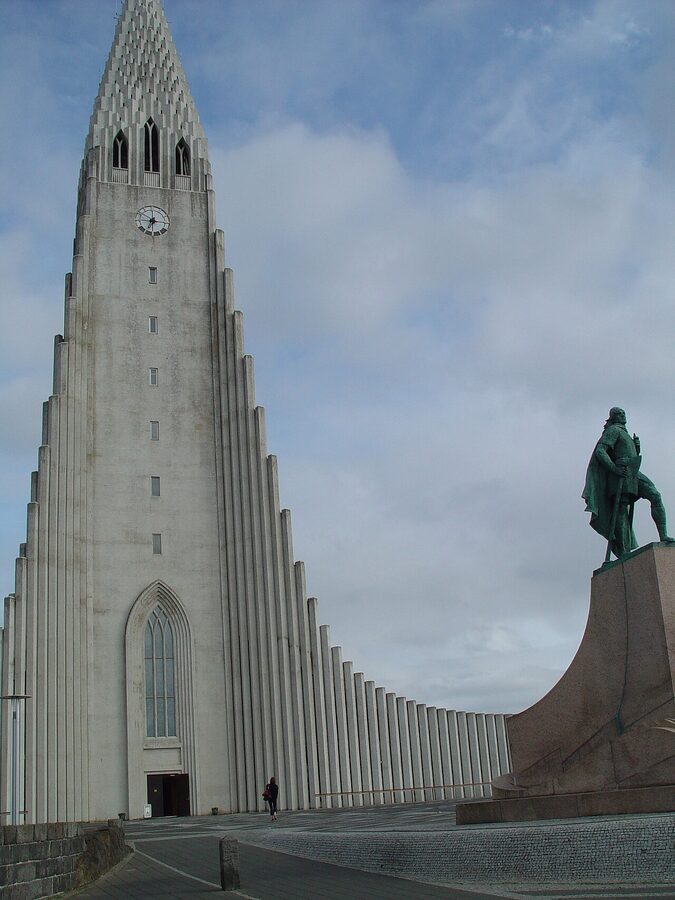
If you only have time for one pool in Reykjavík, this is the one. Sundhöll Reykjavíkur opened on 23 March 1937 as Iceland’s first indoor swimming hall, designed by Guðjón Samúelsson, the state architect who later did Hallgrímskirkja, the National Theatre, and Akureyri Cathedral. The building is a piece of Functionalist architecture from the period, white stuccoed concrete with the small porthole windows and the strict symmetry the style was known for. It sat on Barónsstígur, two blocks from Hallgrímskirkja, and was the first time anywhere in the world a public pool was heated entirely from a city’s geothermal hot-water grid.
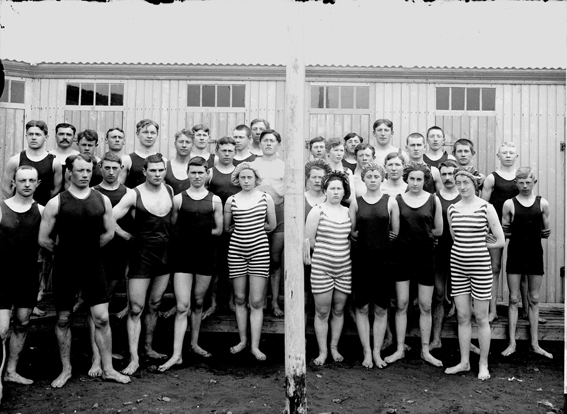
The original 25-metre indoor pool is still there and still in use. In 2017 the city added an outdoor pool on the back of the building plus a row of new hot pots, a steam room, and a kids’ splash area. The result is the city’s most central pool, with the city’s strongest architecture, in walking distance of every Reykjavík hotel that costs less than 200 euros a night. Tickets are around 1,330 ISK (~€9). Open 06:30 weekdays and 08:00 weekends, closing 22:00 most days. The morning rush of locals heading in before work is a real thing and is very fast: shower, ten lengths, hot pot, out, dressed, by 7:45.
Address: Barónsstígur 45a, 101 Reykjavík. Hours: Mon-Thu 06:30-22:00, Fri 06:30-20:00, Sat-Sun 08:00-20:00. Price: 1,330 ISK (~€9), ten-trip card 7,490 ISK (~€51). Getting there: twelve-minute walk from Harpa, ten from Hallgrímskirkja. Bus 12, 13, or 14 to Hlemmur.
Laugardalslaug: the big one
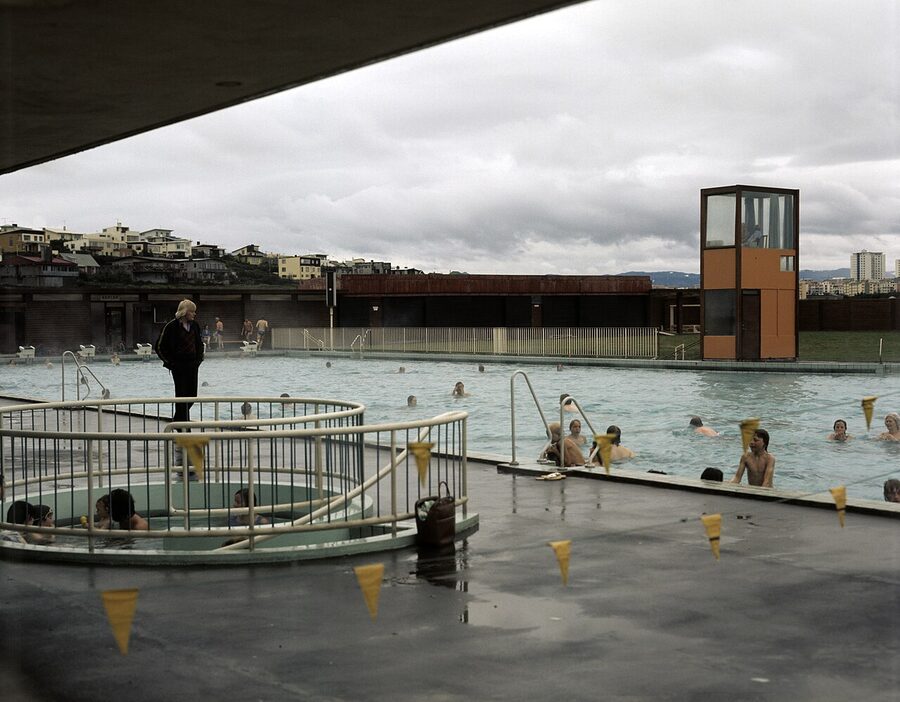
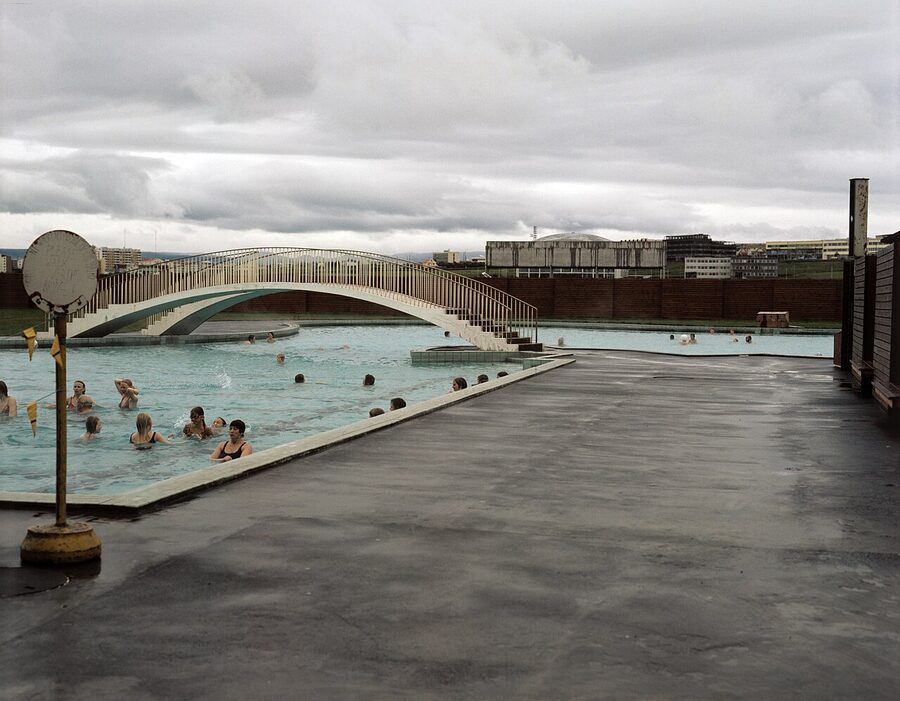
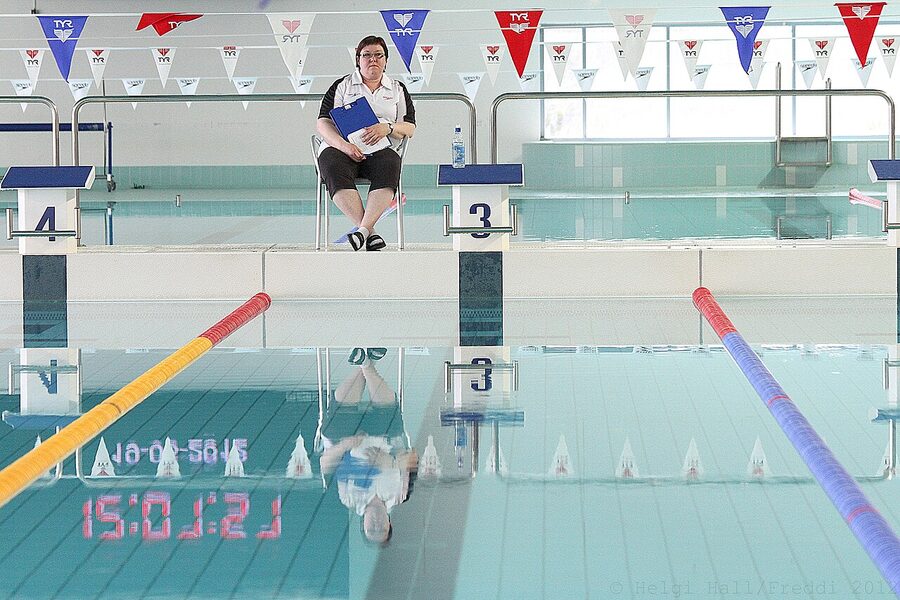
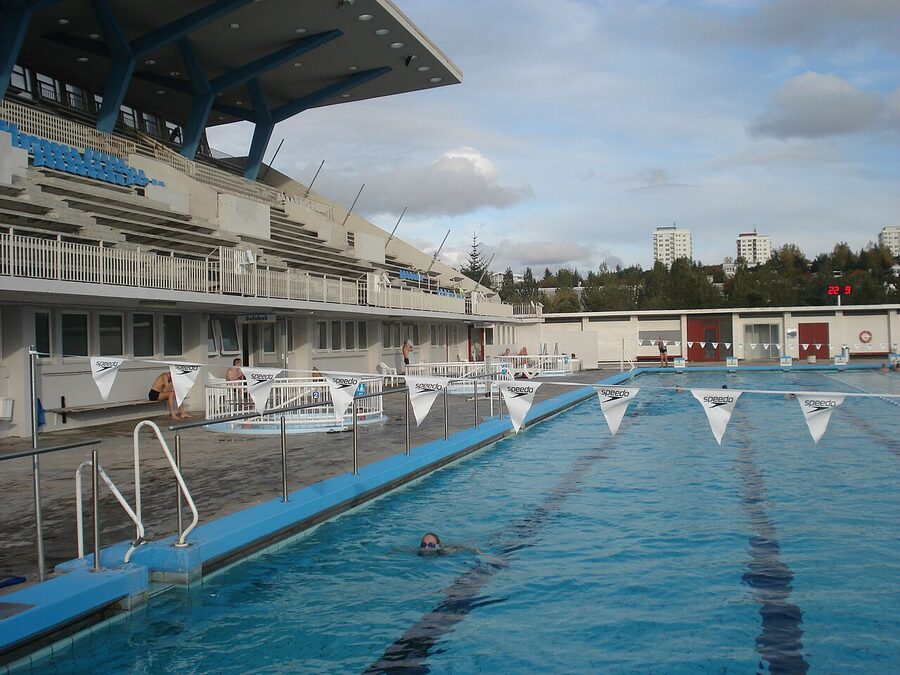
This is the famous one, three kilometres east of downtown in the Laugardalur valley. A 50-metre Olympic outdoor pool with starting blocks and lane ropes. A 25-metre indoor pool on the side. Six outdoor hot pots at staggered temperatures, a saltwater pot, a 5°C cold plunge, two saunas (dry and steam), and the only public water slide in central Reykjavík tall enough to count. There’s a kiddie wading area at the back, a snack bar that does proper hot dogs, a gym, a cafe, and a long wooden balcony where the Icelandic sun-worshippers spend the entire month of July lying out at noon.
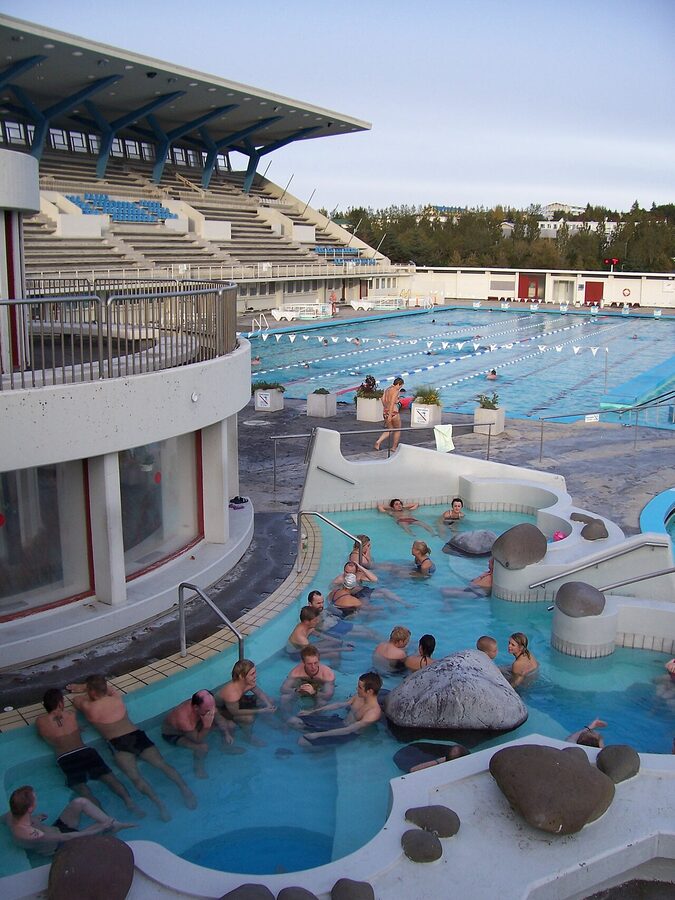
Laugardalslaug is what most Icelanders mean when they say “the pool.” If you have an active small child for the day, this is where you go. If you want to do a 1km swim properly, this is where you go. If you want to sit in the 44°C pot in November and watch the rain run sideways across the city, this is where you go. The downside is the location: Laugardalur is genuinely a 35-minute walk from Hallgrímskirkja, mostly through residential streets that aren’t unpleasant but aren’t a tourist walk either. Most travellers take the bus (route 14 from Hlemmur, six minutes) or a taxi (around 1,800 ISK).
One small thing worth saying: it does fill up. On a Saturday in July around 14:00 the cold plunge can have a queue of three people, and the family changing rooms book out. Go early. The 06:30 opening on weekdays is the best time of the entire week, when the lap pool is mostly Icelandic over-60s doing breaststroke and the hot pots are still empty. By 17:00 it’s the after-work rush and gets loud. By 20:00 it thins out again.
Address: Sundlaugavegur 30, 105 Reykjavík. Hours: Mon-Fri 06:30-22:00, Sat-Sun 08:00-22:00. Price: 1,330 ISK (~€9), ten-trip card 7,490 ISK (~€51). Getting there: bus 14 from Hlemmur (six minutes) or a 35-minute walk along Laugavegur and Suðurlandsbraut.
Vesturbæjarlaug: the locals’ favourite
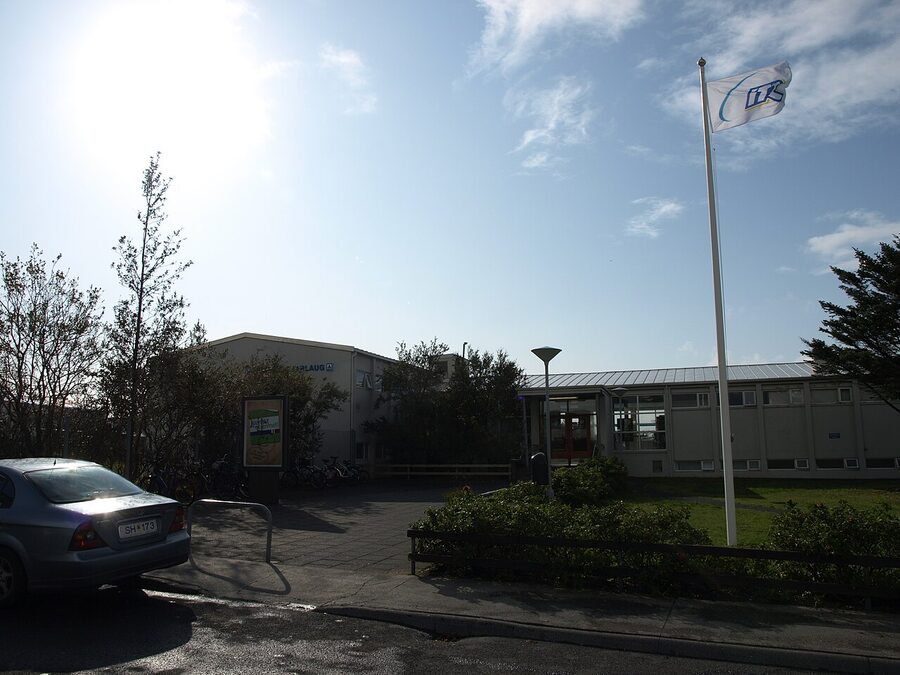
Ask any Reykjavíkur which pool they actually use and most of them name this one. Vesturbæjarlaug sits in the western residential neighbourhood of Vesturbær, ten minutes’ walk from Harpa concert hall. The pool is smaller than Laugardalslaug (a 25m main pool, four hot pots, a steam, a cold plunge, a small sauna), but the atmosphere is what people come for. The Saturday morning crowd is locals reading the newspaper in the 40°C pot. The lane swimmers are mostly the same people year-round. The cafe sells the cheapest hot dog in central Reykjavík, around 590 ISK (~€4).
Björk swims here. Not as a celebrity sighting, but as the Tuesday-9am-as-a-regular kind. So does most of the political class when parliament is in session; Iceland’s prime ministers since the 1980s have done much of their off-the-record discussion in the second-from-the-left hot pot. The water is the same water from the same Hellisheiði grid, but the social geography of who is in it is the most particular of any pool in the city. If you want to overhear an Icelandic conversation about the foreign minister’s haircut, this is where it happens.
Address: Hofsvallagata, 107 Reykjavík. Hours: Mon-Fri 06:30-22:00, Sat 08:00-19:00, Sun 09:00-18:00. Price: 1,330 ISK (~€9). Getting there: bus 11 to Vesturbæjarlaug (eight minutes from downtown) or 25-minute walk west from Hallgrímskirkja.
Sundlaugin í Árbæ: the family one
Árbæjarlaug is the suburban one I’d actually travel for. Out in Árbær, six kilometres east of downtown, with a 25m indoor pool, a 25m outdoor, four hot pots, an extensive kids’ play pool with shallow rapids and small slides, plus a separate tubed slide that’s the longest in any Reykjavík pool. Locals bring small children here in preference to Laugardalslaug because the kids’ area is enclosed and the parents can sit in the adjacent hot pot and keep an eye. The catch is location; you need a car or a 22-minute bus ride. Worth it for one trip if you have a four-year-old; otherwise a rounding error in the city’s pool offering.
Address: Fylkisvegur 9, 110 Reykjavík. Hours: Mon-Fri 06:30-22:00, weekends 08:00-22:00. Price: 1,330 ISK (~€9). Getting there: bus 5 from Hlemmur, 22 minutes.
Klébergslaug: the small village pool inside the city
Klébergslaug is the strangest of the seven Reykjavík city pools, which is partly why I’d recommend it. It sits in Kjalarnes, a small peninsula community technically inside the Reykjavík municipality but a 25-minute drive north of downtown along route 1. It feels like a village pool because it is one: a 25m outdoor heated pool, two hot pots, a steam, a cafeteria run by the same staff for the last decade, and a view across the Atlantic to Mount Esja’s western flank. The catchment is a few hundred families; on a weekday afternoon there might be ten people in the entire facility. Tickets are the same 1,330 ISK as the city pools.
The argument for Klébergslaug isn’t the pool, which is fine, it’s the drive. If you’ve rented a car and are heading north on the Ring Road or out to the Snæfellsnes peninsula, Klébergslaug is exactly twenty minutes off your route, half-empty, mountains-and-sea-view, and the swim is the perfect break before the rest of the drive. Locals call it the closest thing the city has to a country pool. I’d skip it as a downtown-base traveller; I’d absolutely take the detour as a self-driver.
Address: Vallargrund 1, 116 Kjalarnes. Hours: Mon-Fri 16:00-21:00 (winter), 11:00-21:00 (summer); Sat-Sun 11:00-17:00. Price: 1,330 ISK (~€9). Getting there: drive only, 25 minutes north of Reykjavík on route 1.
Grafarvogslaug and Breiðholtslaug: the suburban two I’d skip
For the sake of completeness: Grafarvogslaug is in the northeast suburb of Grafarvogur, modern, clean, perfectly fine. Breiðholtslaug is in the south-eastern suburb of Breiðholt, similar profile. Both have indoor and outdoor pools, hot pots, the standard sundlaug template. Neither is worth a trip from a downtown hotel. If you happen to live near them or are staying in one of those suburbs (the Hilton Reykjavík Nordica is closer to Grafarvogslaug than to Laugardalslaug), they’re a fine substitute. Otherwise, the four central ones above and Árbær cover the city.
The Snorralaug, the saga, and the 13th-century pool
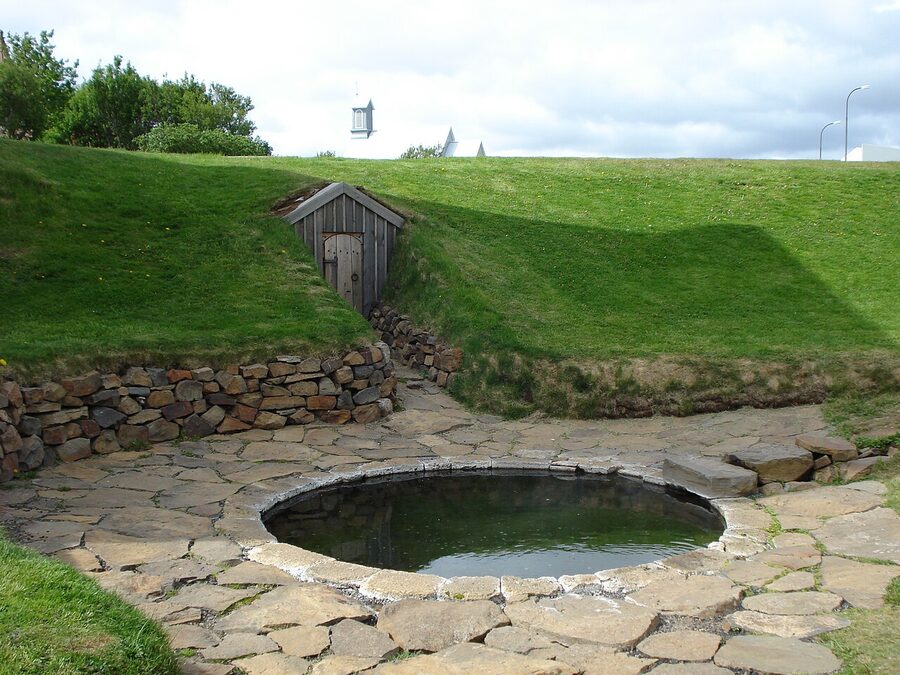
Iceland’s pool culture isn’t an artefact of the 20th century. The Book of Settlement (Landnámabók, 12th century) names the warm pool at Reykholt as a feature of the landscape. By the 13th century the historian and politician Snorri Sturluson, author of the Prose Edda and the Heimskringla, had built a circular stone pool at his Reykholt farm fed by hot water piped from a nearby spring. The pool is still there. It’s about 4 metres across, knee-deep, with a stone-lined tunnel running from the back of it underground to where the farmhouse used to stand. Snorri used it for bathing and for evening political conversations. The tunnel was also his escape route. On 23 September 1241 the Earl of Norway’s men came for him, and he tried to use it to hide; he was killed in the cellar at the other end.
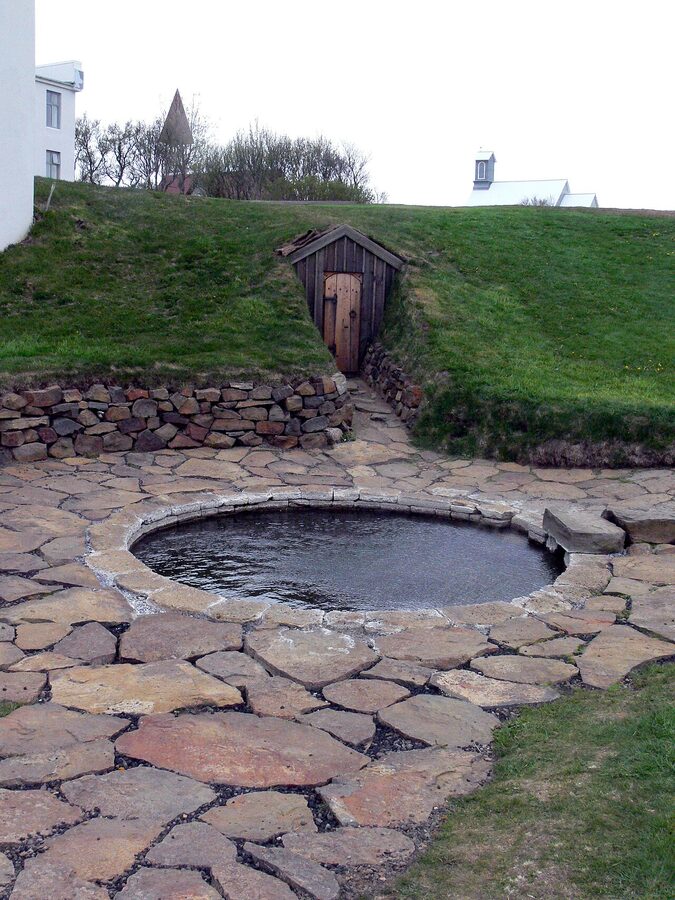
Snorralaug was restored in 1858 and again in 1959. You can visit it at Reykholt today, an hour and a half north of Reykjavík and a worthwhile stop on the way to the Snæfellsnes peninsula. Don’t try to bathe in it (it’s a national monument under heritage protection), but for context on why the modern Icelandic pool culture feels so settled, this is where the line begins.
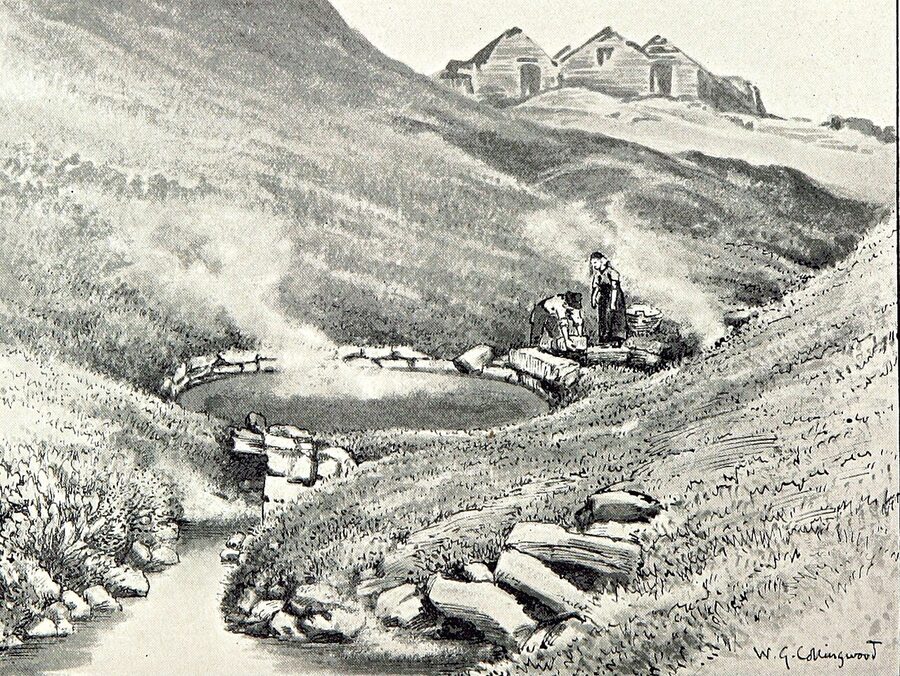
The other Iceland pool with a story this old is Seljavallalaug under Eyjafjallajökull, built into a south-coast cliff by farmers in 1923 and the oldest pool still in use on the island. I cover that one further down.
The regional pools worth a detour
The 12 city pools in the capital area are the entry-level Iceland pool experience. The interesting ones are the regional standouts: most of them at the edge of cliffs, fjords, or volcanic country, often free or close to it, and almost never busy. If you’re driving the Ring Road, build a couple of these into the route. None of them is a long detour from the trunk road.
Hofsós: the infinity edge on Skagafjörður
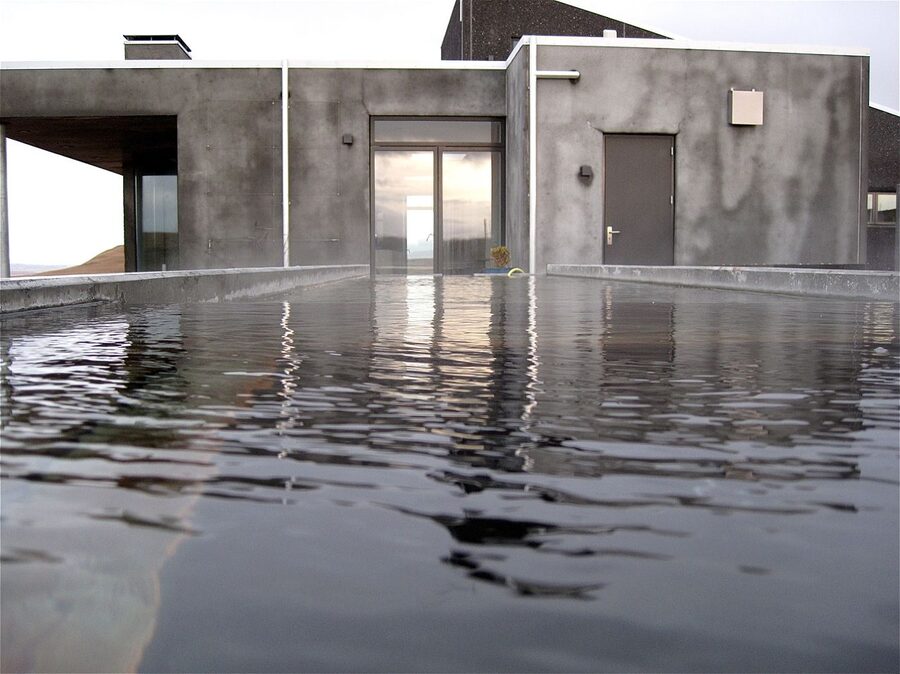
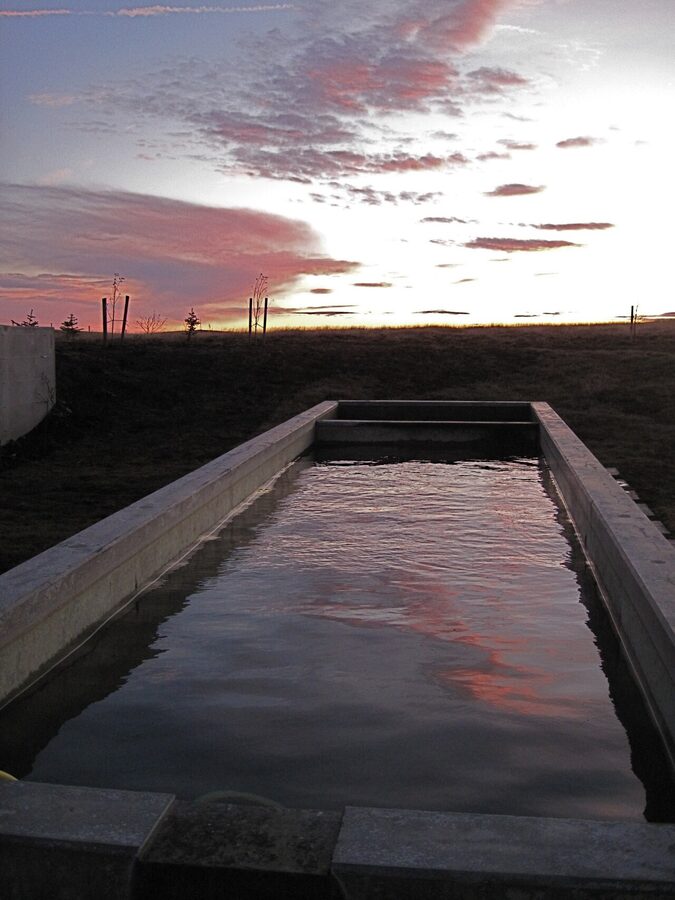
Hofsós is a fishing village on the eastern shore of Skagafjörður in north Iceland, population around 200. In 2010 a husband-wife pair of Icelandic philanthropists (Lilja Pálmadóttir and Steinunn Jónsdóttir) commissioned the architects Basalt to build a new public pool for the community. What Basalt designed has been on the cover of Wallpaper magazine, in the New York Times, and in every “world’s most beautiful pools” listicle since: a 25-metre lap pool with an infinity edge that drops straight off into Skagafjörður, plus two hot pots and a small kids’ pool, all cantilevered toward the fjord with the basalt sea cliff of Drangey island in the middle distance.
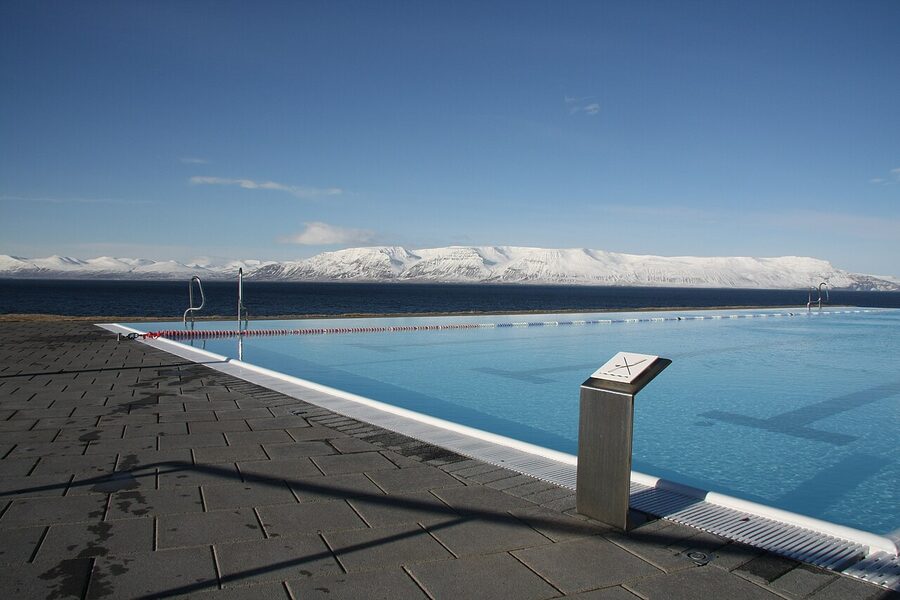
The architecture is the headline; the pool itself is a 100-metre detour from the village’s main road and works like any other small-town sundlaug. Tickets are 1,000 ISK (~€7), staff is one person at a small reception, the changing rooms are basic. The trick is timing. Sunset in May or June is the photograph; January after dark with the aurora is the longer experience. Either way, on a weekday outside July you may have the pool to yourself for the first hour after opening.
Address: Suðurbraut, 565 Hofsós. Hours: Mon-Fri 07:00-13:00 + 17:00-21:00, Sat-Sun 11:00-19:00 (winter); summer hours run later. Price: around 1,000 ISK (~€7). Getting there: 4 hours’ drive from Reykjavík via Ring Road and route 76; an obvious overnight stop on the way to Akureyri.
Krossneslaug: the Atlantic-edge one in the Westfjords
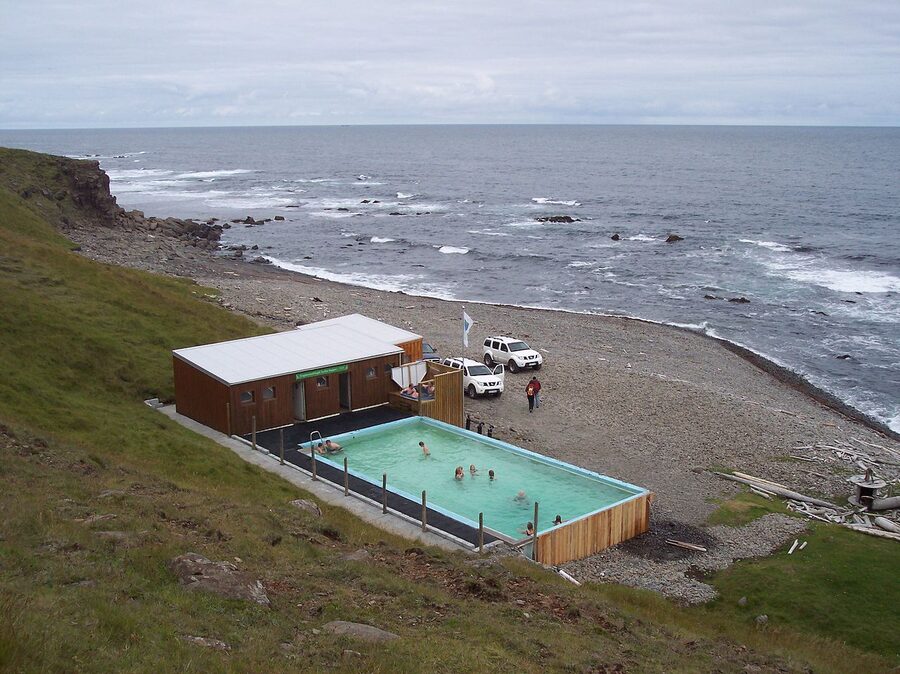
This is the pool people who’ve been to Iceland six times still talk about. Krossneslaug sits at the end of the world’s-end road in Árneshreppur, the most northerly inhabited part of the Strandir coast in the Westfjords. To get there from Reykjavík you drive for six hours, the last 90 minutes on a single-track gravel road that’s closed for half the year. At the end of the road, on a black-pebble beach with the open Atlantic crashing twenty metres away, is a 12-by-25 metre rectangular concrete pool, geothermally fed from a hot spring 200m up the slope, plus one small hot pot. There’s a changing hut. There is no staff. There is an honesty box for the 1,000 ISK ticket.
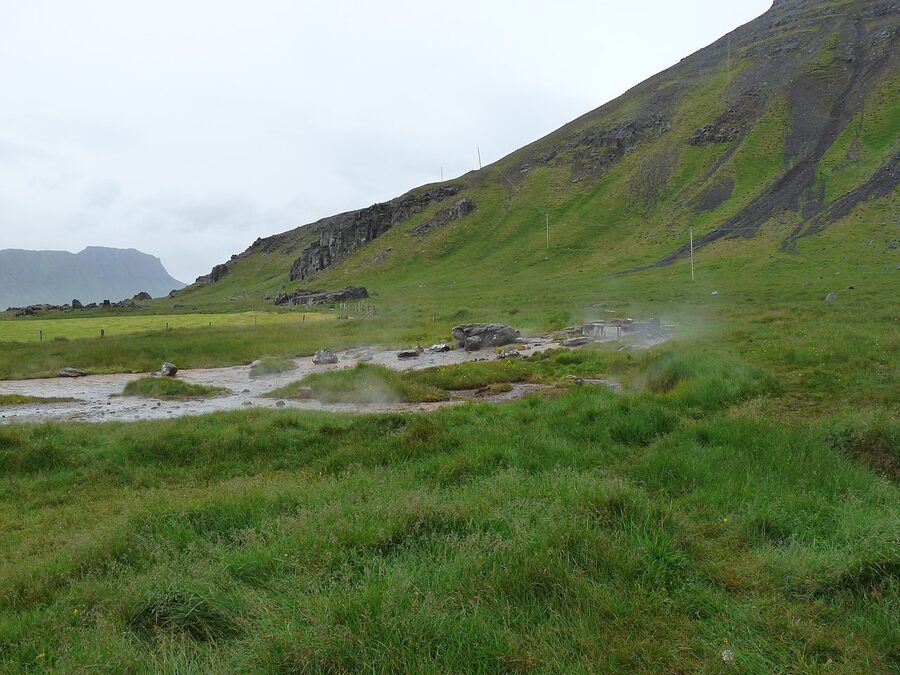
Krossneslaug is the contrarian’s Iceland pool. The journey is the experience: the only way to get here is the drive, you’ll typically meet two cars on the way, and on the gravel section in October you may not see another vehicle for an hour. The pool itself is functional and the temperature drifts depending on weather and how recently somebody adjusted the spring valve, but the situation (black sand, open Atlantic, polar light, the village of Norðurfjörður’s twelve houses behind you) is the closest thing the country has to a private hot pool with a sea view.
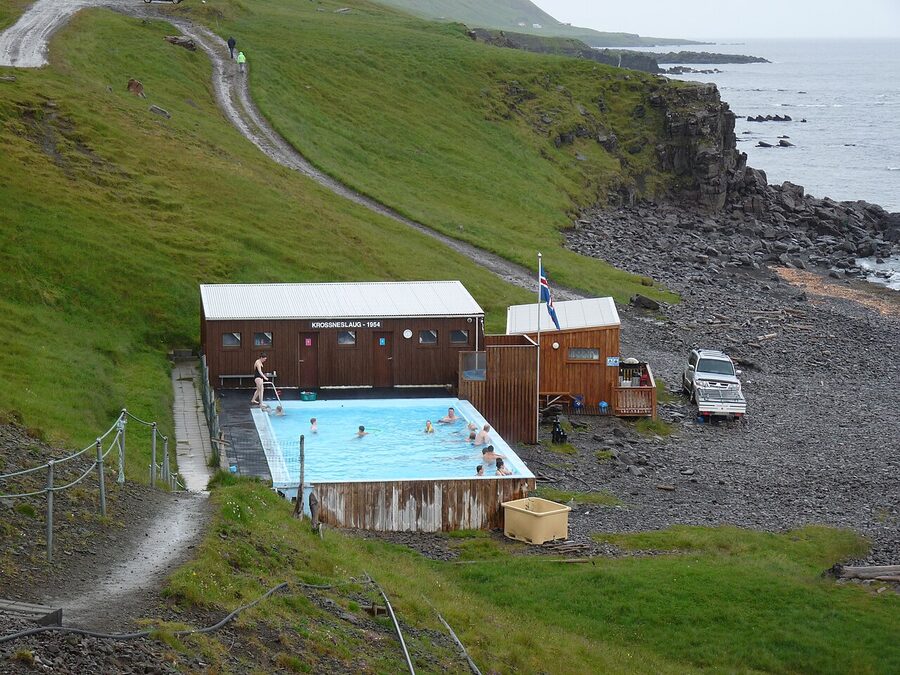
Open all year, but the access road (route 643) is closed roughly from late October to late April depending on snow. In summer it’s a long day-trip from Hólmavík. In winter you’d need a 4WD and the patience of someone who genuinely doesn’t mind being snowed in. If you’re driving the Westfjords loop and you have one extra day, this is what you do with it.
Address: Krossnes, 524 Norðurfjörður (Strandir coast). Hours: 24/7, May-October. Closed winter when route 643 is impassable. Price: 1,000 ISK honesty box. Getting there: drive only, 6 hours from Reykjavík; the last 90 minutes are gravel.
Mývatn Nature Baths: the northern Blue Lagoon
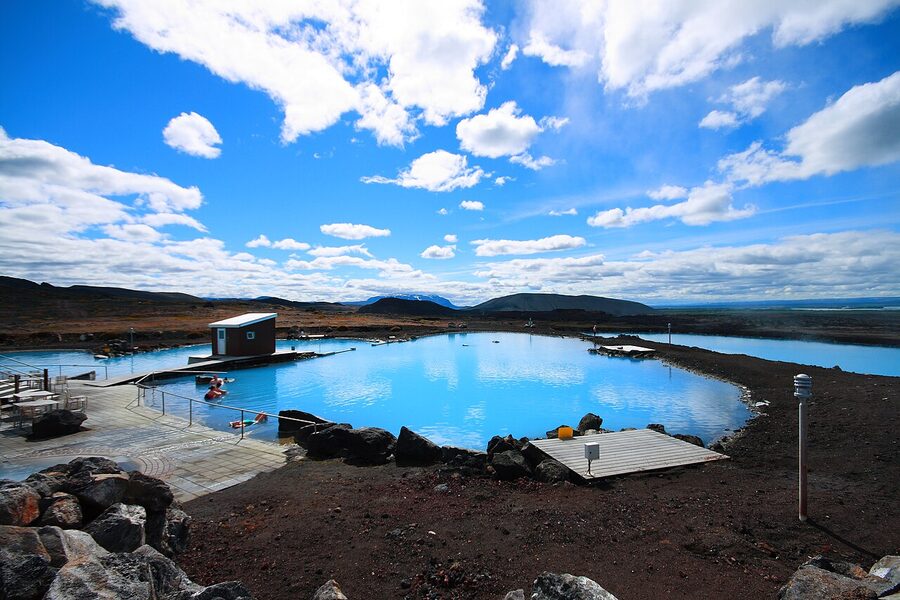
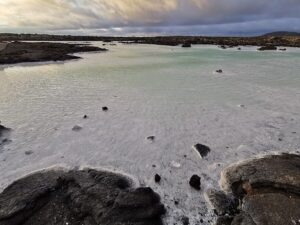
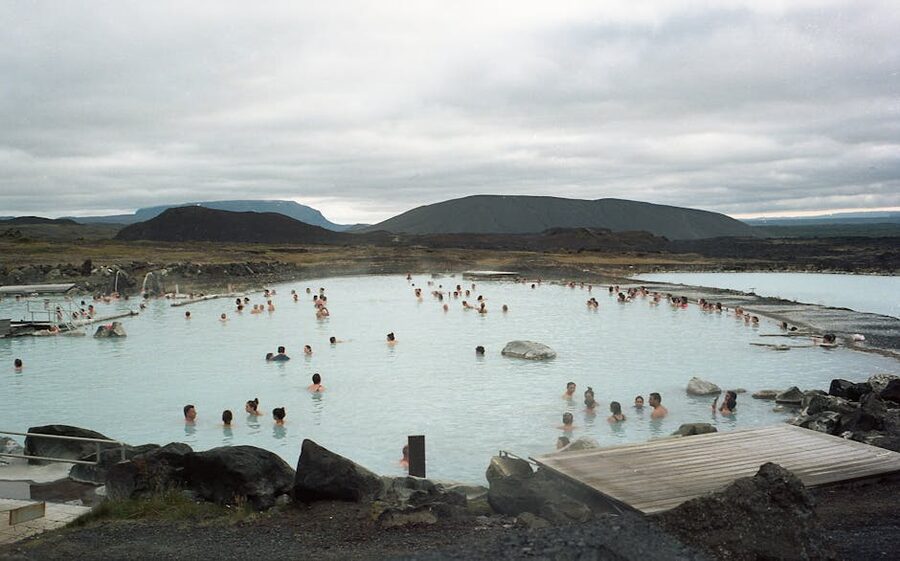
Strictly speaking these are a private bathing complex, not a public sundlaug. Mývatn Nature Baths (Jarðböðin við Mývatn) charges from around 6,800 ISK (~€46) and you book online. They open onto the same pricing and architecture template as the Blue Lagoon: a milky-blue silica pool fed by water from the boreholes drilled for the nearby Krafla geothermal power plant, with a single big outdoor lagoon, two saunas, a steam, a cafe, and changing rooms with private showers.
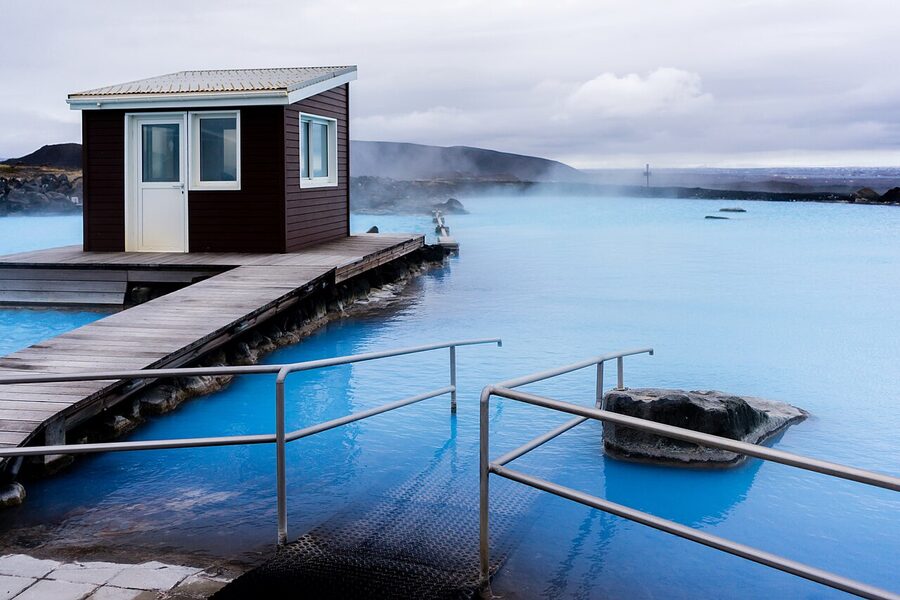
The reason I’d include it in a sundlaug guide is the obvious one: it’s the actual alternative to the Blue Lagoon, and it’s the only one in north Iceland. It’s quieter, the location is genuinely better (Mývatn’s surroundings are pseudocraters, lava fields, and the Krafla volcano), and on most days you’ll find half the crowd. The downside is the same downside as the Blue Lagoon: it’s not where the locals are bathing. The Mývatn villagers all use Reykjahlíð’s small public sundlaug a kilometre away, where a ticket is 1,000 ISK.
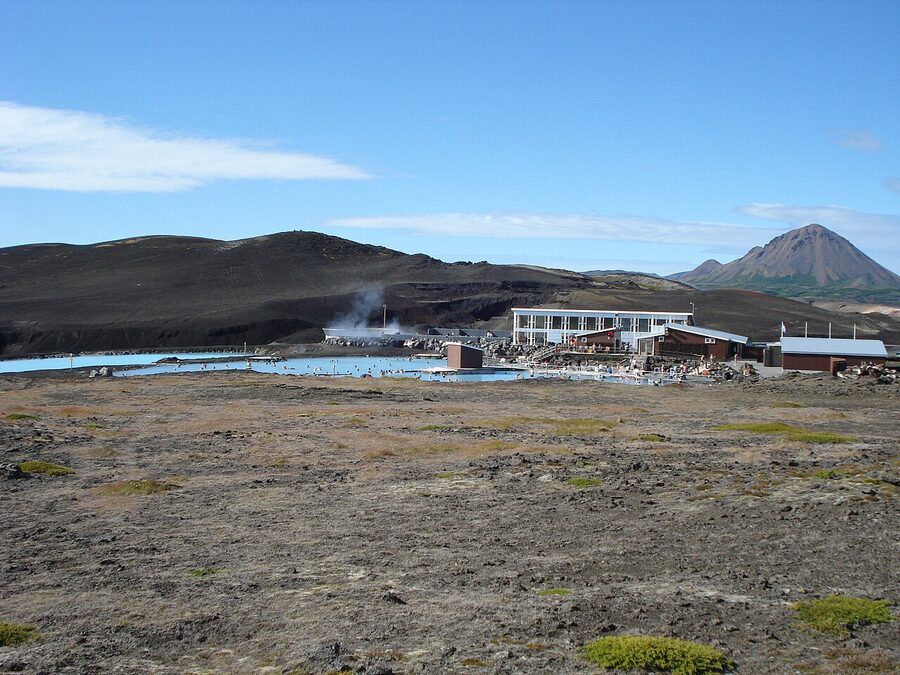
If you’re already going to Mývatn for the lake and the lava, the Nature Baths are worth a 90-minute slot at sunset. If you’re choosing between this and the city sundlaug at Reykjahlíð for an evening, take the city pool. Cheaper, fuller of locals, hot pots are hotter, and the only thing you don’t get is the silica-blue colour.
Address: Jarðbaðshólar, 660 Mývatn. Hours: 12:00-22:00 daily (summer), 12:00-22:00 with reduced midday hours (winter). Price: from 6,800 ISK (~€46), book online. Getting there: 5 hours’ drive from Reykjavík via Akureyri; on the Ring Road.
GeoSea Húsavík: saltwater on the cliff edge
GeoSea is the second of the north’s commercial geothermal baths, a 25-minute drive north of Akureyri to the whale-watching town of Húsavík. The premise is unusual: instead of geothermal fresh water (which most Icelandic pools use) the GeoSea pool is filled with seawater drawn from old fishing boreholes, then geothermally heated to about 38°C. The mineral content is closer to a sea-bath; the colour is blue-grey rather than silica-blue. The setting is excellent: cliff-edge pool, one of the best bay views in north Iceland, the snowfields of the Kinnarfjöll mountains in the middle distance, and (in season) whale-watching boats actively visible in the bay below.
Tickets are around 6,500 ISK (~€44) for adults, less in winter. It’s smaller than Mývatn and more focused: three terraced pools at slightly different temperatures, one steam, no big slides, no families splashing. If your journey is taking you to Húsavík for the whales (you should), GeoSea is a 90-minute add-on that pairs with that day perfectly. If it isn’t, there’s no reason to drive there for the pool alone.
Address: Vitaslóð 1, 640 Húsavík. Hours: 12:00-22:00 most days, reduced winter hours. Price: from 6,500 ISK (~€44). Getting there: 25 minutes north of Akureyri on route 85.
Reykjafjarðarlaug: the Westfjords cliff pool
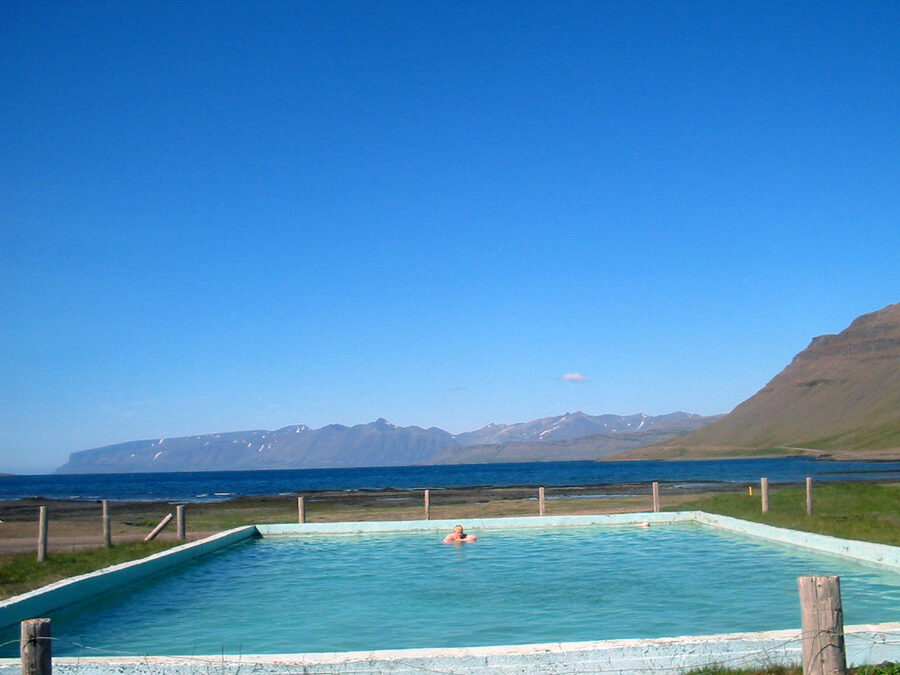
Reykjafjarðarlaug is the Westfjords pool I’d visit if I had time for only one. It sits in Reykjafjörður, a small fjord off the road between Bíldudalur and Þingeyri, with one main concrete pool from the 1970s, a small natural-bottom hot pot a hundred metres away (the older one, fed directly from the ground), a wooden changing hut, and absolutely no staff. The honesty box wants 800 ISK. Getting there involves the road from Þingeyri over the Hrafnseyrarheiði mountain pass, which is a drive in itself.
The natural pot is the better of the two. It’s small, holds maybe four people, the bottom is gravel and grass, the water is around 38°C, and you sit looking down the fjord at the open Atlantic. The concrete pool is fine; functional, clean, tepid. Many Icelanders skip the concrete pool entirely and just use the natural pot. So would I.
Address: Reykjafjörður, off route 60 between Þingeyri and Bíldudalur. Hours: 24/7 in summer; closed winter. Price: 800 ISK honesty box. Getting there: drive only, about 7 hours from Reykjavík.
Drangsnes: the three roadside hot pots on the beach
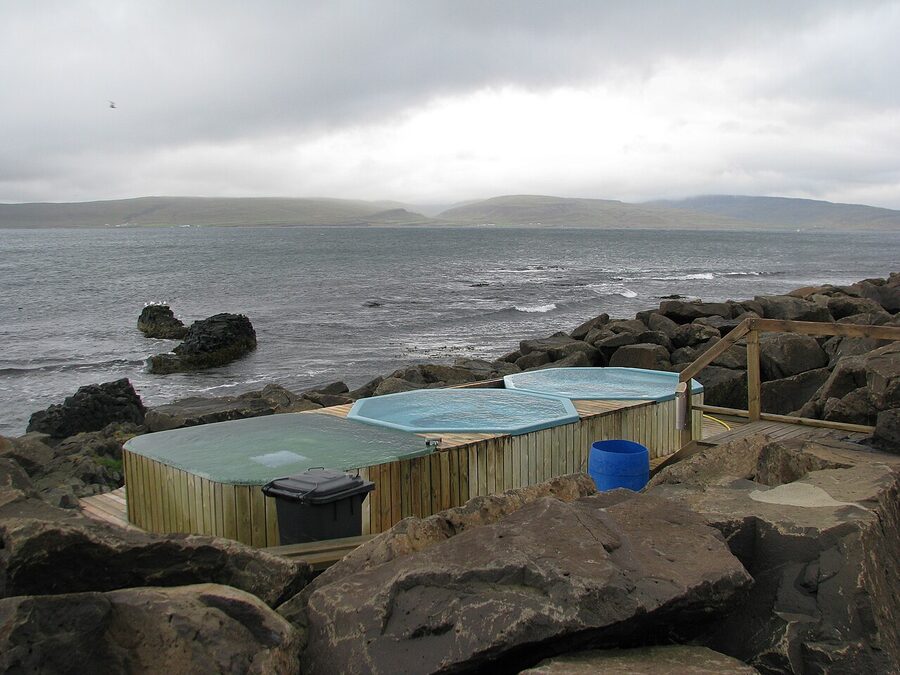
Drangsnes is a fishing village of around 70 people on the Strandir coast, the same coast as Krossneslaug but only an hour from Hólmavík. On the seaward side of the main road, twenty metres from the petrol pump, the village built three small concrete hot pots into the beach. They’re free. They run 24/7. There’s a changing hut on the other side of the road. The water comes from a borehole and runs around 39°C in the warmest pot, 36 in the coolest.
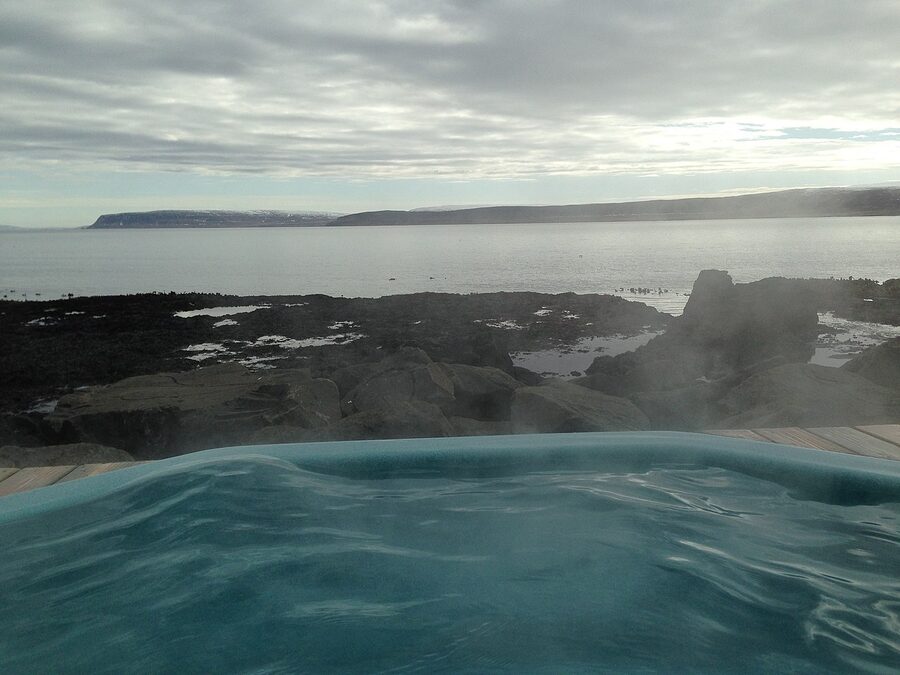
This isn’t a sundlaug strictly speaking. There’s no main pool, no staff, no ticket. It’s the most casual version of Icelandic public bathing: drive into the village, walk to the beach in a swimsuit, sit in a hot pot for forty minutes, drive on. There’s a proper sundlaug a hundred metres away (Drangsneslaug, the village’s actual public pool) if you want a swim, but the three pots on the beach are the thing visitors come for. Combine with the Strandir drive on the way to or from Krossneslaug for the day.
Seljavallalaug: the 1923 pool you have to walk to
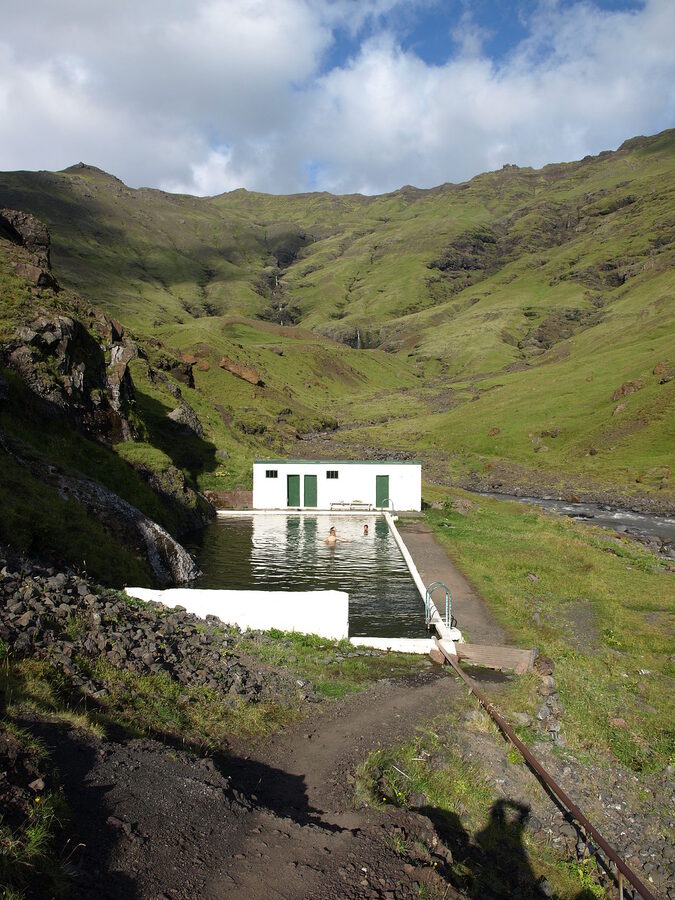
Seljavallalaug, the awkward one. Built in 1923 by the Skógar farming community as Iceland’s first proper outdoor swimming pool, hand-cut into the southern flank of Eyjafjallajökull and fed by a small hot spring at the top end. It’s a 25m rectangle in a glacial valley with one wall built into the cliff. To get there you park at the road, then walk 20 minutes along a stream to the pool. There’s a small wooden changing shed with no door; in winter the wind comes through.
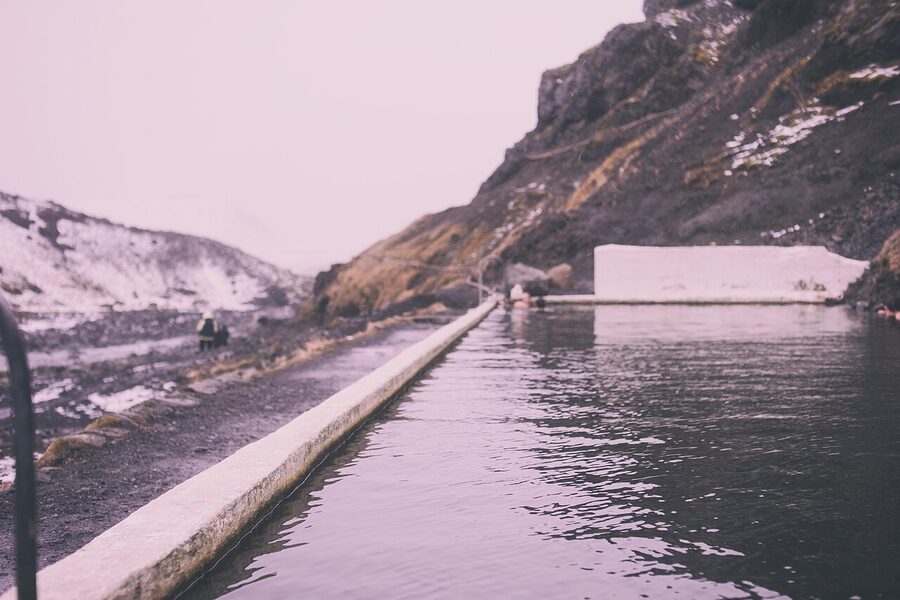
The catch matters. Seljavallalaug used to be a wonderful semi-secret. Then Instagram happened, then a flight from Reykjavík to the south coast became part of every guidebook, and now in summer the pool routinely has 30 people in it at once, which for a 25m pool on the side of a mountain is uncomfortable. The water has also been variable since the Eyjafjallajökull eruption in 2010 dumped ash into it; it’s been cleaned several times since, but the bottom is silt rather than tile and the visibility is a metre on a good day. There’s no staff, no chlorine, no rota for cleaning beyond what the local farming co-op manages once a year.
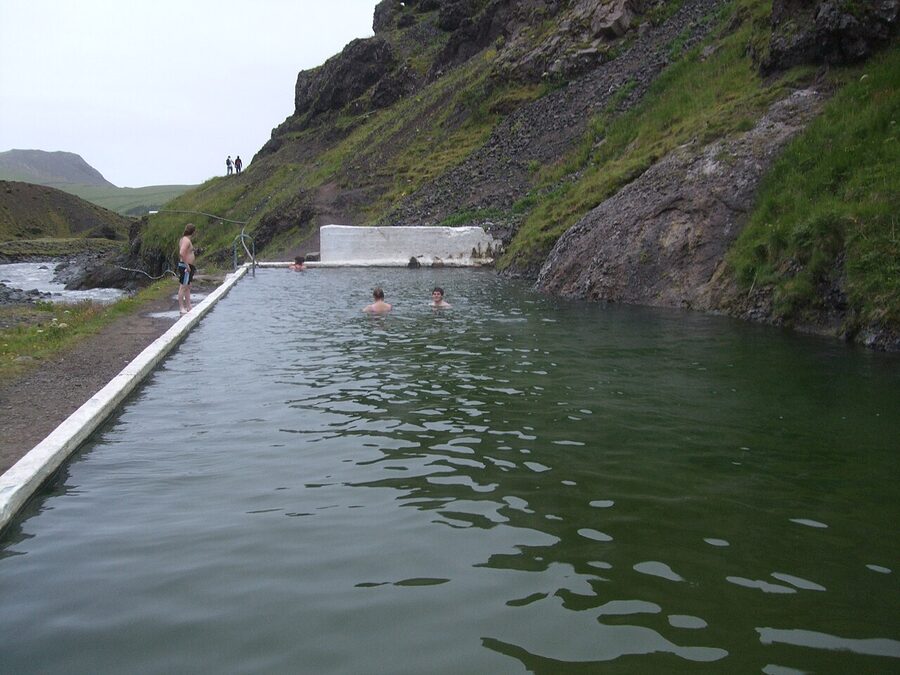
So the verdict. Seljavallalaug is worth doing once, in shoulder season (May or late September) when the crowd is thin, on a clear day after the morning fog has burned off, with water shoes and an old swimsuit you don’t mind staining slightly. The walk in is the half of the experience that hasn’t changed since 1923. The pool itself is no longer the wonder it was twenty years ago, but it’s still the oldest of its kind in the country and worth the morning. Don’t drive specifically for it; build it into a south-coast day trip.
Address: Seljavellir, off route 242 (Raufarfellsvegur), south coast. Hours: 24/7, free. Price: free, no ticket. Getting there: 2 hours’ drive from Reykjavík, then a 20-minute walk from the parking area.
Sundhöll Hafnarfjarðar and the other near-Reykjavík pools
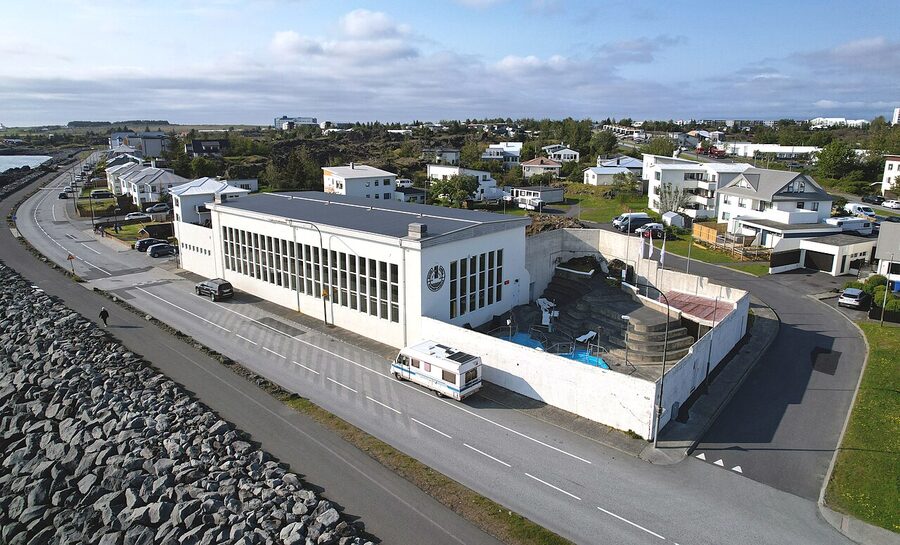
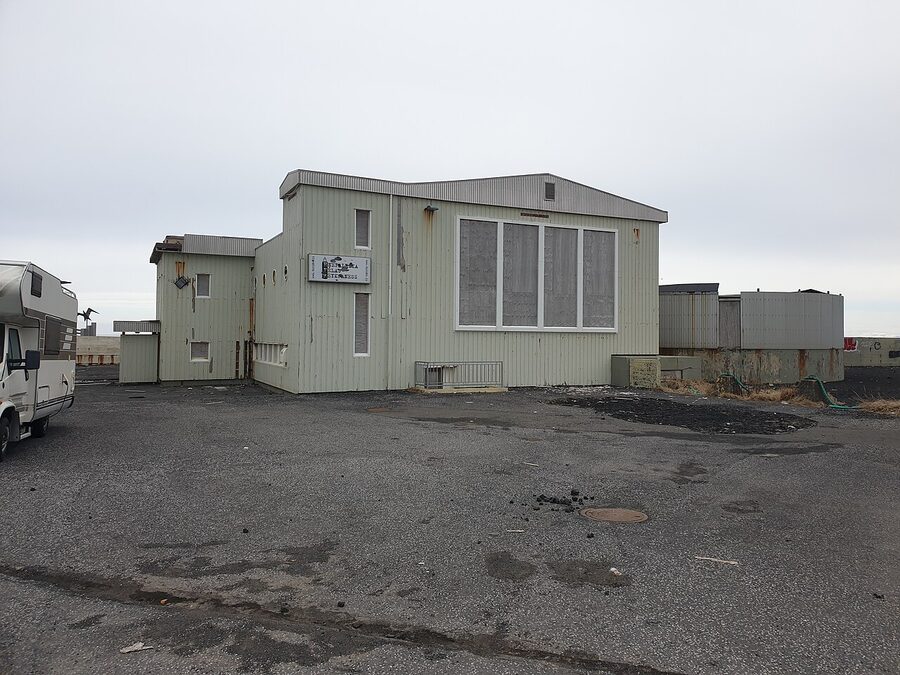
The greater Reykjavík area has another four good pools that aren’t strictly inside the city. Sundhöll Hafnarfjarðar is the headline one: a 25m indoor + 25m outdoor in the lava-built town of Hafnarfjörður, 12km south of downtown, that runs the same ticket price (1,330 ISK) and is significantly less busy than Laugardalslaug on a Saturday. Sundhöll Keflavíkur near the airport is another Samúelsson-designed building from 1936, two years older than Sundhöll Reykjavíkur, and is the right pool to know about if you’re using the early-morning Keflavík bus before a 6am flight; it opens at 06:30 and they will take 1,200 ISK and a towel rental fee from anyone who walks in.
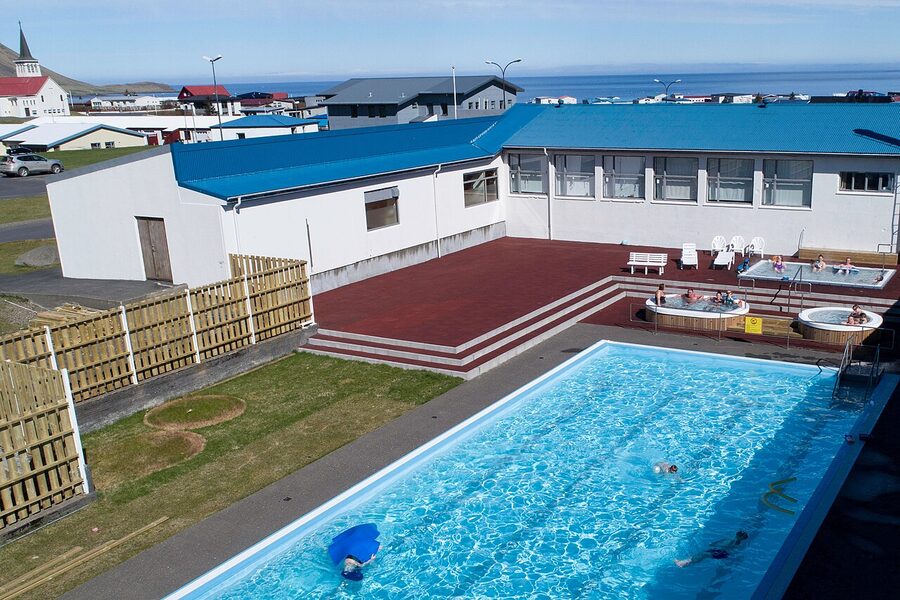
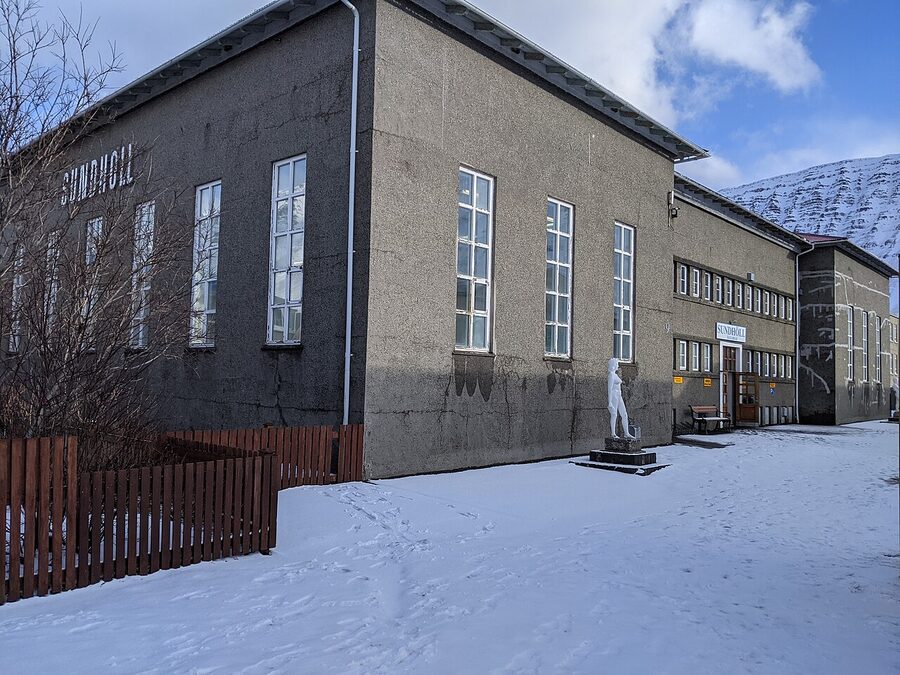
Sundhöllin á Ísafirði is the Westfjords-capital pool, in central Ísafjörður: a small 25m + hot pot setup that’s the natural break-point on a Westfjords loop drive. And the Grundarfjörður pool on the Snæfellsnes peninsula is one of those small-town pools that earns its place because it sits with a direct view across the harbour to Kirkjufell, the most-photographed mountain in Iceland.
What to bring, and what not to
Bring a swimsuit. Bring flip-flops or shower shoes (the floors are wet, and the pool deck around the hot pots can be hot enough on a sunny day to surprise bare feet). Bring a small towel. Bring 1,500 ISK in cash if the pool is rural and the card machine is iffy, otherwise tap-to-pay covers everything. Bring a watch you don’t mind getting wet. Most Icelandic pools have no clocks visible from the hot pots, and timing how long you’ve been in the 44°C is genuinely useful.
Don’t bring a lock. Most pools have key-locker wristbands, and the few that don’t have token-key cabinets the staff can override if you lose the key. Don’t bring a hairdryer; every changing room has them and they’re free. Don’t bring shampoo or shower gel; soap is on the wall. Don’t bring food into the pool area; nearly all the bigger pools have a cafe and the rule is roughly the same as a UK leisure centre.
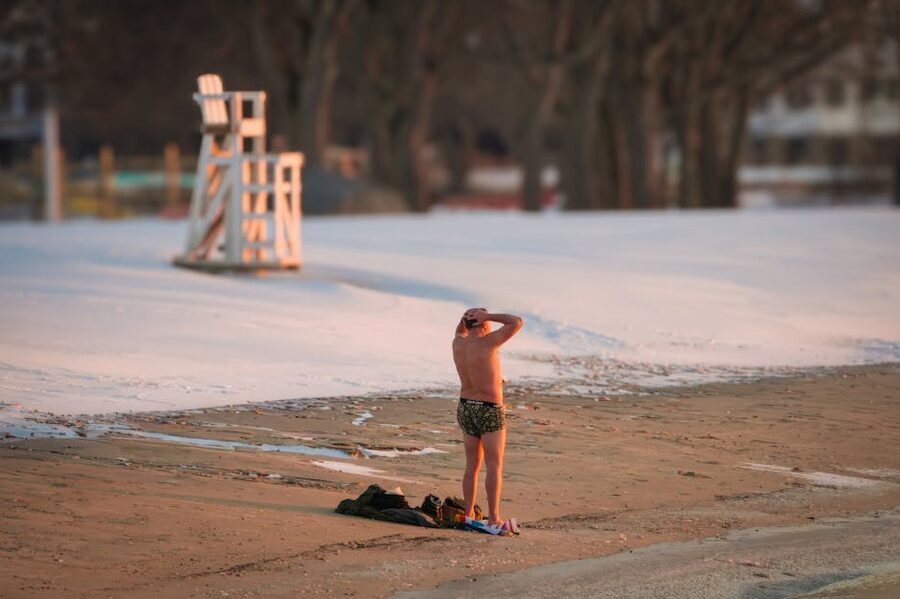
One small detail: most Icelandic pools post a sign saying long hair must be tied back. They mean it, and the staff will quietly hand you a hair-tie at reception if you forgot. Hair conditioner washes out in the pool and gets the chlorine ratio off. Wedding rings are fine, the silica isn’t strong enough to damage them; contact lenses are also fine but hot-pot heat is a long time at high temperature, take them out if you’re staying in for more than half an hour.
When to actually go
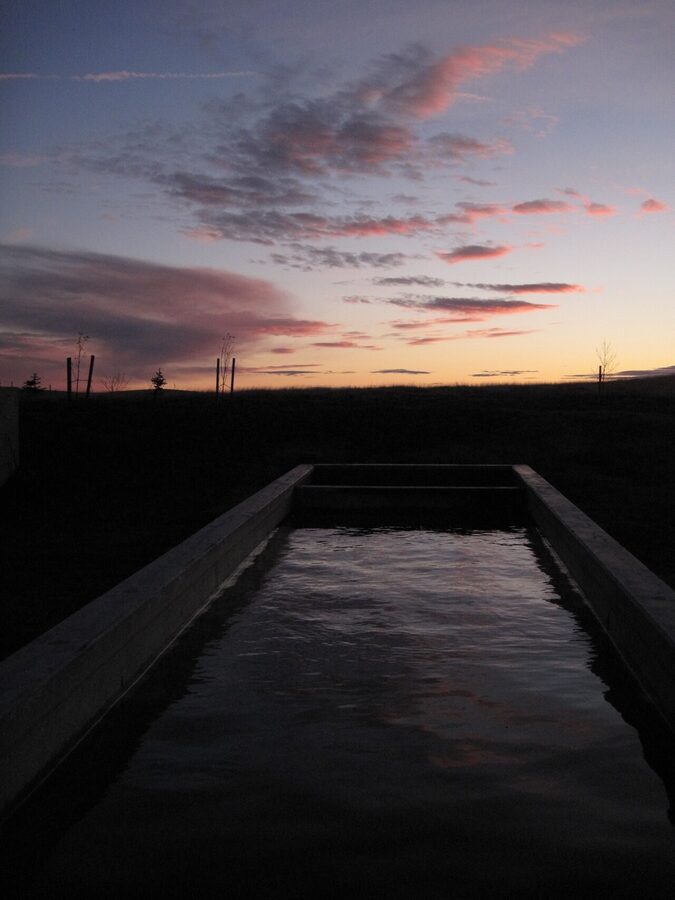
The standard local pattern is two slots: the 06:30 morning one before work, and the 17:00 evening one after. The morning is for serious lap swimmers and a quiet ten minutes in the hot pot before the day starts. The evening is for the social bit. If you’re a tourist with a flexible day, the 16:00 slot in winter is the best of the lot: light is going, the city’s office workers haven’t arrived yet, the pool is warm, and by the time you get out it’s dark and the lit-up Hallgrímskirkja steeple is visible from the Sundhöll changing-room window. In summer this version of the same scene runs at 22:00 in white-night light.
By season, the high winter (December to February) is when an Icelandic pool genuinely makes sense. The contrast between hot pot and cold air is at its sharpest, the lighting is cinematic, and the change-room-to-snow walk takes courage that you’ll be quietly proud of for a week. Spring is the dead season; the air is sometimes bright and the wind is always brutal. Summer is busy with locals doing actual lap swimming, and the hot pots can have queues at the bigger pools.
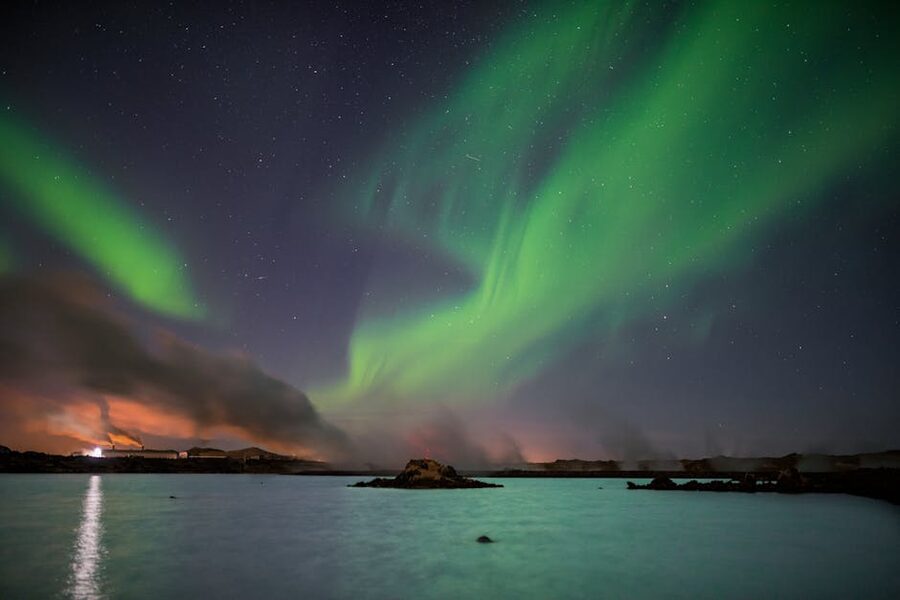
One detail that takes a few visits to notice: Icelandic pools close earlier than you’d think for a country with this much daylight in summer. Most close at 22:00, some at 21:00, and the suburbs go down to 20:00. The Sunday hours are shorter than weekday hours by about an hour at most pools. Check the city sundlaugar website for the day you’re going; the schedule is reliable and changes by season.
The Blue Lagoon question, asked once
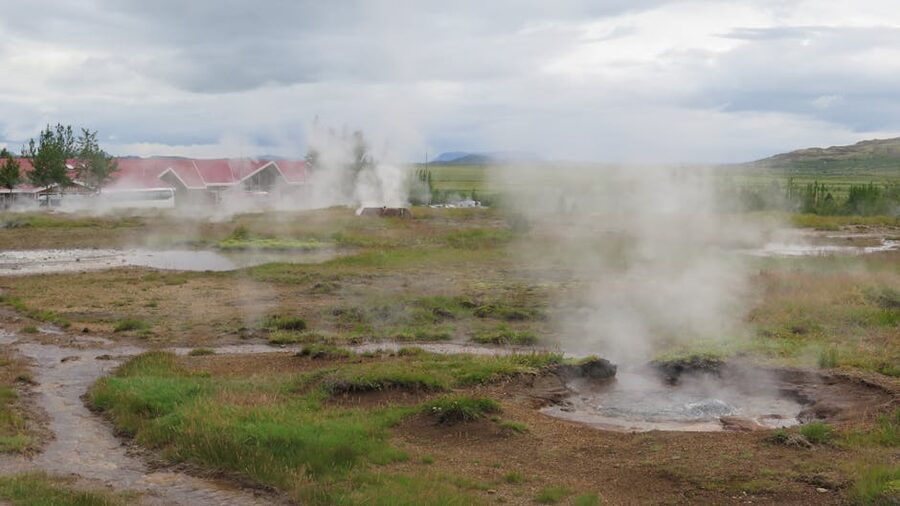
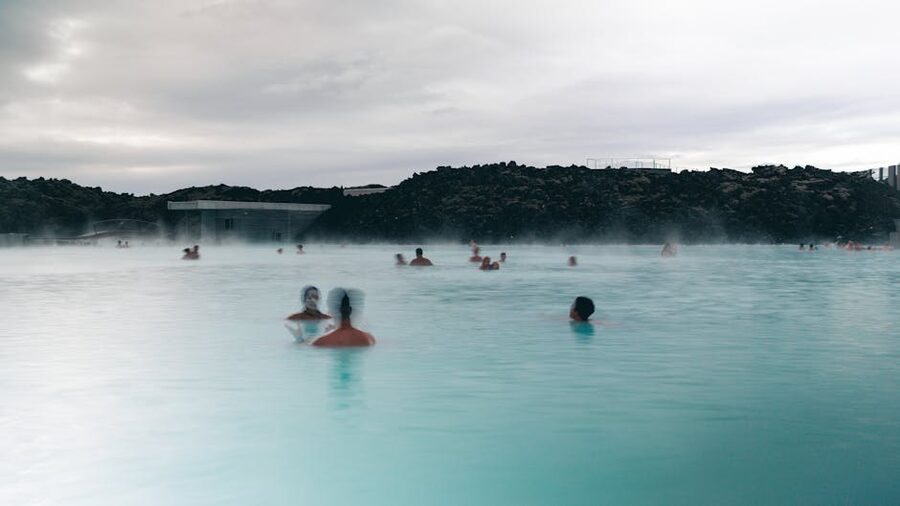
Should you skip the Blue Lagoon and just go to a city pool instead? Yes, if you’re a budget traveller; partly, if you’re not. The Blue Lagoon is genuine. The milky-blue silica water is real and unique to the Reykjanes peninsula, the architecture by Basalt is genuinely impressive, the pre-booking system is well-run. But it’s also 12,990 ISK (~€88) for a basic ticket and you’re sharing the water with three thousand other tourists who’ll cycle through the door that day. The local sundlaug at the same time of day is 1,330 ISK (~€9) and you’re sharing it with 40 Icelanders.
The call: if you have one morning in Iceland and you’ve never seen a silica-blue thermal pool before, do the Blue Lagoon. Take the photo, eat the in-water lunch, leave. If you have a week and you’re going to bathe four or five times anyway, the Blue Lagoon goes once and the rest are city pools and regional standouts. If you’re choosing between Blue Lagoon and Sky Lagoon and want the longer breakdown of the two, that comparison is worth a piece of its own. The single number to remember: ten city-pool entries cost roughly the same as one Blue Lagoon ticket.
Aurora, hot pots, and the photograph
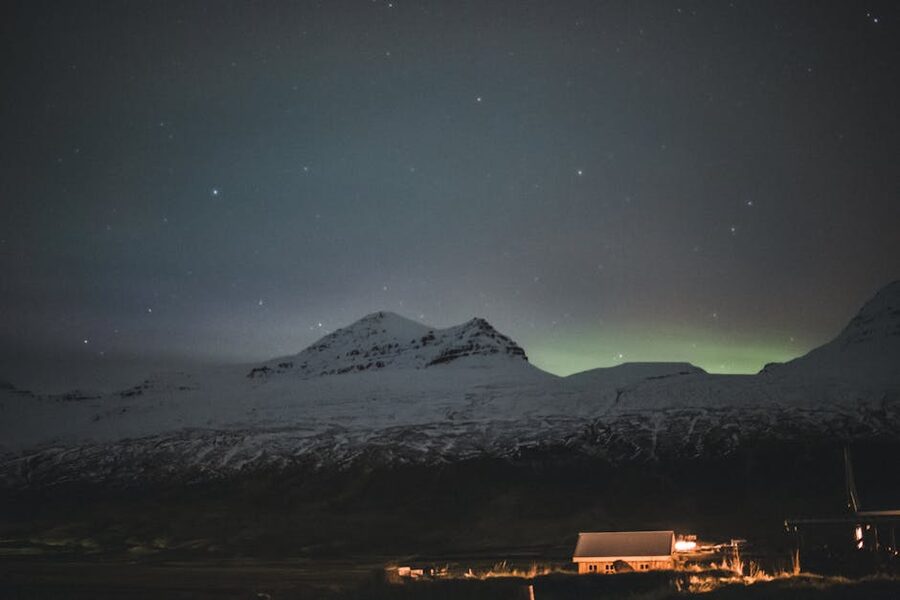
If you’re chasing the northern lights (and the Iceland aurora guide covers when and where in detail), the small-town sundlaug is the best aurora-watching infrastructure in the country nobody talks about. Reykjavík has too much light pollution to make hot-pot aurora reliable, but at any of Hofsós, Krossneslaug, Reykjafjarðarlaug, Drangsnes, or even the Mývatn village pool, the sky is dark, the water is 40°C, and the show happens on a winter night when the cloud breaks. The Drangsnes hot pots in particular have a clean north-facing horizon, so you’re looking up the right axis.
Practical: the aurora forecast (vedur.is) updates daily. If KP is 3 or higher and the cloud cover map is green over your region, drive to the pool in the dark and wait. Bring a head torch with red light for the changing hut. Watches with a backlit display work; phones don’t, the hot pot will steam them. The water keeps you warm enough to sit there for two hours if it takes that long.
The detail nobody tells you about the locker tag
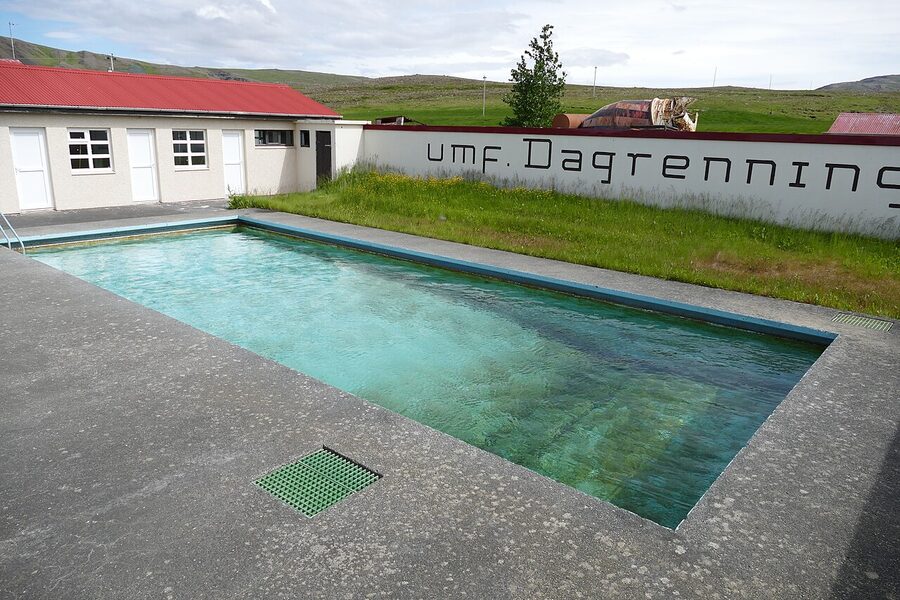
Almost every city pool in Iceland uses a wristband-and-locker system. You get a rubber wristband at reception with a small chip in it. You walk into the changing room, find any free locker, slide your locker key into a slot in the wristband, the door clicks shut. To open it, slide the key back in and turn. The wristband works for the cafe and the towel-rental and the locker, all on one chip. Settle the bill on the way out.
What trips visitors up: the wristband only works inside the building. If you walk out with it, the system charges you for the wristband too on your next visit because it logs the chip as missing. Take it off at reception before you leave, the staff member smiles and unhooks it. Also, the wristband doesn’t go in the hot pot. It isn’t water-damaged but the chip can stop working if it’s been at 44°C for forty minutes, so if it stops registering, pop back to reception. They’ve all seen it before.
Smaller rural pools (Hofsós, Krossneslaug, Reykjafjarðarlaug) skip this entirely and use either honesty-box payment or a token-and-key cabinet. Both are easier than the wristband.
The list of pools that aren’t worth it
Skip the airport pool at Keflavík unless you have a long layover and need a way to kill three hours; it’s fine but it’s a half-hour drive into Keflavík town and back, and your time is better spent in the airport’s actual lounge. Skip Sky Lagoon if you’ve already booked the Blue Lagoon. The two are similar enough that one is enough; only do both if your trip is the lagoon-and-spa version and not the city-pool one. Skip the Secret Lagoon at Flúðir, which markets itself as the “old natural one” but is in practice a Blue-Lagoon-lite at half the price and twice the crowds; the proper old natural one is the small pot at Hrunalaug a kilometre away, free, and signposted at the road.
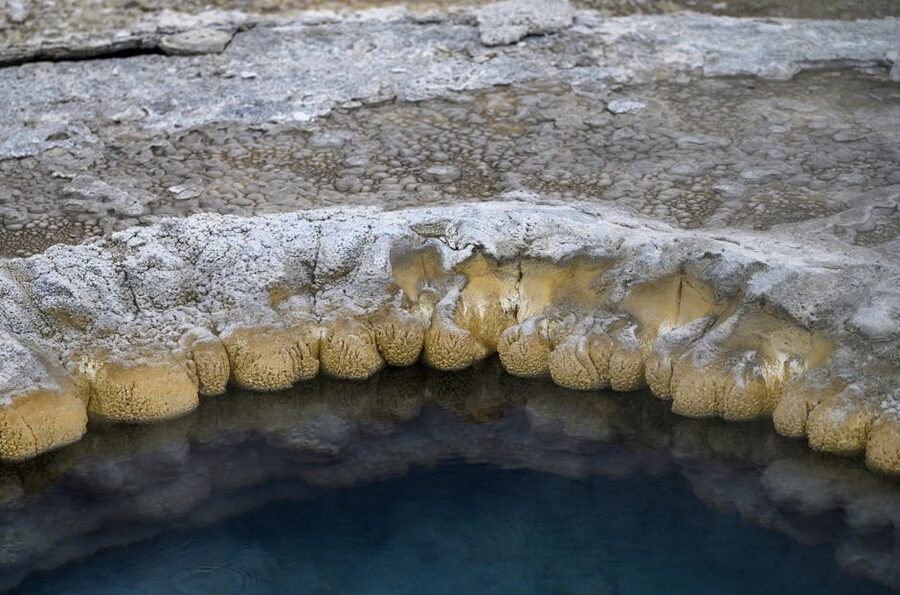
Skip Reykjadalur on a weekend in summer; the hot-river hike is genuinely lovely but at 14:00 on a July Saturday you’ll be sharing the river with 200 other people, and the photograph the guidebook used was taken on a Tuesday in March. Go on a weekday morning instead, or skip and substitute Krossneslaug.
One last thing
The cliché about Iceland is that it’s expensive and weather-broken and you should plan every minute of the day in advance. The cliché is mostly right. The sundlaug is the antidote. It’s the part of the country that runs cheaply, runs every day, runs in any weather, and works whether you’ve planned around it or not. Half the trips I’ve taken to Iceland I’ve ended a day at a city pool that wasn’t on the itinerary, with cold beer afterwards from the Bónus on the way back to the hotel. Most of those evenings have been better than the planned ones.
For your first sundlaug pick Sundhöll Reykjavíkur, on a Tuesday around 17:30, and walk the four blocks to Hallgrímskirkja afterwards. The same architect did both. You’ll see the building differently for it.